
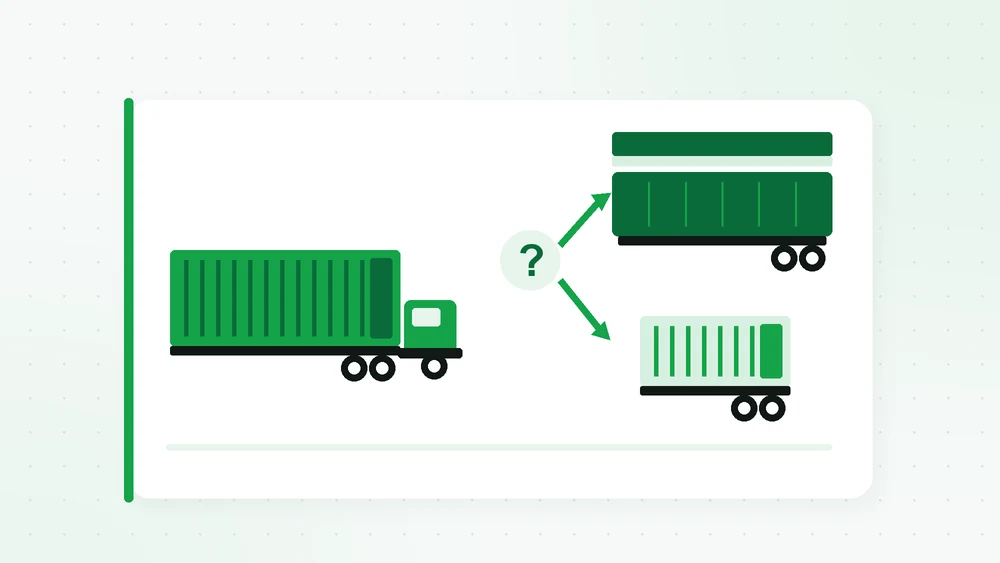
Transload when the freight is going far inland or to several destinations and is light enough to fill 53-ft trailers by space, because the freight from three 40-ft containers can often ride in two 53-ft trailers and the ocean container goes back to the port sooner. Keep it in the container when there is one receiver nearby, the freight is heavy enough to reach the road weight limit first, or the extra handling costs more than it saves.
Transloading is not automatically cheaper or faster than delivering the ocean container. It wins on some freight and loses on other freight, and the difference is mostly arithmetic. The Port of New York and New Jersey handled 8,897,531 TEUs in 2025, including 4,513,966 TEUs of loaded imports, and the Port Authority reported 680,364 rail lifts that year.[1] Each of those import boxes took one of the paths below. This guide walks through the numbers that decide which path is right for yours.
In this guide
- The three ways an import leaves the port
- Pallet math: when three 40s become two 53s
- Weight: the limit that can cancel the savings
- Equipment clocks: whose box is on the street
- One receiver or many?
- Customs status and holds
- A six-question decision checklist
- Two worked examples
- Where RapidShips fits
- Frequently asked questions
Key takeaways
- Transloading saves trucks only when the freight fills trailers by space before it reaches the weight limit.
- Returning the ocean container early stops the carrier’s equipment clock; keeping it means paying for the box’s time on the street.
- Several destinations favor transloading or cross-docking; one nearby receiver usually favors delivering the container.
- Every extra touch adds handling time and damage risk, so count it honestly.
The Three Ways an Import Leaves the Port
Once an import is released by customs and the ocean carrier, it leaves the terminal one of three ways. Store-door delivery is the simplest; transloading and rail exist because the simplest path is not always the cheapest one.
| Path | What happens | Usually fits | Watch out for |
|---|---|---|---|
| Store-door delivery | A drayage carrier trucks the ocean container to the receiver, who unloads it, and the empty goes back to the port. | One receiver within a short drive; heavy freight; receivers set up to unload containers. | The container and chassis stay out until the empty is returned, so the receiver’s unload speed decides the cost. |
| Transload near the port | The container is trucked to a nearby dock, unloaded, and the freight is reloaded into 53-ft trailers or split by destination. | Long inland moves; several destinations; light, bulky freight. | An extra handling step, and its cost, on every carton or pallet. |
| Rail inland in the container | The container moves by rail to an inland ramp and is drayed from there. | Long distances to cities with rail service, when timing allows. | Rail schedules and ramp dwell; the container stays in use for the whole trip. |
This guide compares the first two, because that is the decision most importers moving freight through New Jersey actually make. For the terms, see transloading and drayage in the glossary, and cross-docking vs. transloading vs. warehousing for how the dock services differ.
Pallet Math: When Three 40s Become Two 53s
The case for transloading starts with space. A 53-ft dry van is longer and slightly wider inside than a 40-ft container, so the same freight needs fewer trucks once it is moved into domestic trailers.
- 40-ft container: about 18 standard 48 by 40 inch pallets on the floor.
- 53-ft trailer: 26 pallets loaded straight, or 30 when pallets are turned so two 48 inch sides fit across the width.
- Three 40s: 54 floor positions, which fit into two 53-ft trailers (60 positions) only when the pallets are loaded turned and the weight allows.
The full math, with inside dimensions and the sources behind them, is in 40-ft container vs. 53-ft trailer capacity. Floor-loaded cartons change the picture again: they can be built onto pallets at the transload dock, which adds labor but can also make the outbound loads denser. Floor-loaded vs. palletized containers explains that trade-off.
Use this tool: check your own load
The Container Loading Calculator shows how much of a 20-ft, 40-ft or 40-ft high-cube container your cartons use by volume and by weight, and the Pallet Calculator gives a pallet count and an equipment estimate.
Weight: The Limit That Can Cancel the Savings
Space is only half the arithmetic. On the Interstate System, federal law caps a truck at 20,000 pounds on a single axle, 34,000 pounds on a tandem axle and 80,000 pounds overall gross weight, subject to the bridge formula.[2] That gross figure includes the tractor and trailer, not just the freight.
Heavy freight such as tile, stone, metal parts or liquids in drums reaches the weight limit long before it fills a trailer. When that happens, moving it into a 53-ft trailer does not reduce the number of trucks, because each trailer can only carry roughly what the container carried. The extra handling then costs money without saving any. That is why heavy cargo often ships in 20-ft containers in the first place; see why heavy cargo ships in 20-ft containers and SOLAS VGM vs. U.S. road weight limits.
If a container is already too heavy for the road, the question changes from “should we transload” to “how do we make it legal”. Overweight load correction covers moving weight off the drive axle or into a second load.
Equipment Clocks: Whose Box Is on the Street
An ocean container belongs to the carrier or a leasing company, and it is lent to you for a limited free period. The Federal Maritime Commission describes demurrage as accruing when a container exceeds free time on a marine terminal, and detention as charges for extended use of intermodal equipment.[3] Its rules treat those charges as financial incentives to keep freight and equipment moving.[4]
That is where transloading near the port can pay for itself. If the container is unloaded close to the terminal, the empty can be returned within a short drive instead of travelling to the final receiver and back. With store-door delivery, the box is out for the whole round trip plus however long the receiver takes to unload it. A chassis rented for the move runs on its own clock too.
- Write down the free time for the container and the chassis before you choose.
- Ask how fast the receiver can actually unload: a door appointment three days out keeps the box on the street for three days.
- Check what happens if the empty return location changes; chassis split fees, pre-pulls and street turns covers the common extra charges.
Which clock is running, and how billing works, is explained in demurrage vs. detention and how long a container can stay at the port.
One Receiver or Many?
A container packed for several customers, stores or distribution centers is the strongest case for transloading or cross-docking. At the dock the freight can be sorted by purchase order or destination and loaded straight onto the right outbound trucks, so no receiver has to take freight that is not theirs. Types of cross-docking explains pre- and post-distribution sorting.
A container packed for a single receiver a short drive from the port usually goes store-door. There is no sorting to do, the trip is short, and an extra handling step adds cost and risk without reducing the number of trucks.
Customs Status and Holds
Transloading does not change whether freight has been released. The container still has to be cleared by customs and released by the carrier and terminal before it can leave, and any hold has to be resolved first; container holds explained lists the common ones. If the freight is moving in bond or will be stored before duty is paid, talk to your customs broker before planning a transload: bonded warehouse vs. FTZ vs. duty-paid storage explains the options. If the container is selected for a customs exam, see CBP exam holds.
A Six-Question Decision Checklist
- How far is the final destination? Long inland moves favor transloading, because each 53-ft trailer replaces more than one container’s worth of trucking.
- Does the freight fill trailers by space or by weight? If it reaches the weight limit first, transloading rarely saves trucks.
- How many destinations? Several receivers favor transloading or cross-docking; one nearby receiver favors store-door delivery.
- How fast can the receiver unload a container? Slow or far-off appointments keep the carrier’s box on the street.
- Is it floor-loaded? Loose cartons take longer to unload anywhere, and may need to be palletized for the receiver anyway.
- Is the freight fragile or high-value? Each extra touch is another chance for damage, so weigh that against the savings and ask what record the dock keeps.
Use this tool: put the answers in one place
The Freight Scope Builder turns these answers into a freight request summary you can send to a dock or a trucker, and the Freight Cost Calculator shows which parts of the job will drive the price.
Two Worked Examples
These are illustrative scenarios built to show the reasoning, not real customer jobs, and they leave out prices because rates depend on the job and the carriers involved.
Example 1: transloading wins. Three 40-ft containers of palletized household goods arrive at Port Newark for a distribution center several hundred miles inland. The pallets are light, so the loads fill by space, not weight. At a transload dock near the port, the 54 pallets are loaded turned into two 53-ft trailers, and the three empties go back to the port the same day. One long-haul truck is saved, and the ocean containers come off the street after a short local trip instead of a long round trip.
Example 2: keep it in the container. One 20-ft container of ceramic tile is going to a single receiver in Central New Jersey. It reaches the weight limit long before it fills any trailer, and the receiver has a dock and a forklift. Transloading would add a handling step without reducing trucks, so store-door delivery is the better call, as long as the receiver can unload it within the free time.
Where RapidShips Fits
RapidShips runs a dock at 25A Cotters Lane, East Brunswick, NJ, about 30 road miles from Port Newark, with 3 dock doors and dock operations 24/7 by appointment. We do the dock work: container transloading, container unloading of floor-loaded and palletized freight, cross-docking and short-term storage. We are not a drayage carrier or a freight broker, so your trucker delivers the container and picks up the outbound loads. Each job is quoted from its details; transloading cost explains what drives the price.
If you are weighing transload against store-door delivery for a specific container, call 800-376-2808 or send the details through the Freight Scope Builder.
Frequently Asked Questions
Is transloading cheaper than delivering the container?
What is store-door delivery?
How many 40-ft containers fit into a 53-ft trailer?
Does transloading stop demurrage and detention?
Can I transload a container that has not cleared customs?
Sources
- Port Authority of New York and New Jersey, "Port of New York and New Jersey: Facts and Figures," accessed October 2026.
- Legal Information Institute, Cornell Law School, "23 U.S. Code § 127 – Vehicle weight limitations, Interstate System," accessed October 2026.
- Federal Maritime Commission, "Detention and Demurrage," accessed October 2026.
- Legal Information Institute, Cornell Law School, "46 CFR § 545.5 – Unjust and unreasonable practices with respect to demurrage and detention," accessed October 2026.
This guide is general operational information, not legal, customs or transportation advice. Free time, detention terms and weight rules depend on your contracts, carriers and route; confirm them before you plan the move.