
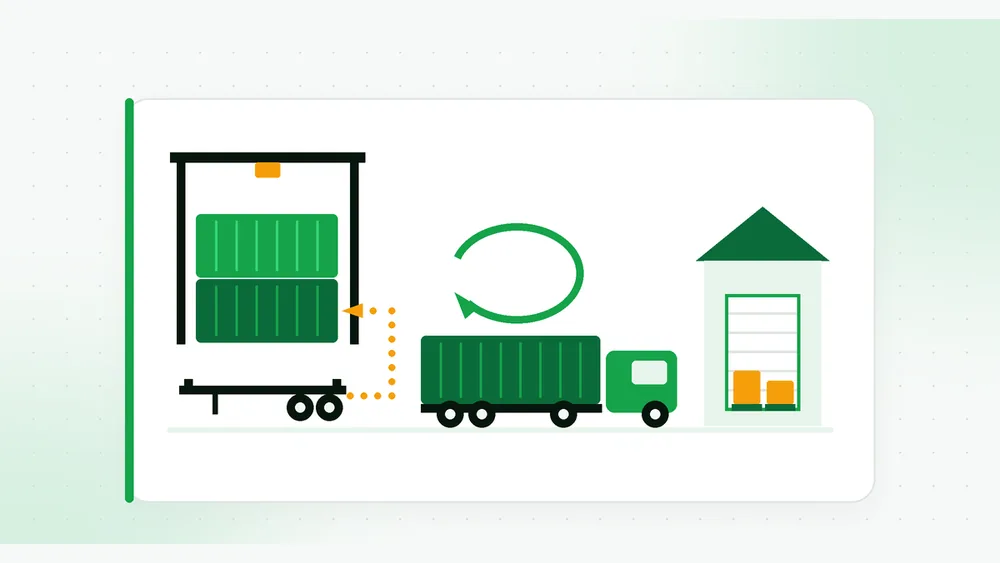
A chassis split fee is what a trucker charges when the chassis and the container are at different locations, so the driver has to fetch the chassis first. A pre-pull moves a box off the terminal before delivery day, a street turn reuses an import empty for an export, and chassis per diem is the daily rent on the chassis.
A chassis split fee, a pre-pull charge and a chassis per diem line are not penalties; each one pays for a specific extra move or extra day of equipment use. Freight forwarder Flexport defines a chassis split as the situation where “the container is not located in the same place as the chassis,” and notes the trucking company may charge a fee to cover bringing the chassis to the container.[1] This guide follows one import container from the terminal to a warehouse and back, and shows where each charge attaches.
In this guide
- What is a chassis split fee, and the other drayage accessorials?
- Chassis in NY/NJ: why a split happens
- Split pick-up vs. split return
- What is chassis per diem?
- What is a pre-pull container move?
- What is a street turn?
- Reading a drayage invoice: what to question
- Example scenario
- How a port-area transload frees the chassis
- Frequently asked questions
Key takeaways
- Each accessorial pays for an extra trip, stop or day of equipment use.
- Pulling a container off the terminal stops demurrage, but the container and chassis clocks keep running until the box is emptied and returned.
- Unloading the box (a transload) is what frees both the container and the chassis at the same time.
- Rates come from each trucker’s rate sheet and provider’s terms; get them in writing before the move.
What Is a Chassis Split Fee, and the Other Drayage Accessorials?
A drayage accessorial is any charge on a port trucking invoice beyond the base line-haul rate, billed because the move needed an extra trip, stop, wait or day of equipment. Industry glossaries also list pre-pulls, storage and driver waiting time among the common ones.[2]
| Charge | What it pays for | Usually billed by | What drives the amount |
|---|---|---|---|
| Chassis split | The extra leg to fetch or drop a chassis at a separate location | The drayage carrier | Distance between the chassis location and the terminal, and time lost at the second gate |
| Chassis per diem / usage | Each day the chassis is in the trucker’s possession | Chassis provider to the trucker, usually passed through to the customer | Number of days the box sits on the chassis, and the chassis type |
| Pre-pull | Pulling the box to the trucker’s yard before delivery day | The drayage carrier | The extra yard move, plus daily yard storage |
| Container per diem (detention) | Keeping the carrier’s container out of the terminal past free days | Ocean carrier (or NVOCC) | Days until the empty is returned |
| Demurrage | The loaded box sitting at the terminal past free time | Ocean carrier or marine terminal operator | Days on terminal after the last free day |
The first three lines are the trucker’s own charges under its rate sheet. The last two come from the ocean carrier or the terminal. Federal rules define demurrage and detention, “including ‘per diem’ charges,” as charges assessed by ocean carriers, marine terminal operators or NVOCCs for the use of terminal space or shipping containers.[3]
Chassis in NY/NJ: Why a Split Happens
A container can’t leave a marine terminal by road without a chassis under it, and at the Port of New York and New Jersey those chassis come from intermodal equipment providers rather than from the container itself. TRAC Intermodal, one of those providers, describes its Metro Pool as covering the marine terminals within the Port of NY/NJ, as well as Philadelphia, Baltimore and western New York State.[4] Which chassis a trucker can use depends on its agreements, so ask rather than assume.
The paperwork side is standardized. The Uniform Intermodal Interchange and Facilities Access Agreement (UIIA), run by the Intermodal Association of North America (IANA), is “the only standard industry contract that governs the interchange of equipment” between intermodal motor carriers and equipment providers, and per diem and use-charge disputes under it can go to binding arbitration.[5]
A split happens when the chassis the trucker is allowed to use is not waiting at the terminal where the container is. Flexport gives the classic case: if a port has no chassis available, the trucker may go to a nearby chassis pool first, pick one up, and then go to the port.[1] That second stop, with its own gate line, is what the split fee pays for.
Split Pick-Up vs. Split Return
“Split” can mean two different legs, and some invoices charge both.
Split on the way out
The driver fetches a chassis from an off-terminal location before going to the terminal for the container.
Split on the way back
The empty has to go to one place and the chassis to another, so the driver drops the empty and then runs the bare chassis to its pool or another yard.
Questions that prevent a surprise split
Before dispatch, ask where the chassis will come from, where the empty returns, and whether the rate sheet charges a split per leg or per container.
What Is Chassis Per Diem?
Chassis per diem (also called chassis usage or a chassis fee per day) is the daily rental on the chassis for every day the trucker has it out, charged by the chassis provider and normally passed on to the shipper by the trucker. It is separate from the container per diem the ocean carrier bills, though both usually run on the same days.
| Charge | Equipment or space | Clock generally runs | Stopped by |
|---|---|---|---|
| Demurrage | Terminal space | From the end of free time until the box leaves the terminal | Picking up (out-gating) the loaded box |
| Container per diem | The carrier’s box | From the end of the equipment free days until the empty returns | Emptying the box and in-gating the empty |
| Chassis per diem | The provider’s chassis | For each day the trucker holds the chassis | Getting the box off the chassis and returning the chassis |
The last free day (LFD) is the final day a container can stay at a port, terminal or rail yard without incurring demurrage; after it, charges accrue per container per day until the box leaves the terminal.[6] It drives most pre-pull decisions. For the carrier and terminal clocks in detail, see demurrage vs. detention.
What Is a Pre-Pull Container Move?
A pre-pull is when the trucker picks up the container from the port but does not deliver it the same day, parking it at its yard until the delivery appointment.[2] The trucker bills an extra move for it, plus yard storage for each day the box sits there.
Pre-pulling is worth paying for when it stops a larger clock. Demurrage runs until the container leaves the terminal, so pulling it before the LFD ends that charge.[6] Typical triggers:
- The LFD falls before the receiver’s earliest delivery appointment.
- A weekend, holiday or appointment shortage would push pickup past the LFD.
What a pre-pull does not do is stop the equipment clocks. A loaded box parked in a yard is still the carrier’s container on the provider’s chassis, so container per diem and chassis per diem keep counting, and yard storage is added on top. A pre-pull trades demurrage for those charges, and the trade gets worse with each extra day.
Pre-pull to a yard or to a dock?
A yard stops demurrage but keeps the box loaded. A nearby warehouse that unloads it stops demurrage and releases the empty and the chassis. Whether that is cheaper depends on the rates and handling cost; short-term freight storage near Port Newark walks through that comparison.
What Is a Street Turn?
A street turn is reusing an empty import container for an export load without returning it to the terminal first, which saves an empty return and a separate empty pick-up. It needs the equipment provider’s approval.
The Intermodal Association of North America runs a Street Interchange Application for UIIA motor carriers and equipment providers. IANA says it documents the transfer of liability between carriers electronically and “stops the clock on the import move and begins it on the export move for street turns,” so free time and per diem are allocated to the right party.[7] Check the provider’s and the trucker’s terms for any charge tied to the street turn before counting on the savings.
It only works when the empty is clean, undamaged and the right type for the export, so ask early.
Reading a Drayage Invoice: What to Question
Check each trucker accessorial against the move that actually happened, and check carrier-issued demurrage and detention invoices against the federal content rules:
- Trucker accessorials (chassis split, pre-pull, yard storage, waiting time, chassis per diem passed through) follow your rate agreement with the trucker. Ask for the rate sheet and gate and yard records.
- Carrier or terminal demurrage and detention fall under the FMC’s billing rule. A compliant invoice must show items such as the allowed free time with its start and end dates, the container availability date on imports, the specific dates charged, the applicable tariff rule or contract provision, the rate, and contact details for requesting mitigation, refund or waiver.[8] The D.C. Circuit set aside only one section of that rule on September 23, 2025, the one on who may be billed; the FMC says the rest remains in effect.[9]
- Was a split charged on a leg where the chassis was actually at the terminal?
- Do the chassis days match the out-gate and the chassis return dates?
- Were pre-pull and yard-storage days counted from when the box actually entered and left the yard?
- Is chassis per diem shown separately from container per diem, so the same day is not billed twice under one label?
Example Scenario
This is a hypothetical to show how the charges stack, not a real shipment. Say a shipper has a 40-foot import at an Elizabeth terminal with its last free day on a Friday, and the receiver’s first appointment is the following Wednesday. The trucker pre-pulls on Thursday, and because no chassis is available at the terminal it splits to a pool first. The box sits loaded in the yard until Wednesday. Demurrage is avoided, but the invoice shows a split, a pre-pull, yard storage and chassis per diem, while container per diem runs on the carrier side.
The alternative: pull the same box on Thursday to a nearby warehouse, unload it that day, return the empty and the chassis, and hold the pallets until Wednesday. Demurrage is still avoided and the equipment clocks stop on Thursday, but the shipper now pays for devanning, storage and a separate delivery on a domestic trailer. Which is cheaper depends on the actual rates each time.
How a Port-Area Transload Frees the Chassis
A warehouse can’t waive a carrier’s charges, set a trucker’s rates or arrange chassis, and RapidShips is neither a freight broker nor a customs broker. What a physical dock near the port can do is get the container empty, and once it is empty the chassis and the box can both go back.
- Unload and reload. Through transloading, freight comes off the ocean container and goes onto domestic equipment, so the empty and the chassis are released the same day the box arrives. How the pallets fit on the outbound side is covered in 40-ft container vs. 53-ft trailer capacity.
- Hold freight, not equipment. If the receiver isn’t ready, the pallets wait in short-term storage instead of on a chassis in a yard.
- Stay close to the port. Our facility in East Brunswick sits on the Port Newark freight corridor, which keeps the extra leg short.
If a container is close to its last free day and the receiver can’t take it, call the dock at 800-376-2808 or send the container details, and we’ll tell you what we can take and when.
Frequently Asked Questions
What is a chassis split fee?
What is chassis per diem?
What are pre-pull charges in shipping?
Does pre-pulling a container stop demurrage?
What is a street turn container?
Sources
- Flexport, "Chassis Split Fee," accessed September 2026.
- Smart Warehousing, "Drayage Terms and Fees You Need to Know," accessed September 2026.
- Legal Information Institute, Cornell Law School, "46 CFR § 541.3 – Definitions," accessed September 2026.
- TRAC Intermodal, "Marine Chassis Pools," accessed September 2026.
- Intermodal Association of North America, "Uniform Intermodal Interchange and Facilities Access Agreement (UIIA)," accessed September 2026.
- 3PL Center, "What Is the Last Free Day (LFD)?," accessed September 2026.
- Intermodal Association of North America, "Street Interchange Application," accessed September 2026.
- Legal Information Institute, Cornell Law School, "46 CFR § 541.6 – Contents of invoice," accessed September 2026.
- Federal Maritime Commission, "U.S. Court of Appeals Issues Decision in Case on Demurrage and Detention Billing Practices," accessed September 2026.
This guide is general operational information, not legal or regulatory advice. Rules change; confirm current requirements with the relevant agency or your carrier before acting.