
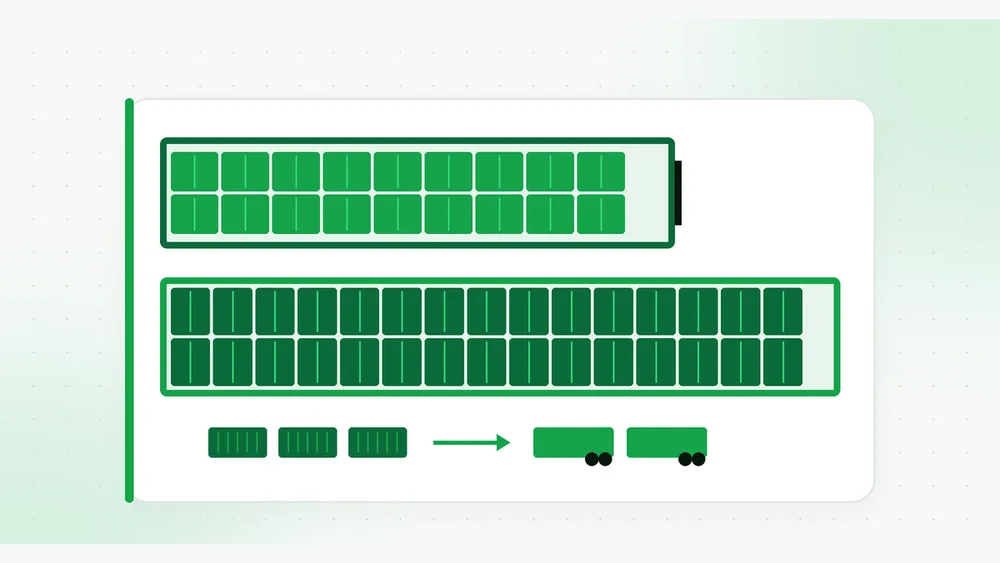
Using published inside dimensions, a 40-ft container (standard or high-cube) holds 18 standard 48 x 40 in. pallets on the floor, while a 53-ft dry van holds 26 loaded lengthwise or 30 turned sideways. That extra floor and cube is why transloads often consolidate containers into fewer trailers, as long as weight limits allow.
Planning a transload starts with one question: how many trailers will these containers become? The answer depends on three numbers for each piece of equipment: the usable floor (which sets pallet positions), the usable height (which sets whether you can double-stack), and the legal weight you can put on the road. Below, each of those is worked out from a published source, with the arithmetic shown, so you can redo it for your own freight. Dimensions vary by manufacturer and container series, so always check the plate on the actual unit before committing a load plan.
In this guide
- Inside Dimensions: Containers vs. a 53-ft Dry Van
- How Many 48 x 40 Pallets Fit on the Floor
- Cube: Where the Extra Space Comes From
- Why Three 40s Often Become Two 53s: The Math
- Weight: The Limit That Overrides Cube
- Is a 53-ft Trailer Legal? Federal Minimum vs. State Law
- Putting It to Work at a NJ Transload Dock
- Example Scenario
- Frequently asked questions
- Sources
Inside Dimensions: Containers vs. a 53-ft Dry Van
On the outside, a 40-ft container is 40 ft x 8 ft, and either 8 ft 6 in. tall (standard) or 9 ft 6 in. (high-cube).[1] The inside dimensions that matter for loading vary slightly by builder and series. The figures below come from a major carrier's published spec sheet for its steel dry fleet[1] and a trailer dealer's published dry van dimensions.[2]
| Equipment | Inside length | Inside width | Inside height | Volume |
|---|---|---|---|---|
| 20-ft standard container | 5,896 mm (≈232.1 in.) | 2,350 mm (≈92.5 in.) | 2,393 mm (≈94.2 in.) | 33 m³ / 1,165 cu ft |
| 40-ft standard container | 12,032 mm (≈473.7 in.) | 2,350 mm (≈92.5 in.) | 2,393 mm (≈94.2 in.) | 67 m³ / 2,366 cu ft |
| 40-ft high-cube container | 12,032 mm (≈473.7 in.) | 2,350 mm (≈92.5 in.) | 2,697 mm (≈106.2 in.) | 76 m³ / 2,684 cu ft |
| 53-ft dry van trailer | ≈630 in. (52 ft 6 in.) | ≈100 in. | ≈108–110 in. | ≈3,800–4,000 cu ft usable |
Container heights are to the load line. Container door openings are narrower than the interior, 2,340 mm (≈92.1 in.) wide on the 40-ft units, and the high-cube door is 2,577 mm (≈101.5 in.) tall.[1] Trailer interiors vary by build: one manufacturer's composite-wall 53-ft van lists 101 in. sidewall to sidewall with 110¼ in. of height at the front and 111¼ in. at the rear.[3] This guide uses the more conservative 100 in. width.
How Many 48 x 40 Pallets Fit on the Floor
The 48 x 40 in. pallet (often called the GMA pallet) is the dominant standardized size in the U.S., about 35% of new wood pallet production and 69% of the recycled market in the USDA Forest Service study.[4] The math below counts single-tier floor positions for that footprint.
40-ft container (standard or high-cube)
- Across the width: two pallets with their 40 in. side across = 80 in., which fits in 92.5 in. Two pallets turned with the 48 in. side across = 96 in., which does not.
- Along the length: 473.7 ÷ 48 = 9.87, so 9 full rows (432 in.), leaving about 41.7 in.
- Result: 9 rows x 2 = 18 pallets. The 41.7 in. gap at the door can sometimes take a 19th pallet turned sideways, but with under 2 in. to spare, 18 is the planning number.
20-ft container
- 232.1 ÷ 48 = 4.8, so 4 rows of 2 = 8 pallets, with about 40 in. left over, too tight to count on a ninth.
53-ft dry van
- Straight (48 in. side along the trailer): 2 across = 80 in. of 100 in. width; 630 ÷ 48 = 13.1, so 13 rows x 2 = 26 pallets, which matches the dealer's published count.[2]
- Turned (40 in. side along the trailer): 2 across = 96 in., which fits inside 100 in. but leaves only about 2 in. per side; 630 ÷ 40 = 15.75, so 15 rows x 2 = 30 pallets. Turned pallets need forklift access from the 40 in. side and pallets whose loads do not overhang.
Double-stacking
Two tiers roughly double the positions if the loads are strong enough to stack. By height alone, a 40-ft high-cube's 106.2 in. allows two tiers of up to about 53 in. each (pallet included); a standard 40-ft at 94.2 in. allows two of about 47 in.; a 53-ft van at 108 in. allows two of about 54 in. Leave clearance for forklift lift and door headers.
Cube: Where the Extra Space Comes From
By the published figures, a 53-ft van's roughly 3,800–4,000 cu ft of usable space[2] is about 1.4 to 1.5 times a 40-ft high-cube's 2,684 cu ft[1] (3,800 ÷ 2,684 ≈ 1.42; 4,000 ÷ 2,684 ≈ 1.49). The gain comes from all three directions: about 156 in. more length (630 − 473.7), about 7.5 in. more width (100 − 92.5), and a similar or slightly higher roof than a high-cube.
The width is set by law as well as by design. Federal rules bar states from imposing a width limit of more or less than 102 in. on the National Network,[5] which is why domestic vans are built to 102 in. outside and roughly 100–101 in. inside, while containers stay at 8 ft outside.[1]
Why Three 40s Often Become Two 53s: The Math
The "three containers into two trailers" shorthand is common in transload planning, but it is a rule of thumb, not a guarantee. Here is the arithmetic that supports it, and where it breaks.
| Measure | 3 x 40-ft high-cube | 3 x 40-ft standard | 2 x 53-ft van |
|---|---|---|---|
| Floor positions (single tier) | 3 x 18 = 54 | 3 x 18 = 54 | 2 x 26 = 52 straight; 2 x 30 = 60 turned |
| Cubic feet | 3 x 2,684 = 8,052 | 3 x 2,366 = 7,098 | 2 x 3,800–4,000 = 7,600–8,000 |
- By floor positions: 54 palletized positions fit in two 53s only if the trailers are loaded turned (60 positions). Loaded straight (52), you are two pallets short.
- By cube: three standard 40s (7,098 cu ft) fit inside two 53s with room to spare. Three high-cubes packed completely full (8,052 cu ft) slightly exceed two vans, so the ratio holds for high-cubes only when the containers were not packed to the doors, or when floor-loaded cartons are palletized more efficiently than they were loaded.
- By weight: the ratio only works for freight that fills a container by volume before it hits a weight limit. Dense freight runs out of legal weight long before it runs out of trailer, as the next section shows.
Floor-loaded containers change the math again, because hand-stacked cartons fill space pallets cannot. See floor-loaded vs. palletized containers for that side of the trade-off.
Weight: The Limit That Overrides Cube
Federal rules set the maximum gross vehicle weight on the Interstate System and reasonable access routes at 80,000 lb, with 34,000 lb on a tandem axle group, subject to the regulation's exceptions.[6] That 80,000 lb covers the tractor, the trailer or chassis, and the freight together. A 40-ft high-cube, by contrast, is rated for a maximum payload of 63,100 lb (28,620 kg),[1] and that particular unit's own tare weight is 8,554 lb.[1] Container plus maximum payload is 71,654 lb, which would leave only 8,346 lb of the 80,000 lb for the tractor and chassis combined. In other words, a container can be packed heavier than it can legally travel on an ordinary U.S. road unit.
For consolidation, that means heavy freight does not compress. If each container carries freight near the road-legal limit, three containers need at least three trailers no matter how much empty cube is left in each. Axle distribution matters too: a load that is under 80,000 lb gross can still be over on the tandem if it is packed toward one end. Our overweight load correction page covers how axle-overweight loads get rebalanced, and the sibling guide on container weight rules explains the gap between ocean and road weight limits.
Is a 53-ft Trailer Legal? Federal Minimum vs. State Law
Federal law sets a floor, not a ceiling: no state may impose a length limit of less than 48 ft on a semitrailer in a tractor-semitrailer combination, and states may not impose an overall length limit on those combinations.[7] FHWA explains that the minimum allowable semitrailer length is 48 ft or the state's grandfathered limit, whichever applies.[8] The 53-ft length itself comes from state law. FHWA's state table lists grandfathered semitrailer lengths from 48 ft (New Jersey and New York) to 53 ft (Pennsylvania) and longer in some western and southern states.[8]
New Jersey allows a trailer up to 53 ft in a tractor-semitrailer combination by statute, with conditions for anything over 48 ft: no more than 41 ft from the kingpin to the centerline of the rear axle or axle group, a kingpin set back no more than 3.5 ft from the front, a rear-end protection device, rear overhang no more than 35% of the wheelbase, and a 102 in. width.[9] On a van with sliding tandems, that 41-ft limit depends on where the tandem is set, so the tandem position and the route are worth confirming before the trailer leaves the dock.
Putting It to Work at a NJ Transload Dock
The math above is what a transload plan is built on: count the pallets or cartons per container, pick straight or turned loading, check heights for double-stacking, then check weight per trailer and per axle group. When the numbers work, several containers leave as fewer trailers, and the ocean equipment goes back to the terminal sooner.
RapidShips is an asset-backed, 24/7 dock at 25A Cotters Lane in East Brunswick, NJ, serving the Port Newark and Elizabeth corridor. We do the physical work: transloading containers into 53-ft trailers, moving freight straight across the dock when outbound equipment is ready through cross-docking, and holding pallets in short-term storage when the outbound appointment is not ready yet. We are not a broker or a carrier. To map a set of containers to trailers, send us the container count, pallet dimensions, and weights or call 800-376-2808.
Example Scenario
Hypothetical, for illustration only. Say a shipper has three 40-ft high-cubes of palletized, lightweight home goods, each carrying 18 single-tier 48 x 40 pallets, 54 pallets in all. Loaded straight, two 53-ft vans hold 52, so two pallets would need a third truck. Loaded turned, the same two vans hold 60 positions, so all 54 fit with 6 positions to spare, provided the pallets have no overhang and the dock can load from the 40 in. side. The load plan is then checked for weight: if each trailer's gross stays under 80,000 lb and the tandem stays within 34,000 lb, the three containers go out as two trailers. If the same shipper's next three containers hold dense, heavy freight, that check fails and they stay as three.
Frequently Asked Questions
How many pallets fit in a 40-ft container?
How many pallets fit in a 53-ft trailer?
Do three 40-ft containers always fit into two 53-ft trailers?
Are 53-ft trailers legal in New Jersey?
Why is a 53-ft trailer wider inside than a container?
Sources
- Maersk, "Our fleet: equipment specifications, dry containers (PDF)," accessed September 2026.
- Hale Trailer, "Dry Van Dimensions & Capacities: 53’, 48’, + 40’ Length, Height, Width & Volume," accessed September 2026.
- Bergey’s Truck Centers, "Wabash DuraPlate Dry Vans (specifications)," accessed September 2026.
- USDA Forest Service Research and Development, "Investigation of new and recovered wood shipping platforms in the United States (Gerber, Horvath, Araman, Gething, 2020)," accessed September 2026.
- Legal Information Institute, Cornell Law School, "23 CFR § 658.15 – Width," accessed September 2026.
- Legal Information Institute, Cornell Law School, "23 CFR § 658.17 – Weight," accessed September 2026.
- Legal Information Institute, Cornell Law School, "23 CFR § 658.13 – Length," accessed September 2026.
- Federal Highway Administration, "Federal Size Regulations for Commercial Motor Vehicles," accessed September 2026.
- State of New Jersey (via NJ oversize/overweight permit portal), "N.J.S.A. 39:3-84 – Vehicles, dimensional, weight limitations; routes, certain; prohibited (PDF)," accessed September 2026.
This guide is general operational information, not legal or regulatory advice. Rules change; confirm current requirements with the relevant agency or your carrier before acting.