
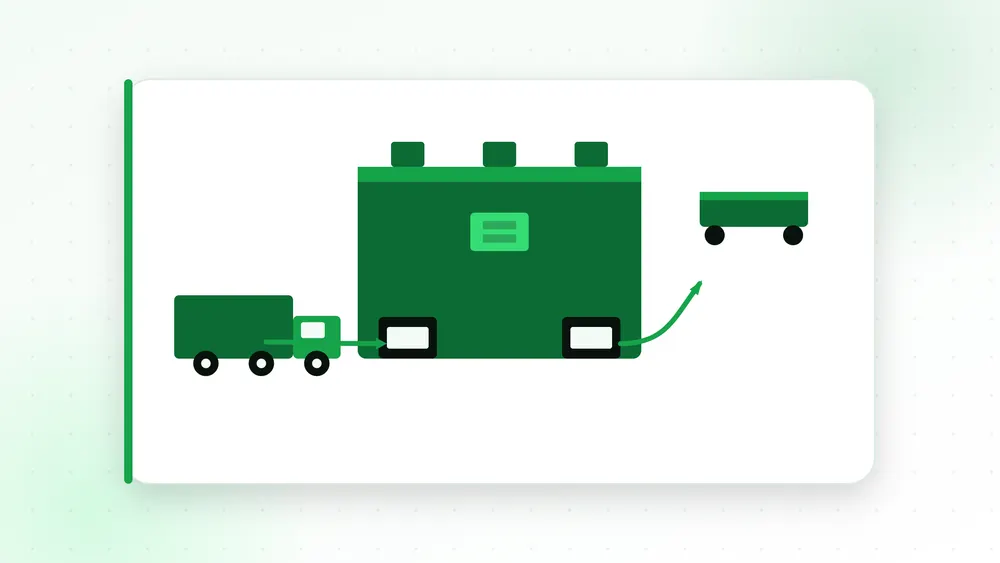
Cross-docking moves freight from an inbound trailer or container directly to an outbound trailer with little to no storage dwell. Transloading transfers freight between two different equipment types, such as an ocean container into a domestic 53-foot dry van. Warehousing holds freight for days to weeks until its next move is scheduled. One shipment can involve all three.
Cross-docking, transloading, and warehousing aren't three tiers of the same service — they're three different answers to three different questions. Cross-docking answers "how do I move this with zero storage dwell." Transloading answers "how do I get this out of one type of equipment and into another." Warehousing answers "where does this sit until its next move is confirmed." A single shipment can touch all three in one visit to our dock — the confusion starts when people use the words interchangeably and then wonder why the quote they got doesn't match what they actually needed.
In this guide
The Three Services, Defined Properly
Freight moves from an inbound trailer or container directly to an outbound trailer, with little to no time on the warehouse floor in between. The entire point is eliminating storage dwell — freight arrives with a next destination already assigned.[1]
Freight is physically transferred between two different types of equipment — most often an ocean container into a domestic 53-foot dry van, or a container into multiple box trucks for local delivery. Transloading is about the equipment change, not the dwell time.[2]
Freight is received and held on the floor for an unconfirmed or extended period — days to weeks — until its next move is scheduled. This is the only one of the three where storage itself is the point, not a side effect.[2]
Here's the part that trips people up: these aren't mutually exclusive. A floor-loaded ocean container that needs to become three separate box-truck deliveries is a transload. If those three box trucks are staged and waiting at the dock when the container arrives, it's also a cross-dock. If instead one of those deliveries isn't scheduled yet and the pallets need to sit for four days, that portion becomes warehousing. Same container, three different classifications depending on what happens to each pallet.
Side-by-Side Comparison
| Cross-Docking | Transloading | Warehousing | |
|---|---|---|---|
| Primary goal | Zero storage dwell | Equipment-type change | Secure short- or long-term storage |
| Typical floor time | Hours | Hours to one day | Days to weeks |
| Triggering condition | Next destination already confirmed | Ocean container needs a domestic trailer or box truck | Next move not yet scheduled |
| Main cost driver | Labor and dock-door time | Labor, equipment, and any palletizing required | Square footage and duration |
| Best fit | Retail replenishment, LTL consolidation, time-critical freight | Import containers headed to regional delivery | Seasonal inventory, delayed orders, buffer stock |
Which One Do You Actually Need?
If the answer to Q1 is yes and you are moving freight through central New Jersey, the booking steps, what to send before the truck rolls, and how after-hours arrivals are handled are on the page for our 24/7 cross-dock in East Brunswick. The rest of this guide stays on the general question of which service fits.
The Expensive Mix-Up We See Most
- Booking a cross-dock for freight that isn't actually ready to move. If the next destination isn't locked in, the freight becomes warehousing whether anyone planned for it or not — and gets billed and handled that way.
- Assuming transloading includes cross-docking automatically. Moving a container into a domestic trailer doesn't mean that trailer has somewhere to go yet — confirm the outbound leg separately.
- Treating a floor-loaded container like a palletized one. Floor-loaded freight needs a transload/palletizing step before it can cross-dock cleanly; skipping that step is how freight ends up damaged in transit.
- Choosing warehousing by default "just in case." If the next move really is confirmed, paying for storage dwell you don't need is pure waste — cross-docking exists specifically to avoid that cost.
What to Have Ready Before You Call
- Inbound arrival window and equipment type (container, trailer, box truck)
- Whether freight is floor-loaded or already palletized
- Confirmed outbound destination and carrier, if cross-docking
- Piece count and any special handling (hazmat[3], temperature[4], retail compliance labeling)
- Whether this is a one-time move or a recurring lane
Not sure which service fits your load?
Tell us the equipment type, the destination status, and the timeline — we'll tell you straight whether it's a cross-dock, a transload, or storage, before you commit to anything. Request a quote →
A Clean Cross-Dock, Start to Finish
Here is the pattern of a cross-dock that goes the way it should. A 53-foot inbound trailer carrying palletized retail goods arrives with a confirmed outbound truck already scheduled for regional delivery. Piece count and destination were confirmed with dispatch the afternoon before, so the outbound door and driver are already staged when the inbound trailer backs in. Twenty-six pallets are checked off the inbound trailer and loaded directly onto the outbound one, with no floor placement in between, and the outbound trailer leaves the same day for its delivery appointment.
What makes it work isn't speed on the floor — the physical transfer of 26 pallets is routine. What makes it work is that the outbound leg was locked in before the inbound trailer ever arrived. That's the entire difference between a clean cross-dock and freight that quietly turns into unplanned storage.
Frequently Asked Questions
What is the actual difference between cross-docking and transloading?
Cross-docking vs. traditional warehousing: when do I need warehousing instead?
How fast is same-day cross-docking, realistically?
Can floor-loaded containers be cross-docked directly?
How is cross-docking priced?
What is the difference between cross-docking and break bulk?
What is the difference between a cross dock and a distribution center?
Is transloading the same as cross-docking?
Sources
- Transportation Research Board, TRID record for J. J. Vogt, "The Successful Cross-Dock Based Supply Chain," Journal of Business Logistics (2010), accessed September 2026.
- Federal Highway Administration, "Freight Glossary and Acronyms," accessed September 2026.
- Legal Information Institute, Cornell Law School, "49 CFR § 177.834 - General requirements," accessed September 2026.
- U.S. Food and Drug Administration, "FSMA Final Rule on Sanitary Transportation of Human and Animal Food," accessed September 2026.
This guide is general operational information, not legal or regulatory advice. Rules change; confirm current requirements with the relevant agency or your carrier before acting.