
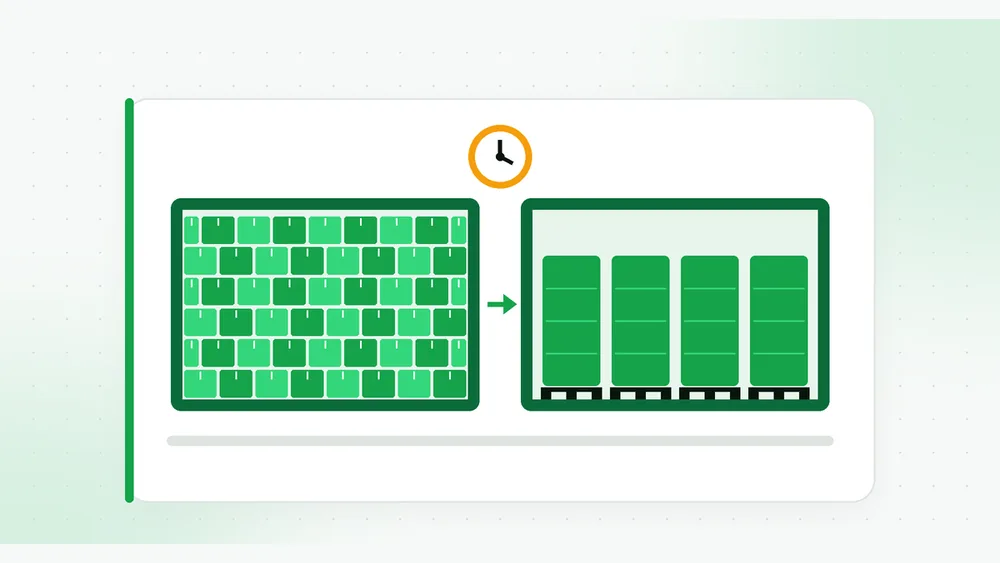
A floor-loaded container has cartons stacked directly on the container floor; a palletized one arrives on pallets. Floor loading fits more cartons per box, but unloading is manual, slower, and keeps the container out longer against detention free time. Palletized freight unloads by forklift in far less labor, at the cost of cube.
Whether an import arrives floor-loaded or palletized is decided at origin, but most of the cost of that decision lands at destination. The shipper who floor-loads buys more cartons per container and skips the pallets. The consignee inherits a box that has to be emptied by hand, one carton at a time, while the per-diem clock on the equipment keeps running. Neither method is right in every case. The choice comes down to freight value per cubic foot, carton weight, what the receiving DC will accept, and how much dock labor and time is available when the container lands at Port Newark or Elizabeth.
In this guide
What Floor-Loaded and Palletized Actually Mean
Cartons are hand-stacked directly on the container floor, usually wall to wall and as close to the roof as the carton strength allows, with no pallets underneath. Unloading means a crew works carton by carton from the door end toward the nose.
Cartons are built into unit loads on pallets (in North America usually the 48 x 40 in. size), wrapped or strapped, and loaded as whole units. Unloading is a forklift or pallet-jack job, one pallet at a time.
There is also a middle ground: slip sheets (a thin fiberboard or plastic sheet under the load, pulled with a push-pull attachment) and mixed loads where heavy SKUs ride on pallets and light, awkward cartons fill the gaps loose. Both come with their own equipment requirements at the receiving dock.
The Trade-Offs Side by Side
| Factor | Floor-loaded | Palletized |
|---|---|---|
| Cube utilization | Highest; cartons fill the floor wall to wall and up to the roof | Lower; pallet footprints leave floor gaps and each pallet deck takes height from every tier |
| Unload method | Manual, carton by carton, often with a conveyor | Forklift or pallet jack, pallet by pallet |
| Unload time and labor | Much longer, multi-person crew | Short, one operator can empty the box |
| Damage exposure | Crushed bottom tiers, cartons toppling at the doors, handling drops | Forklift punctures, pallet failure, loads shifting if not braced |
| Container dwell / detention | Box stays at the dock longer | Faster turn-around of the equipment |
| Origin cost | No pallets to buy; loading labor at origin | Pallet, wrap, and build cost; faster origin loading |
| Receiver acceptance | Many DCs require freight on pallets, so it needs palletizing first | Can often go straight to the receiver or a trailer |
Doing the cube math
The cube argument is easiest to see from the floor. A 40-ft high-cube dry container has an internal length of 12,032 mm and an internal width of 2,350 mm, with 2,697 mm of height to the load line and a volume of about 76 m³ (2,684 cu ft).[1] In inches, that is roughly 473.7 in. long by 92.5 in. wide, or about 43,800 sq in. of floor.
The 48 x 40 in. pallet is the dominant size in U.S. production, about 35% of new wood pallets in the study year and 69% of the recycled market.[2] Two of them side by side take 80 in. of the 92.5 in. width, and nine rows at 48 in. each use 432 in. of the 473.7 in. length. That is 18 floor positions, and 18 x 1,920 sq in. = 34,560 sq in., or about 79% of the floor. Floor loading can in principle use most of the other 21%, plus the height taken by pallet decks, which is why high-volume, low-value goods (apparel, housewares, toys, cartoned furniture) are so often shipped loose.
When floor loading usually makes sense
The freight is light for its size, so the container fills up by volume long before it reaches its weight limit, and the extra cartons per box outweigh the destination labor. When freight is dense or heavy and the box reaches its weight limit before it fills, the cube advantage mostly disappears and palletizing at origin tends to win.
The Detention Clock: Where Floor Loading Really Costs
Under the Federal Maritime Commission's interpretive rule, demurrage and detention cover any charges, including "per diem," that ocean carriers, marine terminal operators, or intermediaries assess for the use of terminal space or shipping containers, and the Commission weighs whether those charges are actually working as financial incentives to keep freight moving.[3] In common trade usage, demurrage is tied to the loaded box sitting inside the terminal, and detention to the equipment being out of the terminal and not yet returned.
That is why unload speed matters. A palletized container can often be emptied and the empty returned within the same working window. A floor-loaded container holds the box, and often the chassis, at the dock for the whole hand-unload. Multiply that across several containers arriving together and dock time, not ocean freight, becomes the constraint. Two practical levers:
- Schedule the devan before the pickup. Pull the container only when a crew and a dock door are lined up, so the free-time days are spent unloading, not waiting.
- Audit the invoice. The FMC's billing rule, effective in 2024, requires carriers and terminal operators to issue demurrage and detention invoices within 30 calendar days of when charges were last incurred, with specified information; missing required information eliminates the billed party's obligation to pay that charge, and billed parties have at least 30 days to request mitigation, refund, or waiver.[4]
For a deeper look at how the two charges differ, see our sibling guide on demurrage vs. detention.
How Devanning a Floor-Loaded Container Works
"Devanning" (or "stripping") is simply emptying the container. For floor-loaded freight, a typical sequence looks like this:
- Secure the unit at the door. Brakes set and wheel chocks under the rear wheels before any powered industrial truck boards it; fixed jacks may be needed to support a semitrailer or chassis that is not coupled to a tractor.[5] The dockboard or plate must carry the intended load, and chocks or similar measures keep the vehicle from moving while people are on it.[6]
- Check the floor and open the doors carefully. OSHA requires trailer flooring to be checked for breaks and weakness before a forklift drives on.[5] With floor loads, cartons at the door face may have leaned against the doors during the voyage, so doors are cracked slowly and the face checked before anyone stands in front of it.
- Photograph and tally the as-found condition. Seal number, door face, and any crushed or wet cartons are recorded before the first carton moves. That record matters if a damage claim follows.
- Unload carton by carton. Crews work tier by tier from the top of the face down, onto a conveyor or directly onto empty pallets staged at the door, sorting by SKU, PO, or destination as they go.
- Build stable pallets. Stacked loads have to be "stacked, blocked, interlocked and limited in height so that they are stable and secure against sliding or collapse."[7] In practice that means column or interlock patterns chosen for the carton, heavy cartons low, then stretch wrap and corner boards.
- Label, count, and stage. Each pallet is labeled, counted against the packing list, and staged for outbound loading, cross-dock, or storage.
Manual handling is the real limiting factor
Hand-unloading means hundreds or thousands of lifts per container, many from the floor or from above shoulder height at the top of the face. NIOSH publishes the Revised Lifting Equation and an applications manual specifically for identifying the risk of low back disorders in manual lifting tasks.[8] The factors it uses (how far the load is from the body, how high or low the lift starts, how far it travels, twisting, and lift frequency) are exactly what a floor-load unload stresses. Practical controls include extendable conveyors that come to the carton face so workers do not carry cartons, rotating workers between the container and the pallet-build station, and team lifts for heavy or awkward cartons. Heavy cartons shipped loose are a strong argument for palletizing at origin next time.
Damage Risk in Each Method
Neither method is damage-free; they just fail differently.
- Floor-loaded: bottom tiers crushed by weight above them during a long voyage; cartons at the door face falling when the doors open; drops and corner damage from hand handling; no pallet to keep cartons off a wet floor.
- Palletized: forklift tines through cartons; broken pallets under heavy loads; unit loads shifting or leaning if the container was not braced or the pallet footprints left gaps; overhang where cartons extend past the pallet edge.
Whichever method arrived, freight that comes out of the box damaged usually needs a rebuild before it can move on. Our guide to how a damaged pallet gets rebuilt walks through that step.
Palletizing at a Transload Facility
Most floor-loaded imports do not stay floor-loaded for long. Receiving DCs, retailers, and LTL networks generally want pallets, and domestic trailers are usually loaded and unloaded by forklift. So the container gets devanned and palletized at a facility near the port, then continues in a different piece of equipment. That is the core of transloading: cartons out of the ocean container, built into pallets, and loaded onto a 53-ft domestic trailer, often consolidating several containers into fewer trailers. Our companion guide on 40-ft container vs. 53-ft trailer capacity shows the pallet-count math.
What happens next depends on timing:
- If outbound trailers are already at the doors, pallets go straight across the dock, which is a cross-dock move with little or no dwell.
- If the delivery appointment is days out, the pallets wait in short-term storage instead of the ocean container sitting on a chassis and accruing detention.
- If the pallets must meet a retailer routing guide, labeling and pallet configuration are fixed during the build rather than after a refusal.
RapidShips runs this work from a 24/7, asset-backed dock at 25A Cotters Lane in East Brunswick, NJ, in the Port Newark and Elizabeth corridor. We are a physical warehouse and cross-dock operation, not a broker. If a floor-loaded container is on its way and you need it devanned, palletized, and moving, send us the container details or call 800-376-2808.
Example Scenario
Hypothetical, for illustration only. Say a shipper imports light, bulky housewares and has the origin supplier floor-load a 40-ft high-cube to maximize cartons per box. The consignee's DC only accepts palletized freight with one SKU per pallet. The container is pulled from the terminal only after a devanning slot is booked, so free time is spent unloading rather than waiting. The crew photographs the door face, runs a conveyor into the box, and sorts cartons by SKU onto 48 x 40 pallets, building interlocked, wrapped loads. Pallets for the DC's next appointment go across the dock onto an outbound trailer; the rest go into short-term storage. The empty container heads back to the terminal. The next order, the shipper compares the extra cartons per box against the devanning and palletizing cost and decides SKU by SKU which to floor-load.
Frequently Asked Questions
Is floor loading cheaper than palletizing?
How many 48 x 40 pallets fit on the floor of a 40-ft high-cube container?
What is devanning?
Why does a floor-loaded container increase detention risk?
Can a transload facility palletize a floor-loaded container?
Sources
- Maersk, "Our fleet: equipment specifications, dry containers (PDF)," accessed September 2026.
- USDA Forest Service Research and Development, "Investigation of new and recovered wood shipping platforms in the United States (Gerber, Horvath, Araman, Gething, 2020)," accessed September 2026.
- Legal Information Institute, Cornell Law School, "46 CFR § 545.5 – Interpretive rule on demurrage and detention under the Shipping Act," accessed September 2026.
- Federal Maritime Commission, "FMC Publishes Final Rule on Detention and Demurrage Billing Practices," accessed September 2026.
- Legal Information Institute, Cornell Law School, "29 CFR § 1910.178 – Powered industrial trucks," accessed September 2026.
- Legal Information Institute, Cornell Law School, "29 CFR § 1910.26 – Dockboards," accessed September 2026.
- Legal Information Institute, Cornell Law School, "29 CFR § 1910.176 – Handling materials – general," accessed September 2026.
- National Institute for Occupational Safety and Health (CDC), "Applications Manual for the Revised NIOSH Lifting Equation (Pub. No. 94-110)," accessed September 2026.
This guide is general operational information, not legal or regulatory advice. Rules change; confirm current requirements with the relevant agency or your carrier before acting.