
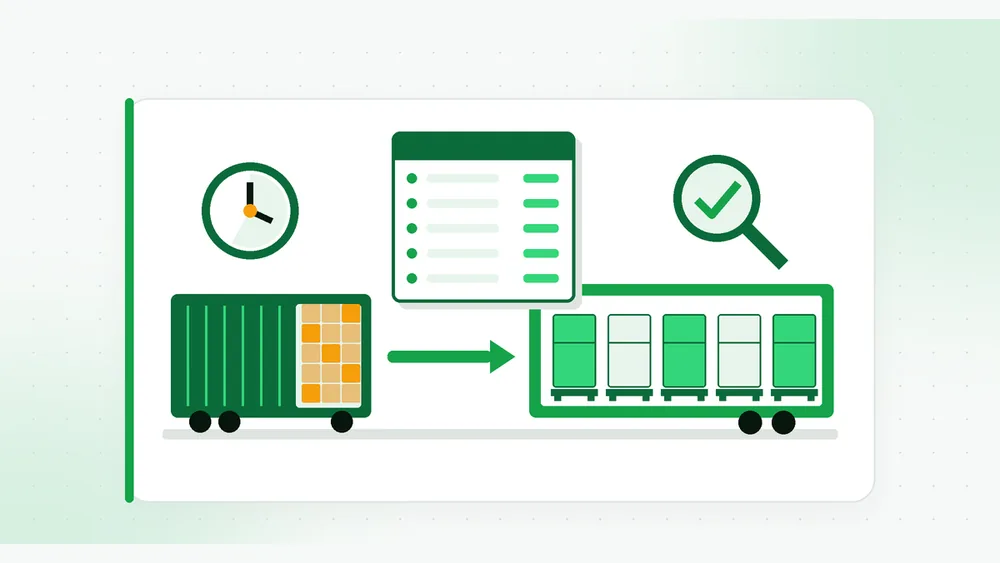
Transloading is priced from labor and materials, not distance. The biggest driver is whether the container is floor-loaded (hand devanning) or palletized (forklift unload). Carton count, SKU sorting, case weight, pallets and wrap, labels, storage days and after-hours work add to it. RapidShips quotes each job individually from the packing list.
The transloading cost on an import container is set almost entirely by what happens between cutting the seal and closing the outbound trailer. Two containers from the same port, going to the same warehouse, can price very differently because one arrived floor-loaded with twenty SKUs mixed together and the other arrived on clean, single-SKU pallets. Below are the cost drivers behind container unloading and transload quotes near Port Newark, a way to estimate a job with variables, and what to ask before comparing quotes. RapidShips quotes per job; nothing here is our pricing.
In this guide
- What should a transload quote include?
- Floor-loaded vs. palletized: the biggest cost driver
- How much does it cost to unload a container?
- Sorting, case weight and labels
- Per container, per pallet or hourly
- Container clock costs while you wait
- Example scenario: building an estimate
- How to compare two transload quotes
- Getting a quote near Port Newark
- Frequently asked questions
- Sources
Key takeaways
- Floor-loaded vs. palletized is the single biggest swing in the price of devanning a container.
- SKU sorting, heavy cases, pallet materials, labels, storage days and after-hours work are usually separate line items.
- The container clock (demurrage and per diem) is billed by the carrier or terminal, not the warehouse, but slow scheduling at the dock adds to it.
- Compare quotes on the same unit of charge and the same scope, from seal cut to seal applied.
What Should a Transload Quote Include?
A transload quote should cover every step from the moment the container is backed into a dock door to the moment the outbound trailer is sealed: receiving, unloading, sorting, pallet building, labeling, reloading and paperwork. There is no industry-standard definition of a "transloading fee," so two quotes that look similar can cover very different scopes.
Our transloading service page explains the process. For pricing, treat scope as a checklist; each step can be included, itemized, or not done at all:
- Receive the container, record the seal number and photograph the door face
- Devan: unload cartons or pallets from the container
- Count and check against the packing list; note overages, shortages and damage
- Sort by SKU, PO or destination if required
- Build and wrap pallets (materials may be a separate charge)
- Label cartons or pallets to the receiver's requirements
- Stage, then load and brace the outbound trailer and apply a new seal
- Return the empty container, or hand it back to the drayage carrier
Floor-Loaded vs. Palletized: The Biggest Cost Driver
A floor-loaded container costs more to unload than a palletized one because every carton is handled by hand, while pallets come off by forklift. That labor difference is the largest single variable in container unloading charges.
Floor loading fits more cartons per box at origin, but the consignee inherits a crew working carton by carton; a palletized box can often be emptied by one forklift operator. See our guide to floor-loaded vs. palletized containers for the full trade-offs. For quoting, what matters is:
- Carton count. More cartons means more lifts and more labor hours.
- Carton weight. Heavy or awkward cartons slow the crew and may need two people.
- How the load was stuffed. A tight, square wall of cartons unloads faster than a load that shifted or collapsed in transit.
- Whether the freight must be palletized. Most receiving DCs want pallets, so a floor load usually means pallet builds, materials and wrap on top of the unload.
How Much Does It Cost to Unload a Container?
The cost to unload a container is mainly labor time, which is far longer for a floor-loaded box than a palletized one, times the crew's rate, plus materials if the freight must be palletized.
For a third-party reference point only: WarehousingCosts.com's transloading cost guide, titled for 2026 (no specific day is shown; accessed September 2026), lists $300 to $600 per container for a floor-loaded 40-ft container transloaded into a 53-ft trailer and $150 to $300 per container for palletized freight, and describes its figures as typical of U.S. port-market facilities, with premium coastal markets pricing above them.[1] The same guide cautions that some facilities quote per hundredweight or per pallet touched instead of per container.[1] Those are that publisher's figures, not RapidShips pricing and not a quote. RapidShips quotes per job.
Devanning charges vs. lumper fees
Devanning charges are what a warehouse or transload facility bills to empty an ocean container. A lumper fee is different: it is paid for third-party labor that unloads a truck, typically at the receiver's dock. Federal law puts the cost on the party that requires the help. Under 49 U.S.C. 14103, when a shipper or receiver requires that a motor carrier be assisted in loading or unloading, the shipper or receiver must provide the assistance or compensate the carrier for its cost.[2]
Sorting, Case Weight and Labels: What Moves Transloading Charges
After floor-loaded vs. palletized, the add-ons that move the price most are SKU sorting, heavy cases, pallet materials, labels and storage. Each should be its own line on a quote.
| Driver | Why it adds cost | What to tell the quoting facility |
|---|---|---|
| SKU / PO sorting | Cartons must be separated into single-SKU or single-PO pallets instead of loaded in any order | Number of SKUs and POs, and whether pallets must be single-SKU |
| Case weight | Heavy cartons slow hand unloading and may need two people or equipment | Heaviest carton weight and total gross weight |
| Pallets, wrap, corner boards | Materials plus build labor for every new pallet | Pallet type required, max pallet height, whether you supply pallets |
| Labels | Printing and applying carton or pallet labels, or relabeling | Label spec or routing guide, and who supplies the labels |
| Storage days | Pallets held while waiting for an appointment take floor space | Expected dwell time and outbound appointment dates |
| After-hours work | Nights, weekends and holidays usually carry a premium | Whether the work must happen outside business hours |
Pallet builds are not just a materials line. Stacked freight has to be "stacked, blocked, interlocked and limited in height so that they are stable and secure against sliding or collapse," as OSHA's materials-handling standard puts it.[3] If labels have to meet a retailer's routing guide, see our guide to relabeling for retailer compliance.
Per Container, Per Pallet or Hourly: How Transload Pricing Is Built
Transload pricing is usually built on one of three units: a flat price per container, a price per pallet (or per pallet touched), or labor hours plus materials. Cross dock pricing follows the same logic but is more often per pallet, because the freight usually arrives already palletized.
- Per container. Easy to budget. Check what carton and SKU count the flat price assumes.
- Per pallet. Scales with volume and suits palletized and cross-dock freight. Check whether "per pallet" means pallets received, pallets built, or both.
- Hourly plus materials. Fair for unpredictable or damaged loads. Ask for an estimated hour range so the total is not open-ended.
Consolidation can also cut outbound cost: a 53-ft trailer has more floor and cube than a 40-ft container, so several containers can sometimes become fewer trailers, weight permitting. Our container vs. trailer capacity guide works through that math.
Container Clock Costs: Per Diem and Demurrage While You Wait
The container clock is not part of the warehouse's price, but it is part of your total cost. The Federal Maritime Commission's interpretive rule treats demurrage and detention as any charges, "including 'per diem,'" assessed by ocean carriers, terminal operators or intermediaries for the use of terminal space or shipping containers.[4]
Those charges start once free time runs out, whether or not the dock is ready, so a cheap quote with no dock slot for days can cost more in total than a faster one. Our guide to demurrage vs. detention covers how each clock starts and stops.
If a charge does land, check the invoice. Under 46 CFR 541.6, a demurrage or detention invoice must show, among other things, the container number, the allowed free time in days, the start and end dates of free time, and the applicable rate.[5] The FMC's billing rule requires invoices to be issued within 30 calendar days of when charges were last incurred, gives billed parties at least 30 calendar days to request mitigation, a refund or a waiver, and says missing required information "eliminates any obligation of the billed party to pay the applicable charge."[6] In September 2025 a federal appeals court set aside only the section of the rule on who may be billed (46 CFR 541.4); the FMC says the rest of Part 541 remains fully applicable.[7]
When storage beats waiting
If the outbound appointment is days away, unloading the container and holding the pallets in a warehouse can stop the container clock earlier. Storage then becomes a line on the transload quote instead of per diem on the carrier's invoice. Our guide to short-term freight storage near Port Newark walks through that trade-off.
Example Scenario: Building a Transloading Cost Estimate
Hypothetical, for illustration only. No real prices are used. Say a shipper has one floor-loaded 40-ft container arriving at Port Newark with a known carton count across several SKUs, and the receiving DC wants single-SKU pallets, labeled, delivered on an appointment a few days after the container becomes available. The estimate can be written with variables:
| Line item | Formula | Set by |
|---|---|---|
| Devanning labor | Crew hours (H) × hourly rate, or a flat per-container price | Carton count, case weight, load condition |
| Sorting | Number of SKUs (S) × sort charge, or included in H | Single-SKU pallet requirement |
| Pallet builds | Pallets built (P) × materials and build charge | Pallet type, height limit, wrap |
| Labels | Labels applied (L) × label charge | Receiver's label spec |
| Storage | P × storage days beyond any free period (D) × storage rate | Gap to the outbound appointment |
| After-hours premium | Applied to H if work runs outside normal hours | Timing you request |
| Container clock (carrier, not warehouse) | Days past free time × carrier or terminal tariff rate | How fast the box is unloaded and returned |
Written this way, the shipper sees which lines it controls: palletizing at origin would shrink H and remove pallet builds, at the cost of fewer cartons per box. It also shows that storage and the container clock pull against each other. Unloading on arrival adds D days of storage but stops per diem; waiting avoids storage but lets the clock run. Plugging in real quoted rates and the carrier's tariff shows which is cheaper for that load.
How to Compare Two Transload Quotes
Compare transload quotes on the same scope and the same unit of charge; a lower headline number often reflects a narrower scope. Use this checklist before accepting one:
- Is the price per container, per pallet, per hundredweight or hourly, and what freight profile does it assume?
- Does it cover everything from seal cut to seal applied, including reloading and bracing the outbound trailer?
- Are pallets, stretch wrap, corner boards and labels included or itemized?
- How many free staging days are included, and what does storage cost after that?
- Will you get photos, counts and an OS&D (overage, shortage and damage) note at unload?
- When is the earliest dock slot, and how does that line up with the container's last free day?
Getting a Quote Near Port Newark
Port-proximate handling matters more in 2026 because drayage is a growing share of the bill. Cushman & Wakefield's Port of New York and New Jersey overview (August 19, 2026) notes that "as trucking rates continue to rise, occupiers may increasingly prioritize locations closer to the Port of NY & NJ to reduce drayage costs."[8] Volume is elevated too: on September 9, 2026, the National Retail Federation forecast U.S. container imports of 2.31 million TEU for September 2026, up 9.6% year over year, with October through December forecast at about 2.0 to 2.11 million TEU a month.[9]
RapidShips is a physical, asset-backed 24/7 warehouse and cross-dock at 25A Cotters Lane, East Brunswick, NJ, serving the Port Newark and Elizabeth corridor from three dock doors. We are not a freight broker. We devan containers, build and label pallets, reload trailers, and hold freight in short-term warehouse storage when the appointment is not ready. We quote each job individually from the packing list: container size, floor-loaded or palletized, carton and SKU count, heaviest case, label spec and outbound appointment. Send the details for a transload quote or call 800-376-2808.
Frequently Asked Questions
How much does transloading cost?
How much does it cost to unload a container?
What are devanning charges?
What is a lumper fee?
What is included in a transloading fee?
Sources
- WarehousingCosts.com, "Transloading Costs (2026): What Container-to-Trailer Transfer Actually Costs," accessed September 2026.
- Legal Information Institute, Cornell Law School, "49 U.S. Code § 14103 – Loading and unloading motor vehicles," accessed September 2026.
- Legal Information Institute, Cornell Law School, "29 CFR § 1910.176 – Handling materials – general," accessed September 2026.
- Legal Information Institute, Cornell Law School, "46 CFR § 545.5 – Interpretive rule on demurrage and detention under the Shipping Act," accessed September 2026.
- Legal Information Institute, Cornell Law School, "46 CFR § 541.6 – Contents of invoice," accessed September 2026.
- Federal Maritime Commission, "FMC Publishes Final Rule on Detention and Demurrage Billing Practices," accessed September 2026.
- Federal Maritime Commission, "U.S. Court of Appeals Issues Decision in Case on Demurrage and Detention Billing Practices," accessed September 2026.
- Cushman & Wakefield, "Port of New York and New Jersey H1 2026 Overview," accessed September 2026.
- National Retail Federation, "Import Cargo's Peak Season Not Over Yet," accessed September 2026.
This guide is general operational information, not legal or regulatory advice. Rules change; confirm current requirements with the relevant agency or your carrier before acting.