
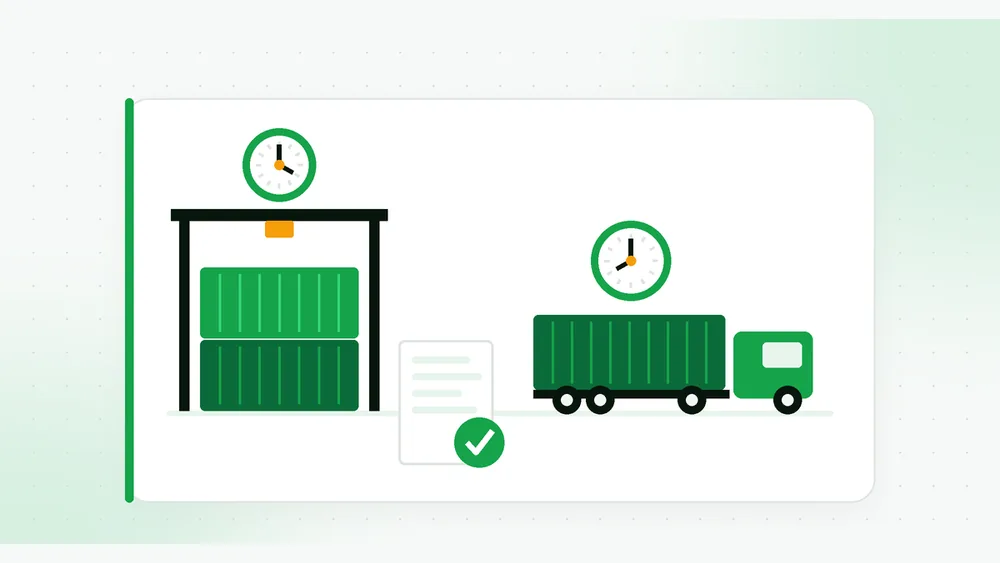
Demurrage is charged for leaving a container at the marine terminal past its free time. Detention (often called per diem) is charged for keeping the carrier’s container outside the terminal too long before returning it. Stop demurrage by getting the box released and picked up; stop detention by emptying it and returning the equipment.
Demurrage and detention are not the same charge, and treating them as one is how importers end up paying both for the same late container. Federal rules lump them together as charges “related to the use of marine terminal space (e.g., land) or shipping containers,” excluding freight charges.[1] In practice they run on separate clocks, are billed for different things, and are stopped by different actions. Once you know which clock is running, you know which move stops it, and you know what to look for when the invoice arrives.
In this guide
- What demurrage and detention actually are
- Where each clock starts and stops
- Why the charges pile up in the Port Newark corridor
- The FMC billing rules every invoice must meet
- How to dispute a demurrage or detention invoice
- Practical ways to stop the clock
- Example scenario
- Where a New Jersey warehouse fits
- Frequently asked questions
What Demurrage and Detention Actually Are
The Federal Maritime Commission (FMC) describes demurrage as accruing “when a container exceeds free time on a marine terminal,” and detention as a charge “for extended use of intermodal equipment.”[2] Put plainly:
A charge for the container sitting at the terminal after free time runs out. You are effectively paying for terminal space. On imports, it runs while the loaded box waits in the terminal for pickup.
A charge for keeping the carrier’s equipment out of the terminal past the allowed days. On imports, it typically runs from when the loaded box leaves the terminal until the empty is returned.
The word “per diem” shows up on a lot of detention invoices; the federal definition explicitly includes per diem charges in the same bucket.[1] Who bills you matters too: the regulations cover demurrage and detention invoices issued by ocean common carriers, marine terminal operators and NVOCCs.[1]
Where Each Clock Starts and Stops
The exact number of free days and the event that starts each clock come from the carrier’s or terminal’s tariff or your service contract, not from a single national rule. That is why every compliant invoice has to spell out the free time, its start and end dates, and the tariff rule or contract that applies.[3] The general pattern on an import looks like this:
| Charge | What you’re paying for | Clock generally starts | Clock generally stops | What stops it |
|---|---|---|---|---|
| Demurrage | Terminal space for a loaded box | When free time at the terminal ends | When the container is picked up (out-gated) | Release, an appointment and a trucker with a chassis |
| Detention / per diem | Use of the carrier’s container off-terminal | When the equipment free days after pickup run out | When the empty is returned (in-gated) | Unloading the box and returning the empty |
Check the dates, not just the total
Every compliant invoice has to show the container availability date on imports (or the earliest return date on exports) and the specific dates charged.[3] Compare those against your own gate-in and gate-out records. A clock that started before the box was actually available, or kept running after the empty was in-gated, is a line item worth challenging.
Why the Charges Pile Up in the Port Newark Corridor
Most demurrage and detention bills are not caused by one big failure. They come from a few days lost at each handoff:
- The box isn’t released. A customs hold or exam, a missing document or an unpaid freight bill keeps the container on the terminal while free time burns.
- No appointment or no chassis. The box is released, but the trucker can’t get a pickup slot or equipment in time.
- The receiver isn’t ready. The container gets pulled, then sits loaded in a yard for days because the destination has no dock space. Demurrage stops; detention starts.
- The empty can’t go back. The terminal or depot isn’t accepting that carrier’s empties, and the box sits on a chassis waiting.
- Notice arrives late. Nobody told the right party the cargo was available until part of free time was gone.
Several of these are exactly the circumstances the FMC weighs when it decides whether a charge is reasonable. Its interpretive rule says it will consider whether the charges are serving their purpose “as financial incentives to promote freight fluidity,” whether demurrage is tied to when cargo was actually available, how cargo-availability notice was given, and extenuating circumstances such as government inspections.[4] On empties specifically, detention that is imposed when it serves no incentive purpose, “such as when empty containers cannot be returned,” is “likely to be found unreasonable.”[4]
The FMC Billing Rules Every Invoice Must Meet
The FMC’s demurrage and detention billing rule (46 CFR part 541) took effect on May 28, 2024, and failing to include any required information in an invoice eliminates the billed party’s obligation to pay that charge.[5] The key requirements:
1. A 30-day deadline to bill
A billing party must issue the invoice within 30 calendar days from the date the charge was last incurred. If it doesn’t, the billed party is not required to pay. NVOCCs get 30 days from receiving their own invoice to bill their customer.[6]
2. Required contents
Among the items a compliant invoice must include:[3]
- Bill of lading number(s), container number(s) and, for imports, the port of discharge
- The basis for why you are the proper party and liable for the charge
- Invoice date and due date
- Allowed free time in days, with its start and end dates
- Container availability date (imports) or earliest return date (exports)
- The specific dates charged, the daily rate(s), the total, and the tariff or contract provision that applies
- Contact information and the timeframe for requesting mitigation, refund or waiver
- A statement that the charges comply with FMC rules and that the billing party’s own performance did not cause them
What changed in September 2025
On September 23, 2025, the U.S. Court of Appeals for the D.C. Circuit set aside one section of the rule, 46 CFR 541.4, which had limited who could receive a demurrage or detention invoice. The FMC says the rest of part 541, including the content requirements and the 30-day deadline, remains in effect.[7] In other words, the rules about what an invoice must say and when it must be sent still apply; the specific rule about who may be billed is currently not in force.
How to Dispute a Demurrage or Detention Invoice
Start with the billing party, then escalate if needed. Keep your own paper trail from the start: availability notices, appointment attempts, terminal notices about empty returns, and gate records.
- Check the invoice against part 541. Missing required information, or an invoice issued more than 30 days after the charge was last incurred, is a defect in itself.[6]
- Request mitigation, refund or waiver in time. The billing party must give you at least 30 calendar days from the invoice date to ask, and must resolve the request within 30 calendar days of receiving it, unless both sides agree to a later date.[8]
- Make the incentive argument with evidence. If the box wasn’t available, notice was late, the terminal wouldn’t take the empty, or a government inspection held the cargo, say so and attach proof. Those are the factors in the FMC’s interpretive rule.[4]
- Escalate to the FMC if a carrier won’t fix it. Under the charge-complaint statute, a person may submit information about charges to the FMC; for demurrage and detention, the common carrier bears the burden of establishing that the charges are reasonable, and the Commission shall order a refund of charges that don’t comply.[9]
Practical Ways to Stop the Clock
- Clear customs early. Have your customs broker file before arrival so a hold shows up while you still have free time to work with it.
- Track availability, not just vessel arrival. Know the date the box actually became available and your last free day under the tariff or contract, before either shows up on an invoice.
- Separate the pickup from the delivery. If the receiver can’t take the freight, pull the box anyway and unload it somewhere that can. Getting the container empty stops detention; parking it loaded on a chassis doesn’t.
- Plan the empty return before pickup. Check where the carrier wants the empty and whether that location is accepting returns. If it isn’t, document it.
- Read every invoice the week it arrives. Both the dispute window and your memory of what happened are short.
Example Scenario
This is a hypothetical to show how the clocks interact, not a real shipment. Say a shipper has a 40-foot import available at an Elizabeth terminal, but the receiving DC is full for the next week. If the box stays on the terminal, demurrage runs once free time ends. If the trucker pulls it and it sits loaded in a yard waiting for the DC, demurrage stops but detention starts, and the shipper also pays for the chassis. The alternative is to pull the box inside free time, unload it at a nearby warehouse, return the empty, and deliver the freight on a domestic trailer when the DC has space. Whether that is cheaper depends on the tariff rates, the storage and handling cost, and the extra delivery leg, which is a calculation the shipper should run for each case.
Where a New Jersey Warehouse Fits
A warehouse cannot waive a carrier’s charges or clear customs, and RapidShips is neither a freight broker nor a customs broker. What a physical facility near the port can do is give the freight somewhere to go, so the container itself can stop costing money. From East Brunswick, our dock handles the physical side of that:
- Devanning an import and loading the freight onto domestic equipment through transloading, so the empty can go back.
- Holding pallets in short-term storage while the receiver makes room, instead of holding the container.
- Splitting a box across several outbound trailers via cross-docking when it is headed to more than one destination.
If a container is running out of free time and the receiver isn’t ready, call the dock at 800-376-2808 or send the details and we will tell you what we can take and when.
Frequently Asked Questions
What is the difference between demurrage and detention?
How long does a carrier have to send a demurrage or detention invoice?
How long do I have to dispute a demurrage or detention invoice?
Can I be charged detention if the terminal won’t accept my empty?
Does a warehouse near the port reduce demurrage and detention?
Sources
- Legal Information Institute, Cornell Law School, "46 CFR § 541.3 – Definitions," accessed September 2026.
- Federal Maritime Commission, "Detention and Demurrage," accessed September 2026.
- Legal Information Institute, Cornell Law School, "46 CFR § 541.6 – Contents of invoice," accessed September 2026.
- Legal Information Institute, Cornell Law School, "46 CFR § 545.5 – Unjust and unreasonable practices with respect to demurrage and detention," accessed September 2026.
- Federal Maritime Commission, "FMC Publishes Final Rule on Detention and Demurrage Billing Practices," accessed September 2026.
- Legal Information Institute, Cornell Law School, "46 CFR § 541.7 – Issuance of demurrage and detention invoices," accessed September 2026.
- Federal Maritime Commission, "U.S. Court of Appeals Issues Decision in Case on Demurrage and Detention Billing Practices," accessed September 2026.
- Legal Information Institute, Cornell Law School, "46 CFR § 541.8 – Requests for fee mitigation, refund, or waiver," accessed September 2026.
- Legal Information Institute, Cornell Law School, "46 U.S. Code § 41310 – Charge complaints," accessed September 2026.
This guide is general operational information, not legal or regulatory advice. Rules change; confirm current requirements with the relevant agency or your carrier before acting.