
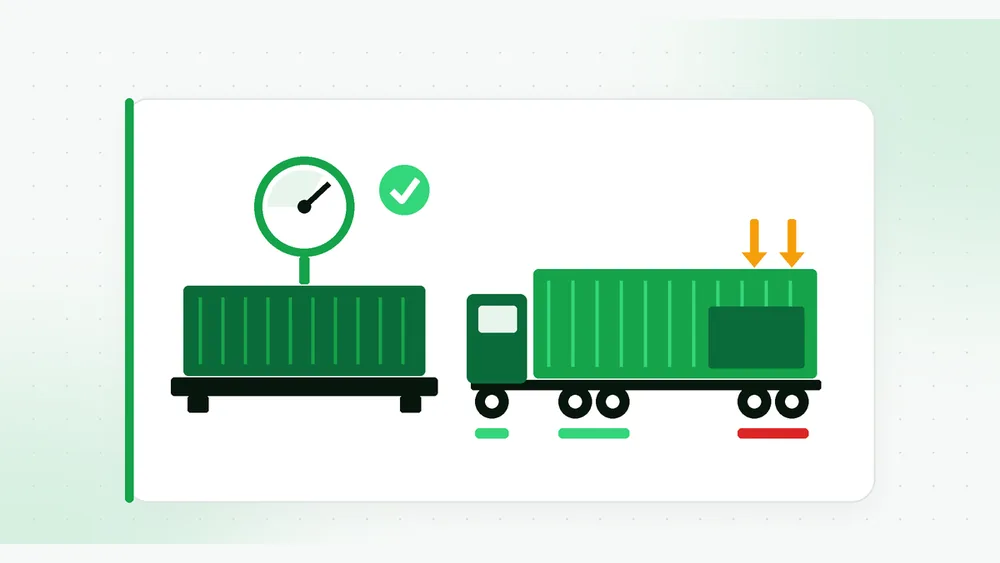
SOLAS VGM is the verified total weight of a packed container, required before it can be loaded on a ship. U.S. road rules are different: federal limits cap gross weight, single and tandem axles, and axle groups under the bridge formula. A box with a correct VGM can still be illegal on the road if its weight is badly distributed.
Two different weight regimes touch every export and import container, and they measure different things. The maritime rule, SOLAS regulation VI/2, asks for one verified figure: the gross mass of the packed container, supplied by the shipper before the box is loaded on a ship.[1] U.S. highway law asks whether the whole truck, and each group of its axles, stays under federal limits on the road.[2] Shippers who treat the VGM as proof the load is “legal” are often surprised at the first scale house. This guide lays out both rule sets and the gap between them.
In this guide
- What SOLAS VGM requires
- The U.S. Coast Guard’s position on VGM
- U.S. road limits: gross, axle and bridge formula
- VGM vs. road weight, side by side
- Why a VGM-compliant box can still be illegal on the road
- Example scenario
- Planning a load that passes both
- Fixing a problem box near Port Newark
- Frequently asked questions
What SOLAS VGM Requires
The International Maritime Organization amended SOLAS regulation VI/2 through resolution MSC.380(94), and the verified gross mass requirement entered into force on 1 July 2016.[1] The core points, as the IMO describes them:
- It is a condition for loading. The verified gross mass is a condition for loading a packed container onto a ship.[1]
- The shipper owns it. The shipper is responsible for providing the verified weight in the shipping document and submitting it to the master (or the master’s representative) and the terminal representative early enough to be used in the ship stowage plan.[1]
- Two ways to get the number. Method 1 is weighing the packed container. Method 2 is weighing all packages and cargo items, including pallets, dunnage and securing material, and adding the container’s tare mass, using a certified method approved by the competent authority of the State where packing was completed.[1]
The total gross mass of a packed container — cargo, packaging, pallets, dunnage, securing material and the container’s own tare — obtained by one of the two SOLAS methods and declared by the shipper.
Notice what the VGM does not tell anyone: where inside the box the weight sits. For stowage planning on a ship, the total is what matters. On a highway, it is only the starting point.
The U.S. Coast Guard’s Position on VGM
In Marine Safety Information Bulletin 009/16, the U.S. Coast Guard declared that existing U.S. laws and regulations for providing verified container weights are equivalent to the requirements of SOLAS regulation VI/2.[3] The bulletin makes several practical points:
- The U.S. regime lets other entities in the export chain work with the shipper to determine and verify container weights.[3]
- Examples it gives include the terminal weighing the container and, when duly authorized, verifying the VGM on the shipper’s behalf, or the shipper verifying the cargo weight while the carrier provides and verifies the container’s tare weight.[3]
- Equipment already used to comply with federal or state law, including the Intermodal Safe Container Transportation Act and the container weight requirements in 29 CFR 1918.85(b), is acceptable for determining VGM.[3]
- The Coast Guard will continue, in vessel inspections, to verify that ships’ masters receive container VGMs.[3]
The two U.S. rules the bulletin leans on are worth knowing on their own. OSHA’s longshoring rule requires every intermodal container to be marked with its empty weight, maximum cargo weight and maximum gross weight, requires outbound containers ready for loading to be weighed for actual gross weight before being hoisted, and bars hoisting a container whose actual gross weight exceeds its marked maximum.[4] Separately, under the Intermodal Safe Container Transportation Act, a person who tenders a loaded container or trailer with an actual gross cargo weight of more than 29,000 pounds to a first carrier for intermodal transportation must provide a certification that includes the actual gross cargo weight, a description of the contents, the certifying party, the container number and the date.[5]
U.S. Road Limits: Gross, Axle and Bridge Formula
Once the container is on a chassis, federal highway weight law applies to the entire vehicle. On the Interstate System, 23 CFR 658.17 sets these limits:[2]
| Limit | Federal maximum | What it measures |
|---|---|---|
| Gross vehicle weight | 80,000 lb | Tractor, chassis, container and cargo combined, unless the bridge formula dictates less |
| Single axle | 20,000 lb | Any one axle, including any one axle of a group |
| Tandem axle | 34,000 lb | Two axles spaced more than 40 and not more than 96 inches apart[6] |
| Bridge formula | W = 500 (LN/(N−1) + 12N + 36) | Any two or more consecutive axles, based on their number (N) and spacing (L, in feet) |
The Federal Highway Administration explains the bridge formula as a way to protect bridges by linking allowable weight to the number and spacing of axles.[6] The key sentence for shippers: any two or more consecutive axles may not exceed the weight computed by the bridge formula even though single axles, tandem axles and gross weight are within legal limits.[6] Interior axle groups, such as the tractor’s axles or the trailer’s axles, have to comply as well as the whole truck.[6]
Two caveats. Some states have higher “grandfathered” Interstate limits,[6] and state routes off the Interstate can have their own rules, so check the states on your route. And the special-permit provisions in 658.17 are aimed at nondivisible loads;[2] ordinary palletized or boxed freight in a container can be divided, so the practical fix for an overweight box is almost always to rearrange or reduce the load.
VGM vs. Road Weight, Side by Side
| SOLAS VGM | U.S. road limits | |
|---|---|---|
| What is weighed | The packed container alone | The whole vehicle: tractor, chassis, container and cargo |
| The question asked | What is the total gross mass? | Is the total, and every axle and axle group, within limits? |
| Who is responsible | The shipper named on the shipping document | Enforced against the vehicle and its operator on the road |
| When it bites | Before the box is loaded on a ship | At weigh stations and roadside enforcement |
| Does distribution matter? | No — one number | Yes — how the weight sits over the axles decides compliance |
Why a VGM-Compliant Box Can Still Be Illegal on the Road
A correct VGM proves the total mass of the box is known. It says nothing about the three things that decide road legality:
- The rest of the vehicle. The VGM excludes the tractor and chassis. Their weight, which varies by equipment, is added before the gross limit is checked.
- Where the cargo sits. Dense freight loaded at the door end loads the chassis axles; freight loaded at the nose shifts weight toward the tractor’s drive axles. The total does not change, but one axle group can go over while the others are light.
- Axle spacing. The same weight can be legal on one chassis and over the bridge formula on another with a shorter spread between axle groups, because the formula depends on spacing.[2]
FHWA’s own bridge formula pamphlet shows how tight this is: its example five-axle truck carries 12,000 pounds on the steer axle and 17,000 on each of the four others, for exactly 80,000 pounds.[6] A combination that is already at the gross limit has no room for weight to bunch up over one tandem. Freight that shifts in transit can create the same problem after the box leaves the terminal. When it happens, the fix is physical: overweight load correction rebalances or reduces the load so each axle group is back within limits.
Example Scenario
This is a hypothetical illustration, not a real shipment.
Say a shipper stuffs a 40-foot container with crated machinery parts. It weighs the packed container on a certified scale (Method 1), declares the VGM, and the figure is under the container’s marked maximum gross weight. The ocean leg goes fine. At the destination port the box is picked up on a chassis, and the driver crosses a scale on the way inland. Gross weight is under 80,000 pounds, but the heaviest crates were loaded at the door end, and the chassis tandem reads over 34,000 pounds.
Nothing about the VGM was wrong. The problem is distribution, and the fix is to get the container to a dock, move crates toward the nose so the load is shared between the tractor’s drive axles and the chassis tandem, re-brace, and re-weigh. If the gross weight had been over the limit too, part of the load would need to move to a second trailer.
Planning a Load That Passes Both
- Decide who produces the VGM (shipper, packer or terminal) and by which method before the box is packed
- Record the weight of every package, pallet and piece of dunnage if you are using Method 2
- Plan the floor layout by weight, not just by cube: spread dense freight along the length of the box instead of bunching it at either end
- Brace heavy items so they cannot migrate toward the doors in transit
- Ask the drayage carrier about their tractor and chassis setup if the load is near the gross limit
- For heavy imports, have the box weighed by axle on a certified scale before the long inland leg, not after
Rule of thumb
VGM answers “how heavy?” Road limits answer “how heavy, and where?” If a packed container is anywhere near the road gross limit, plan the load for the second question too.
Fixing a Problem Box Near Port Newark
RapidShips operates a 24/7, asset-backed warehouse and cross-dock facility at 25A Cotters Lane in East Brunswick, NJ, serving the Port Newark and Elizabeth terminals. We are not a freight broker, a customs broker or a carrier’s legal advisor; what we do is the physical correction.
When a container is over on an axle group, the work is usually overweight load correction: unload what is needed, reposition the heavy freight, re-secure it and re-weigh. When the gross weight is the problem, the excess can be transloaded onto a second trailer. If the freight also has damaged pallets or crushed cartons, freight rework can be handled in the same visit.
Stuck at a scale with a heavy box?
Call with the scale ticket or axle readings and the freight type, and we will tell you what the correction would involve.
800-376-2808 — 24/7 dock commandFrequently Asked Questions
What is the difference between VGM and road weight limits?
Can a container with a correct VGM be overweight on the road?
Who is responsible for the VGM?
What are the federal axle weight limits in the U.S.?
How is an axle-overweight container fixed?
Sources
- International Maritime Organization, "Verification of the gross mass of a packed container," accessed September 2026.
- Legal Information Institute, Cornell Law School, "23 CFR § 658.17 – Weight," accessed September 2026.
- U.S. Coast Guard, "Marine Safety Information Bulletin 009/16: U.S. Declares an Equivalency to Regulation VI/2 of SOLAS," accessed September 2026.
- Legal Information Institute, Cornell Law School, "29 CFR § 1918.85 – Containerized cargo operations," accessed September 2026.
- Legal Information Institute, Cornell Law School, "49 U.S. Code § 5902 – Notifications and certifications," accessed September 2026.
- Federal Highway Administration, "Bridge Formula Weights," accessed September 2026.
This guide is general operational information, not legal or regulatory advice. Rules change; confirm current requirements with the relevant agency or your carrier before acting.