
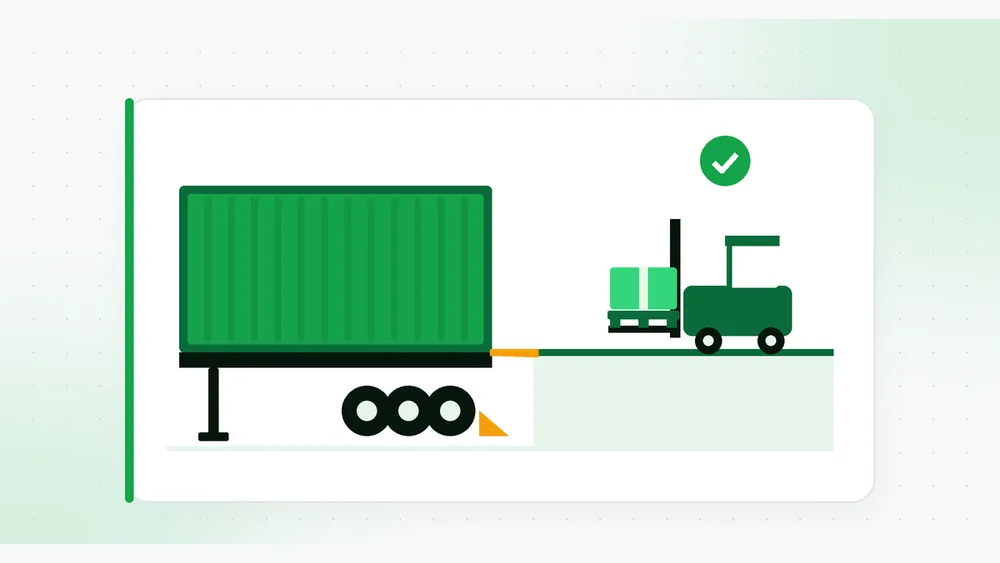
To unload a shipping container, first immobilize it: brakes set, wheels chocked and jack stands under a chassis with no tractor. Check the seal and exterior, then open the doors slowly behind a safety strap or chain in case cargo has shifted, and ventilate before anyone walks in. Pallets come off by forklift over a secured dockboard; floor-loaded cartons come off by hand, tier by tier, onto pallets.
Knowing how to unload a shipping container safely matters most in the first five minutes, before any freight moves. That is when a chassis can roll, a door can swing open under the weight of leaning cartons, and fumigant trapped in a sealed box can reach the person who opens it. The international code of practice for container packing, the IMO/ILO/UNECE CTU Code, has a chapter on receiving and unpacking containers that covers exactly these risks.[1] This guide turns that chapter, and the OSHA rules for forklifts and dockboards, into a working method for a warehouse, a store or a job site.
In this guide
- Dock, ramp or ground: three ways to unload a container
- Before the doors open: paperwork, seal and exterior
- How to open container doors safely
- Fumigated containers and trapped fumes
- Step by step: unloading the container
- Equipment and crew checklist
- When to send the container to a dock instead
- Unloading containers from Port Newark in New Jersey
- Frequently asked questions
Key takeaways
- Immobilize first: brakes, chocks, and jack stands under an uncoupled chassis.
- Treat every door as if freight is leaning on it until you have proved it isn’t.
- A missing fumigation label does not mean the air inside is safe.
- No dock and no rated ramp usually means the container should go to a dock.
Dock, Ramp or Ground: Three Ways to Unload a Container
There are three physical setups for unloading a container, and the right one depends on whether you have a dock-high door, a mobile yard ramp, or only flat ground. The CTU Code says access to a container’s doors should be made by ramps or platforms where needed, and that a forklift driven into a container should cross a bridging unit that is safely connected to the container floor.[2]
| Setup | What you need | What to watch |
|---|---|---|
| On a chassis at a dock-high door | Dock leveler or dockboard, wheel chocks, forklift or pallet jack | Jack stands if the tractor leaves; the gap and height difference at the dock edge |
| On a chassis, no dock | A mobile yard ramp rated for the forklift plus load, or a crew unloading by hand | Ramp secured to the container; hand-unloading down from floor height |
| Grounded (lifted off the chassis) | A side-loader or crane to set the box down, firm level ground, a ramp for access | Uneven ground racks the box so the doors bind |
Grounding a container is not a do-it-yourself step: the CTU Code says proper lifting equipment is required, and that grounded containers deform to the ground they sit on, so the area should be firm, level and well drained.[2] A container on soft or sloping ground can rack, which the code notes can make the doors difficult to open and, more importantly, to close.[2]
With flat ground and no rated ramp, the options are a slow hand unload or sending the box to a dock. Whether the driver waits or drops the chassis changes the clock; see live unload vs. drop trailer.
Before the Doors Open: Paperwork, Seal and Exterior
Before a container is opened, check that it is externally in good condition and that the seal matches the paperwork. The CTU Code tells consignees to document distortion, cracks or bends and report them to the container operator, and to check the seal against the transport documents.[2]
- Packing list in hand. Carton count, weights and SKUs tell you whether this is a forklift job or a hand unload, and how many pallets you need.
- Seal number checked against the bill of lading or delivery order. If it is broken, missing or different, stop: our guide to a broken or mismatched container seal covers who to notify before anyone cuts it.
- Labels read. Fumigation, dangerous goods and “dangerous atmosphere” labels change how the doors are opened (see below).
- Clock known. The last free day and the empty-return deadline decide how fast the box has to be emptied; see demurrage vs. detention.
Use this tool: plan the pallets before the box arrives
The free container loading calculator estimates how many cartons or pallets a 20-ft, 40-ft or 40-ft high-cube holds, and the pallet calculator works out how many pallets the cartons will need once they come off. Staging empty pallets and wrap at the door before it opens is the single biggest time saver on a floor-loaded box.
How to Open Container Doors Safely
Open container doors slowly and from the side, with a restraint across them, because cargo that shifted at sea may be resting on the doors. The CTU Code warns that unstable or poorly packed cargo can force the doors open when the door gear is released, or fall out once they open, and it encourages a safety strap around the inner locking rods to limit how far the first door swings.[2]
- Ring the doors. The CTU Code’s first step for steel doors is to tap both door panels: a dull sound with no resonance suggests cargo is resting against the door.[2]
- Fit a restraint. A chain across the doors from corner fitting to corner fitting, sized so the doors cannot open more than 150 mm (6 in), or a loose strap across the inner lock rods if a chain can’t be fitted.[2]
- Rotate the handles and pull with your whole body. Rotating the lock rods about 90° makes the cams push the doors open; the code says to stand upright and pull backward from about shoulder height.[2]
- Be ready to step back, away from the hinged side, if freight starts to fall or the door is pushing you rather than you pulling it.[2]
- Look before you release the restraint. Through the gap, check whether the door face is leaning, collapsed or braced with bags and straps.
A container carrying a flexitank should be opened on the right-hand door only, and doors that won’t open often mean the box is not level, not that more force is needed.[2]
Fumigated Containers and Trapped Fumes
A closed container can hold fumigant or chemical vapor at harmful levels, so it should be ventilated before anyone enters. The CTU Code says containers should be ventilated before personnel go in, preferably by forced ventilation, or else with the doors open long enough for the air inside to match the outside air.[2] It notes that apparently non-hazardous goods such as shoes, textiles and furniture have repeatedly been found giving off harmful substances after long voyages.[2]
- Don’t rely on the label. Fumigated units should be marked, but the code says marks can be lost in transit and the absence of marking cannot be taken to mean fumigants are not present.[2]
- Check the vents and door gaskets. Tape over vents or gaskets may indicate fumigant.[2]
- Don’t trust your nose. The code says most of these gases are well above safe limits by the time you can smell them; sampling with detector tubes through the door gasket is the practical test.[2]
- Ask for a safety data sheet from the shipper when there is reason to suspect a dangerous atmosphere or damaged dangerous goods.[2]
Your own confined-space and air-monitoring procedures take priority over any general guide.
Step by Step: Unloading the Container
Once the doors are open and the air is clear, the unload itself follows the same sequence whether the freight is palletized or floor-loaded. OSHA’s powered industrial truck rule requires the brakes of highway trucks to be set and wheel chocks placed under the rear wheels while a forklift boards them, and says fixed jacks may be needed to keep an uncoupled semitrailer from upending.[3]
- Immobilize the unit. Brakes set, rear wheels chocked, jack stands under the nose of a chassis with no tractor under it.[3] The CTU Code adds that a chassis must not be able to tip while a lift truck works inside.[2]
- Place and secure the bridge. Portable dockboards must be anchored or held so they can’t move out of a safe position, and must support the maximum intended load.[4] OSHA also requires dockboards to be secured before they are driven over and their rated capacity never exceeded.[3]
- Check the container floor. OSHA requires the flooring of trucks and trailers to be checked for breaks and weakness before a forklift drives on.[3] Container floors certified under the CSC are only required to take an axle load of 5,460 kg (about 12,000 lb), according to the CTU Code, so check the forklift’s loaded front-axle weight and ask the container operator if in doubt.[2]
- Photograph the load as found before the first pallet or carton moves.
- Release securing gear carefully. Open the valves on dunnage bags to let the air out, and expect low-friction items to slide and unstable items to topple once straps come off.[2]
- Unload. Pallets come off as unit loads; floor-loaded cartons come off from the top of the face down onto pallets staged at the door, sorted by SKU or PO. See floor-loaded vs. palletized containers.
- Build stable pallets. OSHA requires stored material to be stacked, blocked, interlocked and limited in height so it is stable and secure against sliding or collapse.[5]
- Count and record damage. Count against the packing list and document damage for the carrier and shipper, as the CTU Code advises.[2] The freight damage claims guide explains what the record needs to show.
- Return the empty clean. Unless otherwise agreed, the consignee returns the container clean and free of cargo residue and pests, with old placards removed.[2]
Equipment and Crew Checklist
The equipment list is short, but each item exists to prevent a specific failure. OSHA requires every forklift operator to be competent, as shown by completing the training and evaluation in the powered industrial truck standard.[3]
| Item | Why it matters |
|---|---|
| Wheel chocks and jack stands | Stop the chassis rolling or tipping while a forklift is inside |
| Dock leveler, dockboard or yard ramp rated above forklift plus load | Rated capacity must never be exceeded |
| Forklift with a trained operator, or pallet jack | Pallets come off as unit loads |
| Safety chain or strap | Limits the door swing if cargo is leaning on it |
| Extendable conveyor (floor-loaded boxes) | Brings cartons to the crew instead of the crew carrying them |
| Empty pallets, stretch wrap, corner boards, labels | Cartons can be palletized as they come off |
| Camera, packing list, pen | Seal, as-found condition, count and damage on record |
| Lighting; gas detector tubes where fumigant is possible | The back of a 40-ft box is dark; smell is not a test |
Floor-loaded containers are a manual-handling job: every carton is lifted at least once, many from floor level or above shoulder height. NIOSH’s Revised Lifting Equation and its applications manual are the standard way to judge whether a lifting task carries a risk of low back injury.[6] Rotating people between the container face and the pallet station, and team-lifting heavy cartons, helps.
When to Send the Container to a Dock Instead
Unloading at your own site makes sense when you have the setup and the time. It usually doesn’t when one of these is true:
- There is no dock-high door and no ramp rated for your forklift and load.
- The box is floor-loaded with heavy cartons and the receiver wants pallets built to a spec.
- The seal is broken or the doors are bulging: the unload needs witnesses, photos and a written count.
- The empty has to go back fast and your crew can’t start until tomorrow.
Use this tool: turn the container into a quote request
The Freight Scope Builder asks for the container size, whether it is floor-loaded, the carton count and where the freight goes next, then writes a summary a dock can price, with a list of what is still missing. If the container is already at your door and something has gone wrong, start with Freight Emergency Help instead.
Unloading Containers from Port Newark in New Jersey
Most import containers in New Jersey come off the Port Newark–Elizabeth terminals or Port Liberty Bayonne on a drayage carrier’s chassis, so the unload races the chassis and the container’s free time. The Port Newark terminal guide lists each terminal’s official site, the drayage guide covers what to send your trucker, and chassis splits and pre-pulls explains the charges that start when a box sits.
RapidShips unloads containers at its own dock at 25A Cotters Lane, East Brunswick, NJ, about 30 road miles from Port Newark. We have 3 dock doors and run dock operations 24/7 by appointment. We are not a drayage carrier: your trucker brings the container, we unload, palletize and record it, and the empty can go back. From there the freight can go into short-term storage, across the dock through cross-docking, or onto a 53-ft trailer through transloading. See how we run container unloading and devanning, or call 800-376-2808 to book a door.
Frequently Asked Questions
How do you unload a shipping container without a loading dock?
Can a forklift drive into a shipping container?
How do you safely open a shipping container door?
Do you need to ventilate a container before unloading?
What equipment do you need to unload a container?
Sources
- International Maritime Organization, "IMO/ILO/UNECE Code of Practice for Packing of Cargo Transport Units (CTU Code)," accessed September 2026.
- International Labour Organization, "CTU Code: IMO/ILO/UNECE Code of Practice for Packing of Cargo Transport Units (2014), chapter 12 and annex 5," accessed September 2026.
- Legal Information Institute, Cornell Law School, "29 CFR § 1910.178 – Powered industrial trucks," accessed September 2026.
- Legal Information Institute, Cornell Law School, "29 CFR § 1910.26 – Dockboards," accessed September 2026.
- Legal Information Institute, Cornell Law School, "29 CFR § 1910.176 – Handling materials – general," accessed September 2026.
- National Institute for Occupational Safety and Health (CDC), "Applications Manual for the Revised NIOSH Lifting Equation (Pub. No. 94-110)," accessed September 2026.
This guide is general operational information, not a site safety plan or legal advice. Follow your own safety program, your equipment manufacturer’s instructions and current OSHA requirements.