
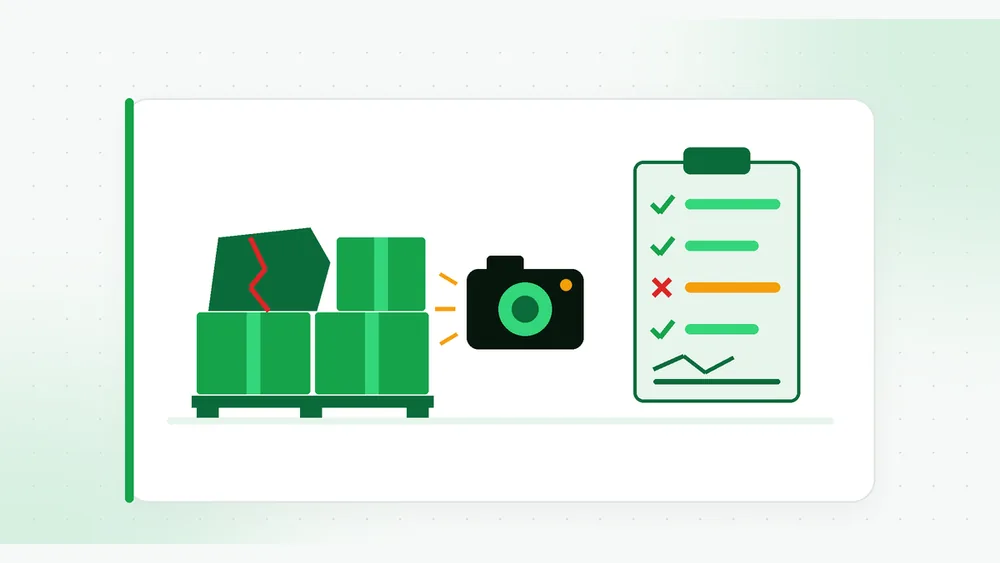
Under the Carmack Amendment, interstate motor carriers are liable for actual loss or injury to the goods they carry. To protect a claim, note damage on the delivery receipt, photograph everything before it moves, keep the damaged goods, and file a written claim for a specific amount within the carrier's filing period, which cannot be shorter than nine months.
The strongest freight damage claims are built in the first thirty minutes after the trailer doors open. Federal law makes the carrier liable for actual loss or injury to property it transports in interstate commerce[1], but the carrier still has to be shown what was damaged, how much, and that the damage happened in its custody. That proof comes from the delivery receipt, the photos, the piece count and the damaged freight itself. This guide covers what to capture at the dock, what the claim-processing rules in 49 CFR Part 370 require of both sides, and the mistakes that most often weaken a claim.
In this guide
- Carmack in one page: who is liable and for what
- At the dock: the delivery receipt and exceptions
- Photographing damage so it holds up
- OS&D notes, concealed damage and the piece count
- Preserving damaged goods and handling salvage
- What a written claim must contain
- Claim timelines under Carmack and Part 370
- Example scenario
- Where a NJ dock facility fits in
- Frequently asked questions
Carmack in One Page: Who Is Liable and for What
The Carmack Amendment, codified at 49 U.S.C. § 14706, requires motor carriers to issue a receipt or bill of lading for property they receive, and makes the receiving carrier, the delivering carrier, and any carrier over whose line the property moves liable for "the actual loss or injury to the property" they caused.[1] In practice a claimant can usually go to the origin or delivering carrier without first proving which leg caused the damage.
Two limits matter before you file anything:
- Liability can be limited by agreement. The statute allows a carrier to limit its liability to a value set by the shipper's written or electronic declaration or by written agreement, where that is reasonable under the circumstances.[1] Check the bill of lading and the carrier's tariff or contract terms for a released value before assuming full invoice value is on the table.
- Part 370 governs how claims are processed. The claim rules in 49 CFR Part 370 apply to claims for loss, damage, injury or delay to property moved in interstate or foreign commerce by motor carriers and freight forwarders.[2] If an ocean or rail leg is involved, different rules may apply to that portion of the move; confirm with your insurer or counsel.
We are a dock, not a claims adjuster
RapidShips is a warehouse and freight recovery facility. We can document, segregate and rework damaged freight, but we do not file claims or advise on what a claim is worth.
At the Dock: The Delivery Receipt and Exceptions
The delivery receipt is the first document an adjuster reads. A clean signature says the freight arrived in good order; a written exception puts the damage on the carrier's own paperwork at the moment of delivery.
A motor carrier bill of lading must show the consignor and consignee, origin and destination, the number of packages, a description of the freight, and weight, volume or measurement where that affects rating.[3] Those fields are your checklist. Compare them against what is actually on the trailer before you sign:
- Seal. Record the seal number and whether it was intact before the doors were opened. Photograph it on the door.
- Piece count. Count pallets and, where practical, cartons against the number of packages on the bill. A short count is a loss, not a damage, and should be noted separately.
- Visible condition. Note crushed, torn, wet, punctured, leaning or re-taped packages, and broken pallets.
- Specific wording. "Subject to inspection" tells the carrier almost nothing. Write what you see: "2 of 18 pallets crushed on top tier, approx. 14 cartons torn, product visible" or "1 pallet short."
- Driver acknowledgment. Have the driver sign or initial next to the exception, and note the driver's name, tractor and trailer numbers, and the date and time.
Keep in mind that an exception on its own is not a claim. Part 370 says bad order reports, damage appraisals, and notations of shortage or damage on freight bills or delivery receipts do not, standing alone, meet the minimum claim filing requirements.[4] The notation is evidence. The claim is a separate written demand, covered below.
Photographing Damage So It Holds Up
Photos are what let someone who was not at the dock see what you saw. A useful set tells the story in order, before anything is moved:
| Shot | What it proves |
|---|---|
| Trailer or container number and seal, doors closed | Which equipment, and that the seal was intact or not |
| Doors just opened, whole load in view | Condition and position of freight as delivered, before handling |
| Each damaged pallet, four sides and top | Extent of damage and whether securement or pallets failed |
| Close-ups of labels, PO and SKU on damaged cartons | Ties the damage to specific line items on the invoice |
| Bracing, straps, load bars, dunnage (or their absence) | How the load was secured in transit |
| Signed delivery receipt showing the exception | That the carrier was on notice at delivery |
| Contents of opened cartons | Actual product damage, not just packaging damage |
- Keep the original files with their date and time data; do not crop or filter them
- Include something for scale in close-ups
- Name files by trailer number and pallet position so an adjuster can follow them
- Photograph again after segregation so the count of damaged units is visible
OS&D Notes, Concealed Damage and the Piece Count
Most receiving operations log overages, shortages and damages (OS&D) on a separate report. It should agree with the receipt exception and the photos; inconsistencies between them are what adjusters question first.
What a good OS&D entry records
- Bill of lading and PRO numbers, carrier name, trailer and seal numbers
- Count expected versus count received, by pallet and by carton where possible
- SKU, description and quantity of each damaged unit
- Type of damage (crushed, wet, punctured, broken) and where on the load it was
- Who inspected, when, and where the damaged goods are now held
Concealed damage
Damage found only after unpacking is harder to tie to the carrier because the receipt was signed clean. Stop, photograph it in place, keep all packaging, and notify the carrier in writing as soon as possible. Check the carrier's tariff or rules tariff for any concealed-damage notice requirement.
Preserving Damaged Goods and Handling Salvage
The damaged product is evidence. Do not throw it out, sell it, or return it to stock until the carrier has had a chance to inspect it or has told you in writing that it does not need to.
- Segregate. Move damaged units to a marked hold area, separate from saleable stock, with the OS&D reference on the pallet.
- Offer inspection in writing. Tell the carrier where the goods are and how long you can hold them.
- Separate the good from the bad. Undamaged cartons from a damaged pallet can often be rebuilt onto a sound pallet and delivered, which limits the loss to the units that are actually damaged.
When damaged property is not delivered, or is rejected or refused by the consignee, Part 370 requires the carrier, after giving due notice to the owner and other interested parties whenever practicable, to sell or dispose of it directly or through a competent salvage agent, in a way that fairly and equally protects the interests of everyone with an interest in it.[5] The carrier must keep salvage records that link the disposal to the original shipment and any claim, including the lot number, money recovered, and date that money was transmitted.[5]
What a Written Claim Must Contain
A claim is a written communication to the carrier. Under 49 CFR 370.3(b), it meets the minimum filing requirements if it is filed with a proper carrier within the time limits in the bill of lading or contract of carriage, and it does three things:[4]
- Contains facts sufficient to identify the shipment
- Asserts liability for the loss, damage, injury or delay
- Makes claim for payment of a specified or determinable amount of money
If you file for an uncertain amount ("$100 more or less" is the regulation's own example), the carrier must still determine the condition of the shipment and the extent of the damage, but it may not voluntarily pay until it receives a formal written claim for a specified or determinable amount.[4] Do not let the filing deadline pass while you wait for final figures; firm up the amount as soon as you can.
When the carrier investigates, the regulations expect the claim, where needed, to be supported by the bill of lading, evidence of the freight charges, and the invoice or a copy certified by the claimant as true and correct (or other certification of value).[6] For a shortage of entire packages that cannot be verified, the carrier must obtain a certified statement from the consignee that the property was not received from any other source.[6] A practical claim file therefore includes:
- The written claim letter or the carrier's claim form, with a specific amount
- Bill of lading and signed delivery receipt showing the exception
- Commercial invoice or other proof of value for each damaged line item
- Freight bill
- Photos, OS&D report, and any inspection or repair report
- Repair, rework or salvage costs, with invoices
Claim Timelines Under Carmack and Part 370
Carriers can set their own claim deadlines, but the statute and the regulations put floors and ceilings on them:
| Step | Rule | Source |
|---|---|---|
| Filing a claim | A carrier may not provide a period of less than 9 months to file a claim. | 49 U.S.C. § 14706(e)(1)[1] |
| Carrier acknowledgment | The carrier must acknowledge a proper claim in writing within 30 days of receipt, unless it has paid or declined the claim in writing within that time. | 49 CFR 370.5[7] |
| Investigation | Each claim must be promptly and thoroughly investigated. | 49 CFR 370.7(a)[6] |
| Disposition | The carrier must pay, decline, or make a firm compromise settlement offer in writing within 120 days of receipt. If it cannot, it must tell the claimant the status in writing at that time and every 60 days after. | 49 CFR 370.9[8] |
| Lawsuit | A carrier may not provide less than 2 years to bring a civil action, measured from the date the carrier gives written notice that it has disallowed any part of the claim. | 49 U.S.C. § 14706(e)(1)[1] |
Read the bill of lading terms
The nine-month and two-year figures are minimums the carrier cannot go below. The actual deadlines, and any released-value limit, are set by the bill of lading, tariff or contract that governs your shipment. Calendar the earliest date that could apply.
Example scenario
Say an importer takes delivery of a trailer of palletized housewares at its New Jersey warehouse. When the doors open, two pallets in the nose are leaning together with torn cartons on top. The receiving lead photographs the seal and the load before anything moves, counts 22 pallets against 22 on the bill, and writes on the receipt: "2 of 22 pallets damaged, top tier crushed, approx. 16 cartons torn." The driver initials it.
The damaged units are counted by SKU and held with their packaging; the intact cartons are restacked and put away. The importer then sends a written claim identifying the shipment, asserting liability and stating a dollar amount, with the bill of lading, receipt, invoice, freight bill and photos attached. What the carrier ultimately pays depends on the facts and the shipment's terms; the file simply makes those facts easy to verify.
Where a NJ Dock Facility Fits In
Damage often surfaces somewhere inconvenient: a refused load, a container devanned with collapsed pallets, or a problem found mid-route near the port. The freight then needs a dock where it can be unloaded, photographed, counted and sorted before it gets worse.
From our 24/7 facility in East Brunswick, NJ, serving the Port Newark and Elizabeth corridor, we can take in a refused or port-rejected load, document its condition as received, separate damaged units from sound ones, and handle the restacking, repalletizing and relabeling needed to move the good freight on. Damaged goods awaiting carrier inspection can be held in short-term storage so they are not discarded before the claim is settled.
If you have damaged freight on the way in or sitting on a trailer now, call 800-376-2808 or send us the details and we will tell you what we can receive and when.
Frequently Asked Questions
What is the Carmack Amendment?
How long do I have to file a freight damage claim?
Is writing damage on the delivery receipt the same as filing a claim?
How long does a carrier have to respond to a damage claim?
Should I throw away damaged freight after I take photos?
Can RapidShips file my freight claim for me?
Sources
- Legal Information Institute, Cornell Law School, "49 U.S. Code § 14706 – Liability of carriers under receipts and bills of lading," accessed September 2026.
- Legal Information Institute, Cornell Law School, "49 CFR § 370.1 – Applicability of regulations," accessed September 2026.
- Legal Information Institute, Cornell Law School, "49 CFR § 373.101 – Motor carrier bills of lading," accessed September 2026.
- Legal Information Institute, Cornell Law School, "49 CFR § 370.3 – Filing of claims," accessed September 2026.
- Legal Information Institute, Cornell Law School, "49 CFR § 370.11 – Processing of salvage," accessed September 2026.
- Legal Information Institute, Cornell Law School, "49 CFR § 370.7 – Investigation of claims," accessed September 2026.
- Legal Information Institute, Cornell Law School, "49 CFR § 370.5 – Acknowledgment of claims," accessed September 2026.
- Legal Information Institute, Cornell Law School, "49 CFR § 370.9 – Disposition of claims," accessed September 2026.
This guide is general operational information, not legal or regulatory advice. Rules change; confirm current requirements with the relevant agency or your carrier before acting.