
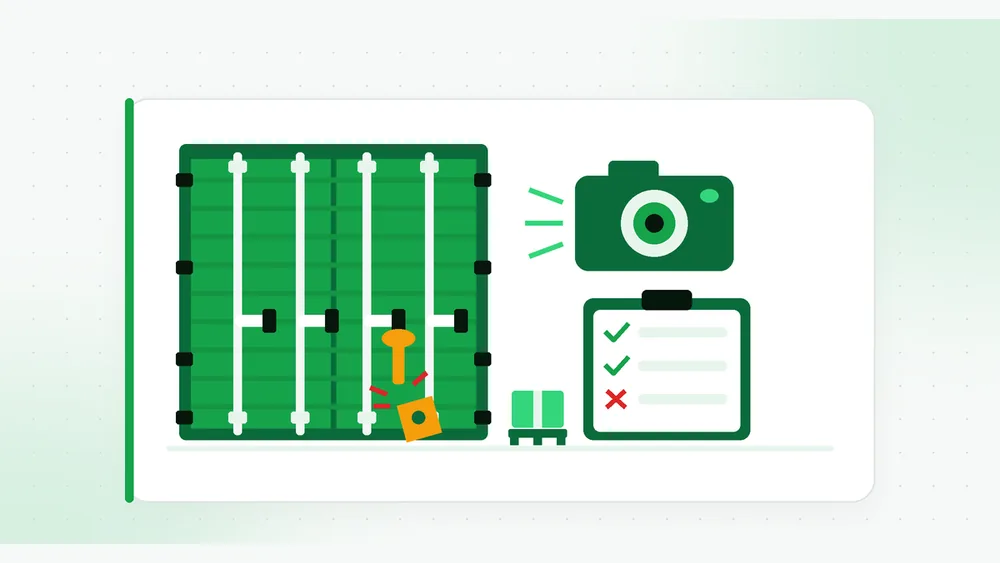
If a container seal is broken, missing or doesn’t match the paperwork, don’t cut it or open the doors. Record the container and seal numbers, photograph the seal and doors, and notify the trucker, the ocean carrier or forwarder, and your customs broker. Open the container only after the parties agree, and with a witness present.
A container seal that’s broken, missing or doesn’t match the paperwork is a security problem first and a freight problem second. CBP’s recommended seal procedures say that before the seal on an inbound shipment is cut, it should be checked with a witness using the View, Verify, Twist and Tug method, and that compromised seals and containers must be reported to CBP or the appropriate foreign authority.[1] Many have an ordinary explanation, but once the doors are open, the evidence of how the container arrived is gone.
In this guide
- Broken, missing or mismatched: three different seal problems
- How to check a seal: View, Verify, Tug, Twist
- What to do if a container seal is broken, step by step
- Who to notify, and what to put in writing
- Opening the container: witness, photos and count
- Does a broken seal mean a CBP exam?
- Filing a loss or damage claim
- Example scenario
- Where a New Jersey dock fits once the container is released
- Frequently asked questions
Key takeaways
- Don’t cut the seal or open the doors until the responsible parties agree.
- Record both seal numbers (door and paperwork) and photograph the seal and doors before anything is touched.
- A “CBP” seal with an unfamiliar number often means an exam; confirm with your broker.
- Customs questions go to your broker; claims go to the carrier and insurer.
Broken, Missing or Mismatched: Three Different Seal Problems
A seal problem is any case where the seal no longer proves the container stayed closed since it was sealed: the seal is cut or tampered with, it’s missing, or its number doesn’t match the shipping documents. CBP’s CTPAT criteria group an incorrect seal number with altered or tampered seals: members’ written seal procedures must cover all three, including documenting the event and communicating with partners.[2]
| Problem | What you see | Possible ordinary explanation | What it can mean otherwise |
|---|---|---|---|
| Broken or tampered | Cut or sheared bolt, a seal that unscrews, damaged rods or hinges | Handling damage, but treat it as tampering until explained | Someone got into the container |
| Missing | No seal on the locking bar | A seal that was never applied or fell off | The box was unsecured for an unknown part of the trip |
| Seal number mismatch | Intact seal, but the number differs from the BOL or delivery order | A customs re-seal after an exam, or a clerical error | A seal was replaced without a record |
CTPAT also lists “an unaccounted new seal has been applied” to a container as an incident that warrants notifying CBP, alongside discovered tampering with a container or high-security seal.[2]
How Do You Check a Container Seal? View, Verify, Tug, Twist
A container seal is only evidence if it is checked before it is cut. CBP’s seal check is the VVTT method. In CBP’s CTPAT criteria the four steps are:[2]
- View the seal and the container locking mechanisms and make sure they are OK.
- Verify the seal number against the shipment documents.
- Tug on the seal to make sure it is affixed properly.
- Twist and turn a bolt seal to make sure its parts don’t unscrew, separate or come loose.
CBP’s CTPAT guidance tells shippers to inspect the doors, handles, rods, hasps, rivets and brackets for tampering before sealing.[3] Check them on arrival too: an intact seal on loosened hardware proves little.
Seal standards: ISO 17712 and where the number should appear
ISO 17712, the international standard for mechanical freight container seals, sorts seals into three strength classes: “I” (indicative), “S” (security) and “H” (high security), and CTPAT requires H-class seals.[4] The standard also requires tamper-indicative features that leave tell-tale evidence when someone tries to defeat a correctly closed seal.[4]
For inbound ocean cargo, the carrier’s cargo declaration to CBP must include the seal numbers for all seals affixed to containers.[5] CBP also recommends printing seal numbers electronically on the bill of lading, which makes it harder to swap a seal and alter the document to match.[3] The federal list of what a motor carrier’s bill of lading must show does not include a seal number,[6] so a notation on the delivery receipt is often the only domestic record of what was on the door.
What to Do if a Container Seal Is Broken: Step by Step
The container broken seal procedure comes down to four things: stop, record, notify and wait for authorization before anyone cuts the seal or opens the doors. CBP’s CTPAT receiving guidance says that when discrepancies or altered or tampered seals are found, you should hold for an investigation.[3]
- Stop. Don’t cut the seal, open the doors or start unloading.
- Record the numbers. Write down the container number, the seal number actually on the door, the number on the bill of lading or delivery order, the time and the driver.
- Photograph before anything is touched. Take a close-up of the seal with the number readable, the seal on the locking bar, both doors, the hinges and rods, and the container number.
- Note an exception on the paperwork. Write “seal broken” or “seal does not match BOL” on the delivery receipt and ask the driver to sign.
- Keep the seal. CTPAT says altered or tampered seals should be retained to aid investigations.[2] Bag and label it once it comes off.
- Notify the parties listed below, by email for a time-stamped record.
- Wait for written authorization to open. From the importer or cargo owner, with the customs broker’s okay on any customs question.
Seal number mismatch? Check for a CBP re-seal first
When CBP inspects a container, officers put on an ISO/PAS 17712 high-security bolt seal marked “CBP” with a unique serial number, place the removed seal inside the container, and notify the appropriate parties of the container number and new seal number before the box reaches the receiving facility.[7] So a CBP-marked seal with an unfamiliar number most likely means an exam took place, but have your customs broker confirm it before you treat the mismatch as explained. A mismatch that looks like a typo still needs confirming in writing from the shipper or carrier.
Who Should You Notify About a Broken Container Seal?
Notify everyone responsible for the container, the cargo and the customs entry: the trucker, the ocean carrier or forwarder, your customs broker, the importer and your cargo insurer. CBP’s CTPAT guidance says compromised seals and containers should be reported to the assigned Supply Chain Security Specialist, the closest port of entry, any relevant law enforcement agencies and affected business partners.[3]
| Party | Why they need to know | What to send |
|---|---|---|
| Drayage carrier | Had custody on the last leg | Signed exception on the delivery receipt, photos |
| Ocean carrier or forwarder | Issued the bill of lading that shows the seal number | Container and seal numbers, photos |
| Customs broker (imports) | Your contact with CBP; can check whether the box was examined | Both seal numbers, photos, time found |
| Importer or cargo owner | Owns the freight and authorizes opening | Everything above; ask for written go-ahead |
| Cargo insurer | Policy notice terms; may send a surveyor | Notice of possible loss, photos |
Report to CBP through your broker
CBP says compromised seals and containers must be reported to CBP or the appropriate foreign authority.[1] How and when that happens for your shipment is a customs question. Work it out with your licensed customs broker; this guide isn’t customs or legal advice. If you suspect theft, call the police as well.
Opening the Container: Witness, Photos and Count
Once the parties agree, follow CBP’s rule for any inbound seal: run the VVTT check with a witness before the seal is cut.[1] The witness can be a carrier representative, a surveyor or a second staff member. Then:
- Photograph the seal, cut it, and bag and label it.
- Photograph the doors as they open, before anyone steps in.
- Look for the original seal inside the doors (CBP leaves it there after an exam) and for opened, re-taped or missing cartons.
- Photograph each tier and count pieces against the packing list.
- Write up shortages and damage; have the witness sign.
CBP recommends that shippers photograph the installed seal at stuffing and forward the images to the destination where feasible,[3] so ask for them and compare.
Does a Broken Seal Mean a CBP Exam?
Not automatically, as far as CBP’s published guidance goes. CTPAT treats tampering with a container or high-security seal as an incident to report to CBP,[2] and federal law lets customs officers inspect merchandise unladen from an arriving vessel whether or not it has already been inspected.[8] Whether a box is examined is CBP’s decision, and your customs broker will hear about it first. If a hold posts, our guide to CBP exam holds explains the exam levels and who pays. If a held box sits unentered too long, see general order cargo.
Filing a Loss or Damage Claim After a Seal Problem
Who pays for missing or damaged cargo depends on where the seal was compromised and which contract of carriage covered that leg. For a U.S. motor carrier, a claim is a written communication that identifies the shipment, asserts the carrier’s liability and claims a specified or determinable amount of money, filed within the time limits in the bill of lading and tariff.[9] The ocean leg runs under the ocean bill of lading and a different liability regime; ask your insurer or claims adviser.
A note on the delivery receipt is evidence, not a claim: notations of shortage or damage on a delivery receipt don’t, on their own, meet the federal minimum requirements for filing one.[9] Who loaded and counted the freight matters too. When the shipper loaded the container and the bill of lading is marked “shipper’s weight, load, and count,” the carrier can avoid liability for goods that were never received or were misdescribed.[10]
Either way, the evidence is the same: both seal numbers, the photos, the signed exception, the retained seal and the witnessed count. Our freight damage claims guide covers building the file.
Example Scenario
This is a hypothetical to illustrate the sequence, not a real shipment. Say a container reaches a warehouse with an intact bolt seal marked “CBP” whose number isn’t on the delivery order. The receiving clerk stops, photographs the seal and doors, notes the mismatch on the delivery receipt and emails the importer and broker. The broker confirms a CBP exam at the port and the new seal number. With the importer’s written go-ahead, the seal is cut in front of a witness, the original seal is inside the doors, and the count matches the packing list. Had the broker found no exam record, the box would have stayed shut while the importer, carrier and insurer decided next steps.
Where a New Jersey Dock Fits Once the Container Is Released
RapidShips is not a customs broker, a carrier or an insurer: we can’t clear a container, report to CBP for you, or decide who is liable. Our part starts once the container is released and opening is authorized, when your trucker brings it to our East Brunswick dock:
- Receiving and unloading it with photos and a written record, through our container unloading and devanning service.
- Rebuilding pallets or cartons disturbed in transit or during an exam, through freight rework.
- Moving the freight onto domestic trailers with transloading so the empty can go back.
- Holding the freight in short-term storage while a survey or claim is sorted out, or recovering a load a receiver has rejected.
If a seal is already in question, tell us before dispatch so the unload is booked once authorization is in writing. Call 800-376-2808 or send us the container details.
Frequently Asked Questions
What should I do if a container seal is broken on arrival?
What is the container broken seal procedure?
Can I open a container if the seal number doesn’t match the BOL?
Who is responsible for a broken container seal?
Does a broken seal trigger a customs exam?
What photos should be taken before opening a container?
How do I report cargo missing from a container with a broken seal?
Is a replacement seal applied after inspection, and who records it?
Sources
- U.S. Customs and Border Protection, "Recommended Seal Procedures Including Best Practices," accessed September 2026.
- U.S. Customs and Border Protection, "CTPAT Minimum Security Criteria – U.S. Importers," October 2021, criteria 6.1, 6.7 and 7.23, accessed September 2026.
- U.S. Customs and Border Protection, "CTPAT Job Aid: Seal Security Procedures," October 2021, accessed September 2026.
- U.S. Customs and Border Protection, "C-TPAT Bulletin: Compliance with ISO’s 17712 Standards for High Security Seals," April 2014, accessed September 2026.
- Legal Information Institute, Cornell Law School, "19 CFR § 4.7a – Inward manifest; information required; alternative forms," accessed September 2026.
- Legal Information Institute, Cornell Law School, "49 CFR § 373.101 – Motor carrier bills of lading," accessed September 2026.
- U.S. Customs and Border Protection, "Containerized Cargo Sealing Policy," accessed September 2026.
- Legal Information Institute, Cornell Law School, "19 U.S. Code § 1467 – Special inspection, examination, and search," accessed September 2026.
- Legal Information Institute, Cornell Law School, "49 CFR § 370.3 – Filing of claims," accessed September 2026.
- Legal Information Institute, Cornell Law School, "49 U.S. Code § 80113 – Liability for nonreceipt, misdescription, and improper loading," accessed September 2026.
This guide is general operational information, not legal or regulatory advice. Rules change; confirm current requirements with the relevant agency or your carrier before acting.