
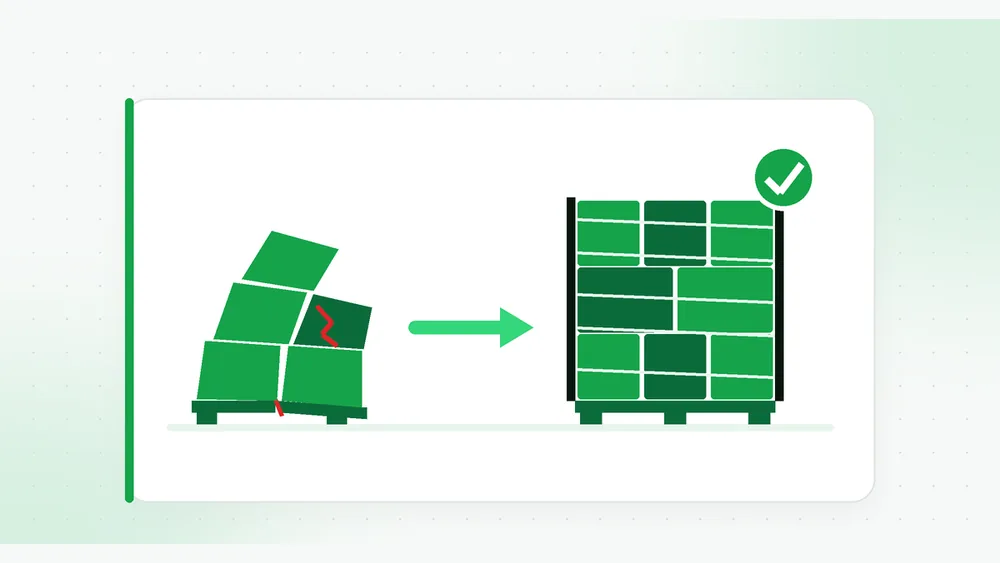
Rebuilding a damaged pallet means unloading it in a controlled way, photographing it, pulling damaged cartons aside, moving sound cartons to a new pallet in a stable pattern with heavy items low and no overhang, then stretch-wrapping, adding corner boards, re-weighing and documenting the result before it is loaded and secured again.
A pallet that has leaned, collapsed or broken in transit has already shown you where the load was weak. A rebuild fixes that weakness instead of recreating it. Federal workplace rules require stored material in tiers to be stacked, blocked, interlocked and limited in height so it is stable and secure against sliding or collapse[1], and cargo on the road must be secured so it does not shift enough to affect the vehicle's stability.[2] Between those two rules sits the physical work: inspecting the load, separating the damage, choosing a stacking pattern, and wrapping and checking the finished unit. This guide walks through each step as a dock crew would do it.
In this guide
- Why pallets fail in transit
- Step 1: Controlled unload and inspection
- Step 2: Segregate damaged cartons
- Step 3: Start on a sound pallet
- Step 4: Column vs. interlock stacking
- Step 5: Weight low, no overhang
- Step 6: Stretch wrap, corner boards and caps
- Step 7: Re-weigh, document and re-secure
- Example scenario
- Getting a rebuild done near Port Newark
- Frequently asked questions
Why Pallets Fail in Transit
Most pallet failures trace back to one of a few causes. Knowing which one applies tells you what the rebuild has to change:
| What you see | Likely cause | What the rebuild changes |
|---|---|---|
| Bottom-tier cartons crushed, upper tiers intact | Too much weight on cartons that could not carry it, or cartons weakened by moisture or gaps in the pallet deck | Heavier or stronger cartons at the bottom, full deck support, possibly fewer tiers |
| Whole stack leaning to one side | Column-stacked load with too little containment, or a cracked stringer | New pallet, interlocked upper tiers, more wrap and corner boards |
| Top tier slid off | Loose top layer, no cap or tie sheet, hard braking | Interlocked top layer, top cap, wrap carried over the top edge |
| Cartons torn at the edges | Overhang past the pallet edge, contact with other pallets or walls | Cartons pulled back within the pallet footprint |
| Deck board or block broken | Damaged pallet, forklift impact, or point loading | Replace the pallet entirely |
If the whole trailer has moved rather than one pallet, treat it as a shifted load first: the securement and load plan need attention as well as the individual pallets.
Step 1: Controlled Unload and Inspection
An unstable pallet is a hazard to the person moving it. OSHA's rule for powered industrial trucks says only stable or safely arranged loads may be handled, and operators must use caution with off-center loads that cannot be centered.[3] A leaning pallet may need to be hand-unloaded in the trailer, or taken down tier by tier, rather than lifted whole.
- Photograph the pallet as found, from all four sides, before anyone touches it
- Record the trailer or container number, seal, and pallet position in the load
- Check the pallet itself: cracked stringers or blocks, broken or missing deck boards, protruding nails
- Note how the load was contained: wrap, straps, corner boards, caps, or none
- Count cartons by SKU against the packing list before breaking the stack down
Step 2: Segregate Damaged Cartons
Take the stack down one tier at a time and sort every carton into one of three groups:
- Sound. No visible damage to carton or contents. Goes back on the rebuilt pallet.
- Packaging damage only. Carton scuffed, torn or crushed at a corner but product intact. May be re-cartoned or over-boxed depending on the receiver's requirements.
- Product damage. Contents broken, wet, leaking or exposed. Held aside with its packaging, not restacked.
A weakened carton should not go back into the bottom tiers of a new stack. Its compression strength is already compromised, and it will fail again under load. Damaged units are also evidence if anyone files a freight damage claim, so photograph them, count them by SKU, and keep them with their packaging in a marked hold area.
Step 3: Start on a Sound Pallet
If the original pallet has any broken component, replace it. A patched pallet under a rebuilt stack is the most common reason the same load fails twice.
- Match the footprint. Use a pallet the same size as the original, or one the receiver specifies, so the load still fits the trailer plan and the receiver's racking.
- Check the deck. Research on unit loads has found that gaps between deck boards reduce the compression strength of corrugated boxes resting on them.[4] Where cartons are light-walled, a pallet with more deck coverage or a slip sheet on the deck helps.
- Check export requirements. If the freight is going on to an international shipment, the replacement pallet may need to meet the destination's wood packaging rules.
Step 4: Column vs. Interlock Stacking
This is the main decision in any rebuild, and it is a trade-off between strength and stability.
Each carton sits directly on top of the carton below, corner on corner. Because a box carries most of its load at the corners, this gives the highest compression strength, but it produces separate columns that can lean or split apart.
Each tier is rotated or offset from the one below, like brickwork, so cartons bridge across the ones beneath them. This ties the load together and improves stability, but moves load from the strong corners onto the weaker carton walls.
A Virginia Tech master's thesis on unit loads summarizes the research this way: interlocking shifts load from box corners to the less resistant walls, with reported reductions in box load-carrying capacity of between 35% and 55% depending on conditions, while columnar stacks tend to be unstable and need additional containment to hold together.[4] The same study found that interlocking the layers reduced pallet deflection by up to 53% compared with column stacking on a low-stiffness pallet.[4]
In practice, many rebuilds use a hybrid: column-stack the lower tiers, where the weight is, and interlock the top tiers to tie the stack together. The Virginia Tech study tested two patterns built this way, with the bottom layers column-stacked and the upper layers interlocked.[4] Stability guidelines cited in that work also suggest each box should rest on at least two boxes below it and the pattern should avoid straight "guillotine" cuts that split the load into independent columns.[4]
Follow the shipper's pattern if there is one
Some shippers and retailers specify a stacking pattern, tier count or maximum height. If a spec exists, the rebuild should match it, and any deviation should be noted in the rework record.
Step 5: Weight Low, No Overhang
- Heaviest cartons on the bottom. Put the heaviest and strongest cartons in the bottom tiers and lighter or crushable items on top.
- Keep the load within the pallet edges. Overhanging cartons lose support at their edges and are exposed to impact from forklifts, trailer walls and neighbouring pallets. Research cited in the Virginia Tech study identified a reduction in box compression strength from overhang, although it was not quantified.[4]
- Build square and level. Each tier should be flat before the next goes on. Fill gaps inside a tier with dunnage rather than leaving voids that let cartons shift.
- Watch height. OSHA requires tiered storage to be limited in height so it stays stable.[1] The receiver's dock, racking and the trailer's door height also set practical limits.
Step 6: Stretch Wrap, Corner Boards and Caps
Containment turns a stack of cartons into one unit. Common methods include stretch wrapping, stretch hooding, strapping and tie sheets, and the amount needed depends on how stable the stack is on its own.[4] A column-stacked load needs more containment than an interlocked one.
- Anchor the wrap to the pallet. Start with several turns around the base that catch the pallet itself, not just the bottom tier. Wrap that stops above the deck lets the whole stack slide off the pallet.
- Work up with overlap. Spiral up with each pass overlapping the last, adding extra turns at tier seams and at the top.
- Add corner boards. Vertical corner boards spread the wrap and strap force, protect carton edges, and add some column support.
- Cap the top. A top sheet or cap under the final wraps keeps the top tier from lifting or sliding.
- Do not over-tension. The same research notes that too much containment force can damage packages.[4] Wrap should hold the load tightly without crushing carton edges.
Step 7: Re-Weigh, Document and Re-Secure
A rebuild changes the pallet's weight (new pallet, removed cartons, added materials) and possibly its dimensions. Before it goes back on a truck:
- Weigh the rebuilt pallet and update the weight on the pallet label and the load paperwork
- Record final carton count by SKU, and the count of units held aside as damaged
- Photograph the finished pallet from all four sides, with its label visible
- Relabel if the receiver's labels were damaged or the count changed
- Note the stacking pattern and materials used in the rework record
Then the pallet has to be secured in the trailer. The federal cargo securement rules require cargo to be firmly immobilized or secured by structures of adequate strength, dunnage or dunnage bags, shoring bars, tiedowns, or a combination of these.[5] The securement system has to withstand forces of 0.8 g deceleration forward and 0.5 g rearward and lateral.[6] A well-built pallet that sits loose in the trailer can still shift, so load bars, straps or void fill are part of the fix. If the total load is close to legal limits after rework, check the axle weights as well.
Example scenario
Say a shipper sends a 40-foot container of cased beverages from Port Newark to a transload dock. On devanning, one pallet has lost its top two tiers and the bottom tier is crushed on one side where it overhung a broken deck board. The crew photographs it in place, hand-unloads the loose cartons, and sorts them: most are sound, a handful have wet or crushed cases, and those are counted and set aside with their packaging.
The sound cartons go onto a new pallet of the same size. The heaviest cases form the bottom tiers, column-stacked and pulled in flush with the pallet edges; the top two tiers are interlocked. The pallet gets corner boards, a top cap and stretch wrap anchored to the pallet base. It is weighed, relabeled with the new count and weight, photographed, and staged for the outbound trailer with a short rework note listing what was removed and why.
Getting a Rebuild Done Near Port Newark
Pallet rebuilding needs dock doors, forklifts, replacement pallets, wrap and corner boards, and a crew that can work carefully around unstable freight. It is rarely something a driver can do at a truck stop or a receiver will do for free.
At our 24/7 facility in East Brunswick, NJ, pallet rebuilds are part of our freight rework service. They often come up alongside other jobs: a shifted load that needs restacking before it can continue, a container being transloaded into a domestic trailer, or a load that needs pallets redistributed during an overweight correction. We photograph the freight as received and as rebuilt so you have a record for your customer or your claim file.
If you have a damaged pallet on a trailer now, call 800-376-2808 or send us the details to arrange a dock slot.
Frequently Asked Questions
Is column stacking or interlock stacking better for a rebuilt pallet?
Can I reuse the original pallet if only one board is broken?
What should happen to damaged cartons during a rebuild?
Why re-weigh a pallet after rebuilding it?
Does stretch wrap alone make a pallet safe to ship?
Sources
- Legal Information Institute, Cornell Law School, "29 CFR § 1910.176 – Handling materials – general," accessed September 2026.
- Legal Information Institute, Cornell Law School, "49 CFR § 393.100 – Which types of commercial motor vehicles are subject to the cargo securement standards of this subpart, and what general requirements apply?," accessed September 2026.
- Legal Information Institute, Cornell Law School, "29 CFR § 1910.178 – Powered industrial trucks," accessed September 2026.
- Virginia Tech, Center for Unit Load Design (E. Molina Montoya, M.S. thesis, 2017), "Investigation of Pallet Stacking Pattern on Unit Load Bridging," accessed September 2026.
- Legal Information Institute, Cornell Law School, "49 CFR § 393.106 – What are the general requirements for securing articles of cargo?," accessed September 2026.
- Legal Information Institute, Cornell Law School, "49 CFR § 393.102 – What are the minimum performance criteria for cargo securement devices and systems?," accessed September 2026.
This guide is general operational information, not legal or regulatory advice. Rules change; confirm current requirements with the relevant agency or your carrier before acting.