
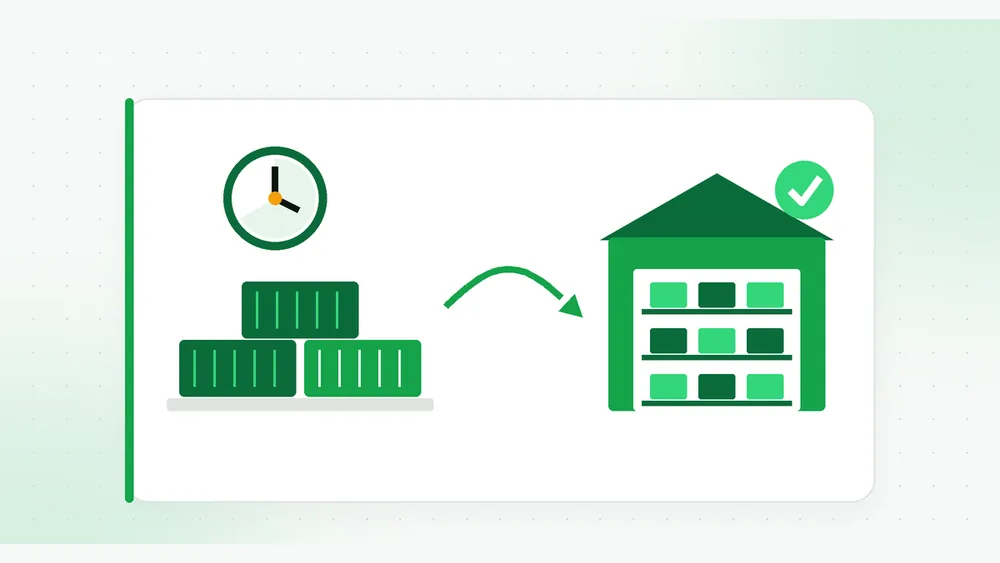
Pulling a container into short-term storage beats paying demurrage when the consignee cannot receive for several days and the extra costs — the drayage move, handling in and out, storage days and the final delivery leg — add up to less than the daily demurrage and per diem you would otherwise accrue. Devanning and returning the empty stops both clocks.
Every day an import container sits past free time, somebody is paying for terminal land and equipment they are not using to move freight. The Federal Maritime Commission (FMC) describes demurrage as the charge that accrues when a container exceeds free time on a marine terminal, and detention as the charge for extended use of intermodal equipment.[1] Neither charge buys you anything except time. Short-term storage off the terminal also costs money, so the real question is not “should we avoid demurrage?” but “which way of waiting is cheaper, and which one keeps our options open?”
In this guide
- What the terminal clock is actually charging for
- The trade-off in one comparison
- When pulling to storage usually wins
- When staying put is the better call
- Example scenario
- Checklist before you pull the box
- Check the invoice either way
- Where a NJ storage and cross-dock facility fits
- Frequently asked questions
What the Terminal Clock Is Actually Charging For
The FMC’s rule on unreasonable demurrage and detention practices treats the two terms broadly: they cover any charges, including “per diem,” assessed by ocean carriers, marine terminal operators, or ocean transportation intermediaries for the use of marine terminal space or shipping containers, not including freight charges.[2] The same rule says these charges are supposed to work as financial incentives to keep freight moving.[2] That framing matters for your decision: the charges are designed to hurt more the longer the box stays, so the longer your delay, the stronger the case for moving the freight somewhere cheaper to wait.
| Demurrage | Detention / per diem | |
|---|---|---|
| What it pays for | The loaded container occupying terminal space past free time | Extended use of the carrier’s container (and sometimes chassis) outside the terminal |
| Where the box is | On the terminal | Out of the terminal, loaded or empty, until returned |
| What stops it | Getting the box out of the terminal | Returning the empty container |
| Where to find the rate | The applicable tariff rule named on the invoice, along with the free time and its start and end dates | |
The last row is not a guess. Under the FMC’s billing rule, a compliant demurrage or detention invoice has to show the allowed free time in days, the start and end dates of free time, the applicable tariff rule, and the specific rate or rates.[3] Those fields are your inputs for the comparison below. Rates, free time and tiering vary by carrier, terminal and contract, so this guide deliberately does not quote numbers — use the ones on your own paperwork.
The Trade-Off in One Comparison
Strip the decision down to the days you expect to wait (call it n) and two columns of cost.
Demurrage for each day past free time, plus per diem once the box eventually leaves and until the empty is returned, plus one drayage move straight to the consignee at the end.
One drayage move to the storage facility, devanning and receiving, storage for n days (usually priced per pallet or per space), handling out, the final delivery leg, and per diem only until the empty goes back.
Two details swing the math more than people expect:
- Parking the box loaded only stops one clock. If the container is pulled out and simply parked, still loaded, in a yard, demurrage stops but detention keeps running until the empty is returned. The version of Option B that stops both clocks is devan, then return the empty.
- The last mile changes. Once the freight is palletized in a warehouse, the final delivery may move on a standard dry van or box truck instead of a container on a chassis, and it can be split across several consignees. That can make the final leg cheaper, or simply possible when the receiver cannot take a 40-foot container.
A simple rule of thumb
If (daily demurrage + daily per diem) × days of delay is larger than (extra drayage + handling in and out + storage for those days), pulling the freight wins on cost alone. If the numbers are close, the tie usually goes to storage, because freight in a warehouse can be split, inspected or reworked, and a box on the terminal cannot.
When Pulling to Storage Usually Wins
- The consignee cannot receive for more than a few days — a closed DC, a full receiving calendar, a construction site that is not ready, or a retail appointment that keeps slipping.
- Your tariff escalates. If the tariff rule named on your invoice charges a higher daily rate after the first days past free time, check where your delay lands. The later tiers are where storage looks cheapest by comparison.
- The freight is going to more than one place. Splitting a container at a warehouse is a normal cross-dock job; splitting it on a terminal is not an option.
- The freight needs work anyway — relabeling, repalletizing, a count, or damage inspection. If it has to be handled once for rework, storage adds little extra handling.
- You want the empty back early. Devanning promptly lets the empty go back while the freight waits, which is the only way to stop per diem before the consignee is ready.
When Staying Put Is the Better Call
- The delay is short. If the consignee can receive within free time, or a day past it, the extra drayage and handling usually cost more than the charges you avoid.
- The box is not released. A container with a customs or carrier hold cannot be picked up for storage. Under the general order statute, when imported merchandise is not entered within the time provided by law or regulation, the carrier notifies a bonded warehouse, which moves and stores it at the consignee’s risk and expense — storage you did not choose.[4]
- The freight is hard to handle twice. Heavy machinery, oversized crates, or fragile product may cost more in handling and risk than a few days of charges.
Example Scenario
This is a hypothetical illustration using placeholders, not real rates or a real shipment.
Say a shipper has one 40-foot import container at a Port Newark terminal, released by customs and the carrier, with free time ending tomorrow. The consignee’s warehouse has told them it cannot take delivery for n days. The shipper pulls the invoice fields and the tariff: a daily demurrage rate D and a daily per diem rate P. A storage facility quotes drayage to its dock T1, handling in and out H, and a storage rate s per pallet per day for p pallets.
| Cost line | A: leave on terminal | B: devan into storage |
|---|---|---|
| Demurrage | D × days past free time | None, if picked up within free time |
| Per diem | P × days from pickup to empty return | P × days from pickup to empty return (short, if devanned promptly) |
| Drayage | T0: terminal to consignee | T1: terminal to storage |
| Handling | None | H |
| Storage | None | s × p × n |
| Final delivery | Included in T0 | T2: storage to consignee |
The shipper then asks one question: does the demurrage line in column A exceed (T1 + H + s×p×n + T2 − T0)? If yes, storage is cheaper. Because demurrage grows with every day of delay and the drayage and handling lines do not, there is a break-even number of days; past it, every extra day favors storage. Run the same table again whenever the consignee’s date moves.
Checklist Before You Pull the Box
- Confirm the container is released by customs and by the carrier, and that freight and terminal charges are settled
- Read the free time, its start and end dates, and the tariff rule off the invoice or carrier notice
- Book a terminal pickup appointment and confirm a chassis is available
- Confirm the storage facility can devan the container type and freight (floor-loaded cartons vs. pallets)
- Confirm the empty return location and appointment so per diem actually stops
Check the Invoice Either Way
Whether you pull the box or not, the demurrage and detention bills that do arrive have to meet the FMC’s billing rule, which took full effect on May 28, 2024.[5] A few provisions are worth knowing before you pay:
- Required contents. Invoices must include identifying information (bill of lading and container numbers), timing information (free time and its dates), rate information, and dispute contact details.[3] Leaving out any required information eliminates the billed party’s obligation to pay that charge.[6]
- Invoice timing. The billing party must issue the invoice within 30 calendar days from the date the charge was last incurred; if it does not, the billed party has no obligation to pay.[7]
- Your window. Billed parties have at least 30 calendar days to request fee mitigation, a refund or a waiver.[8]
- Who gets billed. Invoices can go only to the party that contracted for the ocean transportation or storage, or to the consignee.[8]
- If it is wrong. Recipients of non-compliant invoices can negotiate with the carrier, file a charge complaint, or ask the FMC’s Office of Consumer Affairs and Dispute Resolution Services for help.[5]
Detention charged when an empty container cannot be returned is an example the FMC says is likely to be found unreasonable, because it no longer serves its incentive purpose.[2] Keep records of rejected return appointments; they matter in a dispute.
Where a NJ Storage and Cross-Dock Facility Fits
RapidShips runs a 24/7, asset-backed warehouse and cross-dock operation at 25A Cotters Lane in East Brunswick, NJ, serving the Port Newark and Elizabeth corridor. We are not a freight broker or a customs broker, so the release and paperwork side stays with your broker and carrier; our part is the physical work once the box is released.
In practice that means receiving the container, devanning it so the empty can go back, and holding the freight in short-term warehouse storage until the consignee is ready. If the freight is headed to more than one receiver or needs a domestic trailer, it can move on through transloading instead of sitting. If it arrives with problems — crushed cartons, mixed SKUs, labels that will not pass a retailer’s receiving — freight rework can happen while it waits rather than as a separate trip.
Running the numbers on a box right now?
Call with the container’s free-time date, the freight type, and when the consignee can receive, and we will tell you what the storage side of the comparison would involve.
800-376-2808 — 24/7 dock commandFrequently Asked Questions
Does pulling a container off the terminal stop demurrage and detention?
How do I know if short-term storage is cheaper than paying demurrage?
Can I move a container to storage if it has a customs hold?
What should a demurrage invoice show?
Is short-term storage only worth it for long delays?
Sources
- Federal Maritime Commission, "Detention and Demurrage," accessed September 2026.
- Legal Information Institute, Cornell Law School, "46 CFR § 545.5 – Unjust and unreasonable practices with respect to demurrage and detention," accessed September 2026.
- Legal Information Institute, Cornell Law School, "46 CFR § 541.6 – Contents of invoice," accessed September 2026.
- Legal Information Institute, Cornell Law School, "19 U.S. Code § 1490 – General orders," accessed September 2026.
- Federal Maritime Commission, "Final Rule on Demurrage & Detention Cleared to Take Full Effect May 28," accessed September 2026.
- Legal Information Institute, Cornell Law School, "46 CFR § 541.5 – Failure to include required information," accessed September 2026.
- Legal Information Institute, Cornell Law School, "46 CFR § 541.7 – Issuance of demurrage and detention invoices," accessed September 2026.
- Federal Maritime Commission, "FMC Publishes Final Rule on Detention and Demurrage Billing Practices," accessed September 2026.
This guide is general operational information, not legal or regulatory advice. Rules change; confirm current requirements with the relevant agency or your carrier before acting.