
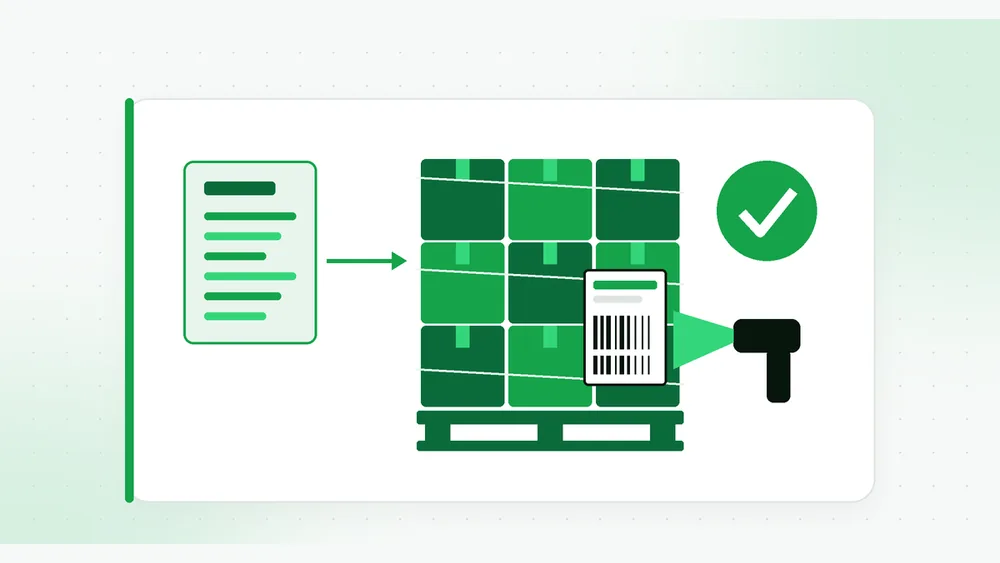
Retail compliance relabeling means correcting cartons and pallets so they match a retailer's routing guide before delivery: scannable GS1-128 labels carrying an SSCC, labels in the specified positions, pallets built to the retailer's height and footprint rules, and contents that agree with the Advance Ship Notice. Fixing it before the appointment is what avoids the chargeback.
A retailer's distribution center does not argue with a pallet; it scans it. If the barcode on the label will not read, if the SSCC it carries is not on the Advance Ship Notice (ASN), or if the pallet is built taller or wider than the routing guide allows, receiving has to stop and handle it by exception. That extra handling is what vendor compliance programs are designed to charge back. The upside is that most of these failures are physical and fixable: labels can be reprinted and reapplied, pallets rebuilt, cartons re-sorted, and the finished result photographed before the load goes anywhere near the dock door.
In this guide
- What retailer compliance actually covers
- The labels that matter: SSCC, GS1-128 and case codes
- Where labels go on pallets and cartons
- ASN matching: why the label and the data must agree
- Common failures that lead to chargebacks
- How a relabel and re-palletize job works
- Example scenario
- Getting it fixed near Port Newark
- Frequently asked questions
- Sources
What Retailer Compliance Actually Covers
Large retailers typically publish two kinds of documents for suppliers. A routing guide governs how freight moves: which carriers or modes to use, how to book delivery appointments, and when paperwork has to be transmitted. A vendor compliance manual (the name varies) governs how freight is packed, labeled and documented. Your vendor agreement normally makes both binding, and the penalty side, usually called chargebacks, deductions or non-compliance fees, lives in those same documents.
Because every retailer writes its own rules and revises them regularly, there is no universal fee table and this guide does not quote one. What is consistent across retailers is the set of things they check:
- Labels: the right label format, the right data, readable barcodes, in the right place on every carton and pallet.
- Electronic data: an ASN sent on time, matching what is physically on the truck.
- Pallet build: pallet type and condition, maximum height and weight, no overhang, single-item or clearly identified mixed pallets.
- Carton specs: carton condition, pack quantity and case marking.
- Transportation: appointment, carrier and paperwork such as the bill of lading.
Chargebacks are contractual, not regulatory
No government agency sets retail compliance fees. The requirement and the penalty both come from your agreement with the retailer, so the dispute path runs through that agreement, and the best evidence you can bring is a dated photo record of what actually shipped.
The Labels That Matter: SSCC, GS1-128 and Case Codes
The core of almost every retail logistics label is the Serial Shipping Container Code (SSCC). GS1 US describes it as an 18-digit identifier assigned to a logistics unit, meaning any combination of items such as cases or pallets packaged together for transport, which acts as a license plate for tracking that unit through the supply chain.[1] It is built from an extension digit, the company's GS1 Company Prefix, a serial reference and a check digit.[2] GS1 US also notes that many major retailers and logistics partners require SSCCs for pallets, packages and smaller parcel shipments.[1]
The SSCC is typically encoded in a GS1-128 barcode printed on a GS1 logistics label.[1] GS1-128 uses Application Identifiers that tell the scanner what kind of data follows and in what format, and it can carry up to 48 characters, including attributes such as batch or lot number, serial number or country of origin.[3] Case-level product identification is a different code: an ITF-14 barcode encodes a GTIN in 14-digit format, is designed for cases and pallets that are not sold at point of sale, and can be printed directly on corrugate.[4]
| Identifier | What it identifies | Usual barcode | Where you see it |
|---|---|---|---|
| SSCC | One specific logistic unit: this pallet, this carton | GS1-128 | Pallet and carton shipping labels |
| Case GTIN | The product and pack configuration inside a case | ITF-14 (or GS1-128) | Printed on the carton or on a case label |
| PO, ship-to, store or DC number | Where the unit is going and on which order | Human-readable, sometimes barcoded | Label zones defined by the retailer's guide |
The SSCC deliberately does not contain the GTIN. According to GS1 US, the product information travels in the ASN, and the SSCC is the license plate that links the physical unit to that data.[2] That split is exactly why label errors and data errors so often show up together.
Where Labels Go on Pallets and Cartons
GS1 US guidance for pallets is specific. Each pallet should carry at least one SSCC barcode, and a second label on an adjacent side is recommended so the pallet can still be scanned when it is turned sideways in a trailer or on a rack. The label should sit on the upper right half of the side, 16 to 32 inches from the base of the pallet and at least 2 inches from the vertical edge.[2]
Retailer guides generally build on that standard and add their own diagrams for carton labels: which panel, how far from the bottom and edges, and whether a label may sit near a seam. Where the retailer's diagram differs from general guidance, the retailer's diagram is the one that decides the chargeback for that customer. On the dock, the practical checks are simple:
- The label is flat, not wrapped around a corner or folded over a carton seam
- Strapping, corner boards or banding do not cross the barcode
- Stretch wrap over the label is smooth and not layered so thick it glares under a scanner
- Obsolete labels are removed or fully covered so only one scannable SSCC shows per unit
- Every pallet label faces out on the sides the guide specifies
- No new label covers a country-of-origin marking on imported goods
ASN Matching: Why the Label and the Data Must Agree
The ASN is the electronic description of what is on the truck, built pallet by pallet and carton by carton. GS1 US explains the pay-off: one scan of the SSCC at the receiving bay can be linked to a pre-received electronic ASN describing the contents, which speeds receiving, reconciliation and put-away.[2] The flip side is that a perfectly printed, perfectly placed label still fails if the SSCC on it is not in the ASN, or if the ASN says the pallet holds something it does not.
One GS1 rule matters for every rework job: if a logistic unit is broken down and repacked, a new SSCC needs to be assigned to the new unit.[2] In other words, re-palletizing is never just a physical job. Rebuilt pallets need new SSCC labels, and the ASN has to describe the new pallets.
| Mismatch | What it looks like at receiving | Fix |
|---|---|---|
| SSCC not on the ASN | Scan returns no match | Relabel from the vendor's labeling system, or correct the ASN before it is sent |
| Quantity differs | Physical carton count does not equal ASN count | Physical recount per pallet, then correct the ASN or the pallet |
| Wrong hierarchy | Cartons listed on pallet A are physically on pallet B | Rebuild to match, or send an ASN that reflects the actual build |
| Duplicate labels | Two units share one SSCC, or one unit shows two | Remove extras; issue a new SSCC where required |
Who owns the data
SSCCs are built on the vendor's GS1 Company Prefix and the ASN comes from the vendor's system or its EDI provider. The dock crew's job is to apply labels generated from that data and report back an exact count of which cartons are on which rebuilt pallet, so the ASN can be corrected before the retailer's cutoff. Nobody on the floor should be making up label numbers.
Common Failures That Lead to Chargebacks
| Failure | What receiving sees | Physical fix |
|---|---|---|
| Missing or unreadable pallet label | Unit cannot be scanned; manual receipt | Print and apply new labels on two adjacent sides |
| Label in the wrong position | Missed scans, manual handling | Remove and reapply per the retailer's diagram |
| Carton labels missing or on the wrong panel | Cartons cannot be sorted automatically | Label every carton on the specified panel |
| Pallet over height or overhanging | Pallet refused or reworked at the DC | Rebuild to the height and footprint in the guide |
| Mixed items where single-item pallets are required | Pallet has to be broken down at receiving | Sort by item and rebuild, or label as mixed if allowed |
| Wrong or damaged pallet | Unsafe or non-spec pallet refused | Transfer the load to a compliant pallet |
| Crushed or re-taped cartons | Damage exception at receiving | Replace outer cartons where the product owner authorizes it |
How a Relabel and Re-Palletize Job Works
A compliance rework is only as good as the spec it is built to, so the job starts with paperwork, not a pallet jack.
- Get the spec. The current routing guide pages that apply, the label format, the PO, and the ASN or packing list for the shipment.
- Photograph as found. Every pallet from its label sides, plus any damage, before anything is touched.
- Audit and count. Cartons per pallet, items per carton where needed, and PO numbers, compared line by line against the ASN.
- Rebuild pallets. Transfer to the specified pallet type, build square to the height and footprint in the guide, and stack so the load is stable. OSHA's general rule is that material stored in tiers must be stacked, blocked, interlocked and limited in height so it is stable and secure against sliding or collapse.[5]
- Apply labels. New SSCC labels for every rebuilt unit, generated from the vendor's system; carton labels on the correct panel; old labels removed or fully covered.
- Wrap and protect. Stretch-wrap, and add corner boards or banding if the guide calls for them, keeping label faces flat and readable.
- Scan-verify. Scan every label and reconcile the scan list against the corrected ASN before release.
- Photograph the finished pallets. Label sides, full height, date-stamped, filed with the PO for any later dispute.
Never cover the country-of-origin marking
On imported goods, compliance labels must go around origin marking, not over it. CBP warns that any person who removes, destroys, alters, covers or obliterates country-of-origin marking with intent to conceal it could face prosecution,[6] and the statute sets criminal fines for that conduct.[7] If the origin marking itself is wrong, that is a customs problem, covered in our guide to fixing country-of-origin marking errors.
Example Scenario
This is a hypothetical to show how the steps fit together. Say a shipper's floor-loaded import container is devanned and palletized for a big-box DC delivery, and a pre-shipment check turns up three problems: pallet labels printed from an outdated template, carton labels on the wrong panel, and two pallets built with mixed items where the guide asks for single-item pallets.
The crew photographs everything as found, then sorts the two mixed pallets by item and rebuilds them, which changes the pallet count. The vendor's labeling system issues new SSCC labels for every rebuilt pallet and a corrected ASN that reflects the new carton-to-pallet structure. The crew applies pallet labels on two adjacent sides within the placement window, relabels the cartons on the specified panel without covering the origin marking, wraps, scans every label against the new ASN, photographs the finished pallets, and holds the load for the retailer's appointment.
Getting It Fixed Near Port Newark
RapidShips is a 24/7, asset-backed warehouse and cross-dock facility at 25A Cotters Lane in East Brunswick, NJ, serving freight moving through the Port Newark and Elizabeth corridor. Relabeling, re-palletizing, re-wrapping and photo documentation are part of our freight rework service. If the corrected ASN or a new delivery appointment is not ready yet, the rebuilt pallets can sit in short-term storage rather than on a trailer, and once they are compliant they can move straight out through our cross-dock operation.
We are not a freight broker and we do not negotiate chargebacks with retailers. We do the physical work to the spec you send us and give you the photo record. Send the routing guide pages and the PO through our contact form, or call 800-376-2808 to line up labor before the freight arrives.
Frequently Asked Questions
What is a retail chargeback?
What is an SSCC label?
Can I reuse the old SSCC after re-palletizing?
Where should the pallet label go?
Can relabeling cover the country-of-origin marking on imported cartons?
Sources
- GS1 US, "Serialized Shipping Container Codes (SSCC)," accessed September 2026.
- GS1 US, "An Introduction to the Serial Shipping Container Code (SSCC), Release 3.0, February 2019," accessed September 2026.
- GS1 US, "What is a GS1-128 barcode?," accessed September 2026.
- GS1 US, "What is an ITF-14 Barcode?," accessed September 2026.
- Legal Information Institute, Cornell Law School, "29 CFR § 1910.176 – Handling materials – general," accessed September 2026.
- U.S. Customs and Border Protection, "Marking of Country of Origin on U.S. Imports," accessed September 2026.
- Legal Information Institute, Cornell Law School, "19 U.S. Code § 1304 – Marking of imported articles and containers," accessed September 2026.
This guide is general operational information, not legal, contractual or customs advice. Retailer requirements and fees are set by each retailer’s own routing guide and vendor agreement and change often; always work from your customer’s current documents.