
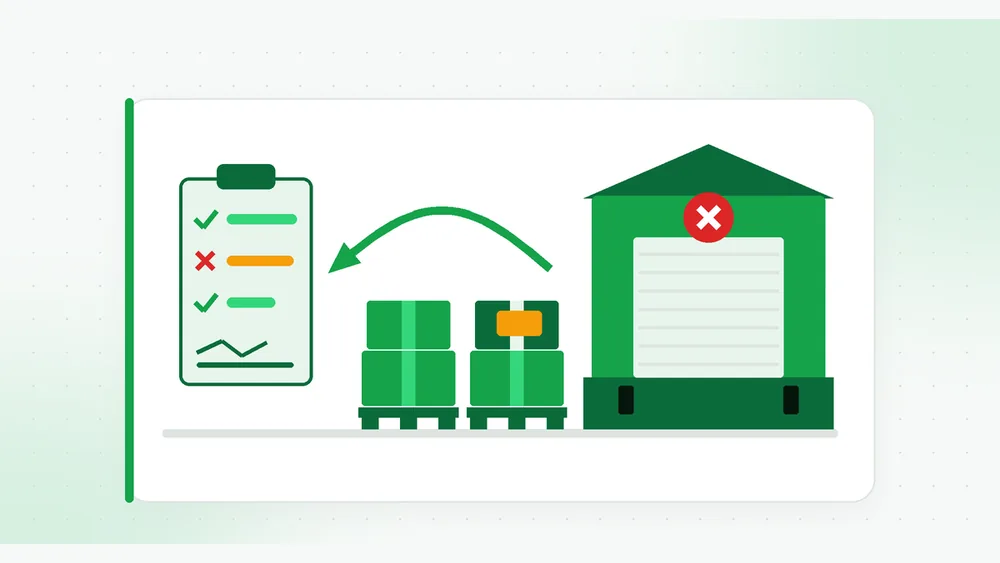
When freight is rejected by the receiver, get the refusal reason written on the delivery receipt, photograph the load before it moves, and call dispatch and the shipper or broker before leaving the dock. The owner of the goods then decides: rework and redeliver, hold for a new appointment, return to the shipper, or salvage. The carrier needs those instructions in writing.
Freight rejected by the receiver is a paperwork problem and a physical problem at the same time, and the first hour decides how expensive it gets. A distribution center that refuses a delivery sends the trailer back out the gate with the freight still on it, and the driver, dispatcher, broker and shipper all need to act on the same facts. Below: the common refusal reasons and their fixes, the first-hour steps for each party, the paperwork, who pays, and how to choose between returning, reworking and holding refused freight.
In this guide
- What it means when a receiver rejects a shipment
- Why receivers refuse freight: reason and fix
- What to do if a receiver refuses a load: the first hour
- What to write on the BOL or delivery receipt
- Who authorizes the next move and who pays
- Partial refusal: when only some pallets are rejected
- Return, rework or hold for a new appointment
- Missed the delivery appointment?
- Getting refused freight reworked in New Jersey
- Frequently asked questions
Key takeaways
- Get the exact refusal reason written on the delivery receipt and signed before the truck leaves.
- Photograph the freight and the paperwork before anything is moved or restacked.
- The carrier needs written disposition instructions from the shipper or its broker; the driver should not decide alone.
- Match the fix to the reason: rework for damage, labels or pallet build; a new appointment for timing; a return for the wrong product.
- A refusal is not a claim. If the goods were damaged in transit, a written claim is a separate step.
What It Means When a Receiver Rejects a Shipment
A receiver-rejected shipment is freight that the consignee or its warehouse declines to accept at delivery, in whole or in part, so it stays in the carrier's possession. You will also hear it called refused freight, a refused load, or a shipment refused by the consignee.
The refusal does not end the carrier's responsibility for the goods or the shipper's ownership of them. It creates a decision: where the freight goes next, what has to be fixed first, and who pays for the extra miles, time and handling. That decision is made by the owner of the goods (usually the shipper, often through its broker), not by the receiving clerk or the driver.
A container turned away at a marine terminal gate, for example for an overweight axle group or a failed inspection, is a different problem with different parties. If the terminal or the ocean carrier refused the box, see our guide to port-rejected containers at Port Newark, Elizabeth and GCT Bayonne. This page covers refusals at the receiver's dock.
Why Receivers Refuse Freight: Reason and Fix
Most receiver refusals fall into a handful of causes, and each one points to a different fix. Knowing the reason tells you whether the freight needs a dock, a new appointment, or a trip home.
| Refusal reason | What the receiver sees | Usual fix |
|---|---|---|
| Visible damage | Crushed or wet cartons, broken pallets, leaning stacks | Segregate damaged units, photograph, rebuild the sound cartons onto good pallets, redeliver; document damaged units for a claim |
| Count or OS&D mismatch | Pallet or carton count does not match the BOL or purchase order (overage, shortage) | Physical recount, sort by PO or SKU, corrected paperwork from the shipper |
| Labels, ASN or routing-guide non-compliance | Missing or unreadable pallet labels, labels that do not match the advance ship notice, wrong pallet height or type | Relabel and rebuild to the retailer's routing guide, then a new appointment |
| Late or missed appointment | Truck arrived outside its window, or the receiver cannot fit it in | New appointment; hold the freight if the next slot is not today |
| Wrong product or wrong PO | Items, quantities or PO numbers the receiver did not order | Usually return or reroute on the shipper's instructions; rework only if the order can be corrected |
| Temperature or condition concern | Reefer reading or product condition the receiver will not accept | Shipper's quality decision first; move only to a facility equipped for that freight |
Retail and grocery distribution centers usually identify each pallet by a serial shipping container code (SSCC), an 18-digit identifier encoded in a GS1-128 barcode that ties the physical pallet to the supplier's advance ship notice.[1] When the label and the ASN disagree, the DC's system cannot receive the pallet even if the product is perfect, which is why a relabel often clears a refusal without touching the goods.
Temperature refusals are the exception to "just fix it." Under FDA's sanitary transportation rule, food that shows a possible material failure of temperature control may not be sold or distributed unless a qualified individual determines the deviation did not make it unsafe, and a carrier must, if the receiver asks, show it held the operating temperature the shipper specified.[2] That decision belongs to the shipper's quality team, not to a rework dock.
What to Do If a Receiver Refuses a Load: The First Hour
In the first hour after a refusal, the driver documents, the dispatcher or broker gets instructions, and the shipper decides. Doing those in order keeps the truck from driving away with no plan and no proof.
Driver, at the receiver's dock
- Ask for the reason in writing, on the delivery receipt or the receiver's refusal form, and get the receiving clerk's name.
- Photograph the trailer number, seal, the load as it sits, each problem pallet, and the signed paperwork.
- Count what is refused and what, if anything, was accepted.
- Call dispatch before leaving the property. Do not drive to a new destination on a verbal suggestion from the dock.
Dispatcher or broker
- Notify the shipper (the owner of the goods) with the reason, photos and counts.
- Ask the receiver whether a corrected or rescheduled delivery would be accepted, and what it needs to see.
- Get disposition instructions in writing: return, rework, hold, or new appointment, and who is paying.
- Line up the physical stop (rework dock or storage) before the driver's hours or the trailer are tied up waiting.
Shipper
- Decide whether the freight can be fixed and redelivered, needs to come back, or should be salvaged.
- Send corrected labels, PO data or routing-guide requirements if a relabel or rebuild is needed.
- Open a claim file if the goods look damaged in transit, and keep the damaged units until the carrier can inspect them.
What to Write on the BOL or Delivery Receipt
Write the refusal as a specific exception on the delivery receipt: what was refused, how many pieces, and why, signed or initialed by both the receiver and the driver. "Refused" on its own tells an adjuster or a billing clerk almost nothing.
A motor carrier's bill of lading must show the consignor and consignee, origin and destination, the number of packages, a description of the freight, and weight, volume or measurement where it affects the rate.[3] Use those fields as the checklist for the exception:
- Pieces refused versus pieces on the bill ("4 of 22 pallets refused")
- The stated reason in the receiver's words ("labels do not match ASN," "top tier crushed," "outside appointment window")
- Seal number and whether it was intact
- Date, time, receiving clerk's name, driver's name, tractor and trailer numbers
- For a partial refusal, what was accepted and signed for
Keep in mind that a note on the delivery receipt is evidence, not a claim. Under 49 CFR 370.3, notations of shortage or damage on freight bills, delivery receipts or other documents do not, standing alone, meet the minimum requirements for filing a claim.[4] See our guide to documenting freight damage for a claim for what the written claim itself must contain.
Who Authorizes the Next Move and Who Pays?
The owner of the goods, usually the shipper, authorizes what happens to refused freight, and who pays generally follows who caused the refusal and what the shipping contract says. The following is general information, not legal advice.
- Shipper. Gives disposition instructions and typically bears the cost when the cause was on its side: wrong product, missing labels or ASN, a pallet build that breaks the receiver's rules, or an order the receiver did not want.
- Carrier. Keeps custody until it has instructions. Under the Carmack Amendment, 49 U.S.C. 14706, motor carriers that issue or deliver under a bill of lading are liable to the person entitled to recover for actual loss or injury to the property, so transit damage or a carrier-caused delay can shift cost to the carrier.[5]
- Broker. Coordinates between shipper, carrier and receiver and passes charges through under its own contracts. A broker's agreement with the shipper often says who pays for returns, redelivery and storage.
Return miles, redelivery, detention and storage charges come from the carrier's rates and rules. A motor carrier of property must give the shipper, on request, a written or electronic copy of the rate, classification, rules and practices its charges are based on,[6] so ask for the rules before you agree to a plan.
If damaged property is rejected or refused on tender to the consignee, the claims regulations have the carrier, after notice to the owner and other interested parties, sell or dispose of it directly or through a competent salvage agent, and keep an itemized record with a lot number for each lot.[7] Owners who want a say in salvage should give instructions early.
Partial Refusal: When Only Some Pallets Are Rejected
A partial refusal means the receiver accepts part of the shipment and refuses the rest, so the carrier leaves with a mixed trailer and a split paper trail. The accepted freight is delivered; the refused pallets become a new problem to solve.
- Split the paperwork. The delivery receipt should show exactly which pallets or cartons were accepted and which were refused, by count and ideally by PO or SKU.
- Secure what is left. Removing pallets leaves gaps; the remaining load needs to be braced before the truck moves.
- Fix only the refused portion. A partially refused load is often a good fit for rework: the refused pallets can be sorted, rebuilt or relabeled and scheduled back as a smaller delivery.
- Watch for concealed damage. If refused pallets were damaged, check whether accepted pallets from the same load need a second look.
Return, Rework or Hold for a New Appointment
Refused freight has four exits: back to the shipper, into rework and back to the receiver, into storage until a new appointment, or to salvage. The right one depends on the refusal reason and whether the receiver will take it once fixed.
| Option | When it fits | Confirm first |
|---|---|---|
| Return to shipper | Wrong product, cancelled order, or damage the shipper wants to inspect itself | Return rate, who pays, whether origin can receive it |
| Rework and redeliver | Damage limited to packaging or pallets, label or ASN problems, pallet height or build violations, count sorting | That the receiver will accept the corrected freight, and its new appointment |
| Hold for a new appointment | Missed or late appointment, or the receiver's next slot is not today | Storage availability and charges, how the freight will be picked up again |
| Salvage or disposal | Goods not fit for sale | Owner's instructions, claim status, carrier's salvage records |
Rework and holding usually beat a long return when the fix is mechanical and the receiver still wants the goods. A return makes sense when the product itself is wrong. Whatever you choose, get the receiver's acceptance criteria in writing before the freight is touched, so the fix matches what the dock will actually receive.
Missed the Delivery Appointment? What Happens Next
If a driver misses a delivery appointment, the receiver may refuse the load, work it in later, or require a new appointment, depending on its receiving rules. The freight is not the problem, so the goal is a new slot and a safe place for the trailer or the pallets until then.
- Call the receiver or the broker as soon as the window is at risk; some docks can work a late truck in if they hear early.
- Ask for the next available appointment and any requirements for it (new PO paperwork, check-in time).
- Find out what the carrier's rules charge for redelivery, layover or storage.
- If the new appointment is not the same day, decide whether the loaded trailer waits or the freight is unloaded into storage so the equipment can move.
Short-term storage makes sense when the trailer or driver is needed elsewhere. Our guide to short-term freight storage near the port covers when holding freight costs less than keeping equipment tied up.
Getting Refused Freight Reworked in New Jersey
Refused freight needs a dock where it can be unloaded, counted, photographed and corrected before it goes back out. RapidShips runs a 24/7-by-appointment facility with 3 dock doors in East Brunswick, NJ, reached from the Port Newark–Elizabeth terminals via the New Jersey Turnpike. We are not a freight broker; we are the dock.
For refused and partially refused loads, our freight rework service for refused loads covers restacking, pallet rebuilds, re-wrapping, re-banding, relabeling, and sorting and segregating by PO or SKU, with photos and a written record of the work. When the next appointment is days away, freight can go into short-term warehousing instead of staying on a trailer. Space, timing and charges vary, so call the dock to confirm before you route a truck.
Before the truck turns around, send us:
- The delivery receipt or BOL with the refusal exception, and photos of the load
- Pallet and carton counts, what was refused and what was accepted
- The receiver's requirements: routing guide, label format, pallet height or type
- The new appointment, if one exists, and who authorizes the work and pays for it
Call 800-376-2808 or send the refusal details and we will tell you what we can receive and when.
Preventing the Next Refusal
- Get the receiver's routing guide and label requirements before the first shipment, not after the first chargeback.
- Check that pallet labels, the ASN and the BOL all show the same counts and PO numbers before the trailer is sealed.
- Build pallets to the receiver's height, overhang and pallet-type rules, and secure the load for the trip.
- Book appointments with realistic transit time, and call ahead the moment a window is at risk.
Frequently Asked Questions
What does it mean when a receiver rejects freight?
What should a driver do if a receiver refuses a load?
Can a receiver legally refuse a shipment?
Who pays when freight is rejected at delivery?
What should be written on the BOL when freight is refused?
What happens to a rejected load after it leaves the receiver?
What if only part of the shipment is refused?
What happens if I miss my delivery appointment?
Does a rejected load mean I have a freight claim?
Can rejected freight be reworked and redelivered the same day?
Is a receiver-rejected load the same as a port-rejected container?
Where can refused freight be held near Port Newark?
Sources
- GS1 US, "Serial Shipping Container Codes (SSCC)," accessed September 2026.
- Legal Information Institute, Cornell Law School, "21 CFR § 1.908 – What requirements apply to the sanitary transportation of human and animal food?," accessed September 2026.
- Legal Information Institute, Cornell Law School, "49 CFR § 373.101 – For-hire, non-exempt motor carrier bills of lading," accessed September 2026.
- Legal Information Institute, Cornell Law School, "49 CFR § 370.3 – Filing of claims," accessed September 2026.
- Legal Information Institute, Cornell Law School, "49 U.S. Code § 14706 – Liability of carriers under receipts and bills of lading," accessed September 2026.
- Legal Information Institute, Cornell Law School, "49 U.S. Code § 13710 – Additional billing and collecting practices," accessed September 2026.
- Legal Information Institute, Cornell Law School, "49 CFR § 370.11 – Processing of salvage," accessed September 2026.
This guide is general operational information, not legal or regulatory advice. Rules change; confirm current requirements with the relevant agency, your carrier or your counsel before acting.