
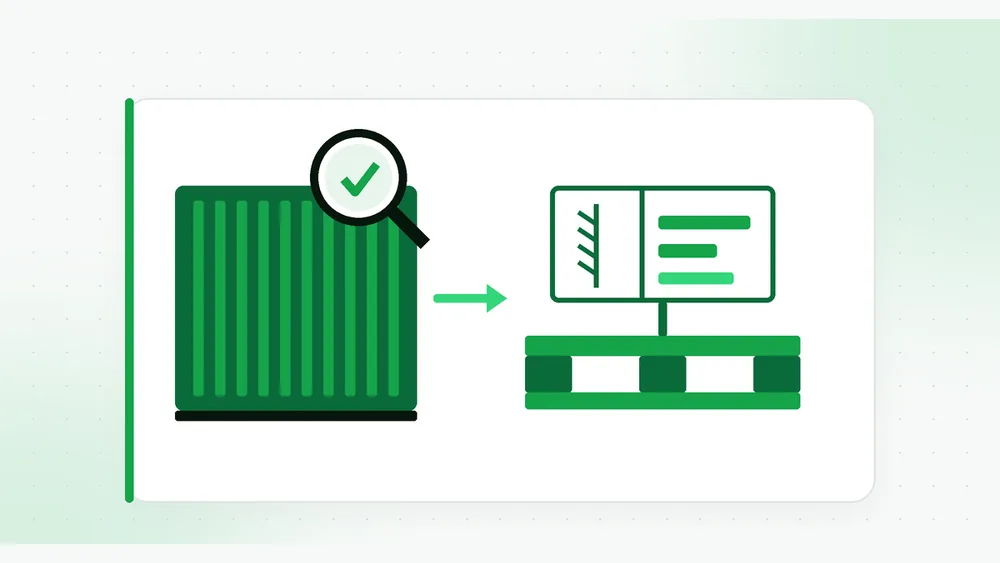
Wood pallets, crates and dunnage entering the U.S. must be heat-treated or fumigated and carry a legible ISPM 15 mark. If they don't, the responsible party receives an Emergency Action Notification and the wood is not allowed in. CBP says U.S. rules require export of non-compliant WPM, and separating it from the cargo is at the government's discretion.
An unstamped pallet can hold up a whole container, even when there's nothing wrong with the freight on it. ISPM 15 is the international standard for wood packaging material (WPM), meaning pallets, crates, skids, dunnage and other wooden pieces used to support, protect or carry cargo. The United States enforces it at the border through USDA's Animal and Plant Health Inspection Service (APHIS) and U.S. Customs and Border Protection (CBP).[1][2] This guide covers what compliant wood looks like, what inspectors check, and what happens when a shipment fails, based on what the regulators themselves publish.
In this guide
What ISPM 15 Covers
The International Plant Protection Convention (IPPC) publishes ISPM 15, Regulation of wood packaging material in international trade. It describes measures that reduce the risk of spreading quarantine pests through "wood packaging material made from raw wood," and it excludes packaging made from wood "processed in such a way that it is free from pests (e.g. plywood)."[1] CBP defines wood packaging material as "wood or wood products (excluding paper products) used for supporting, protecting, or carrying cargo."[2]
In U.S. law, the requirement sits in 7 CFR 319.40-3(b). Regulated WPM, "whether in actual use as packing for regulated or nonregulated articles or imported as cargo," may enter under a general permit only if it has been treated under 7 CFR part 305 and carries the approved mark.[3] CBP's FAQ lists the covered items as including "dunnage, crating, pallets, packing blocks, drums, cases, or skids."[4]
There are two approved treatments:
- Heat treatment (HT): the wood reaches a minimum core temperature of 56 °C for at least 30 minutes.[2]
- Methyl bromide fumigation (MB): per CBP's FAQ, fumigation in an enclosed area for at least 16 hours at the regulated dosage, followed by aeration.[4]
Treatment only has to happen once. Per CBP, once WPM has been properly treated and marked by an approved facility in any country, "the mark will be accepted as proof of compliance for the life of the WPM."[4] Paper treatment certificates are no longer required or accepted for U.S. entry.[4] The mark is the proof.
Reading the ISPM 15 Mark
Under 7 CFR 319.40-3(b)(2), each article must be marked "in a visible location on each article, preferably on at least two opposite sides of the article, with a legible and permanent mark." The mark must include four elements:[3]
| Element | What it shows |
|---|---|
| IPPC symbol | The unique graphic symbol approved by the IPPC |
| Country code (XX) | ISO two-letter code of the country that produced the WPM |
| Producer number (000) | Unique number assigned to the producer by that country's national plant protection agency |
| Treatment code (YY) | Abbreviation for the treatment, e.g. HT for heat treatment or MB for methyl bromide |
Layouts vary. CBP's FAQ shows accepted variants: stacked or single-line text, rounded or square borders, stenciled marks, and a rotated symbol.[4] What doesn't vary is legibility. CBP's position is that "if the mark is not permanent or not legible, the WPM is violative," and that includes marks that condensation inside a container has made unreadable.[4]
What Inspectors Look For
CBP and USDA publish a rapid visual checklist for shippers to run before a shipment leaves for the United States. It asks five questions:[5]
- Marking: Is all WPM stamped with ISPM 15 marks that are easily visible?
- Stamp compliance: Are all stamps in a valid ISPM 15 format?
- Material consistency: Is the same wood used throughout, or is each different part marked and compliant?
- Debarked: Is all bark removed?
- No live pests: Are there holes, tunnels, channels, or loose or compacted sawdust that could indicate live pests?
A stamp is not a free pass
CBP's FAQ says WPM "found to be infested is deemed not properly treated, and, therefore, not compliant, regardless if properly marked." If pests are found, the pest-safeguarding protocol comes first, and WPM enforcement follows once the pest threat is eliminated.[4]
Dunnage gets some leeway. Bracing is often cut from a longer marked piece, which separates it from the stamp. CBP says that if it believes cut or damaged pieces are part of a larger piece of properly marked wood, it will treat them as non-violative. CBP also says it must be notified before compliant dunnage is offloaded.[4]
What Happens When WPM Fails Inspection
APHIS states it directly: "Shipments containing noncompliant WPM will not be allowed to enter the country."[6]
1. An Emergency Action Notification is issued
When a WPM violation is found, an Emergency Action Notification (EAN) is issued to the party responsible for the WPM, which CBP defines as "the party whose bond was obligated" at the time the violation is discovered.[4] The EAN specifies the action required and the deadline. CBP says the time frame "will be specified in Block 17 of the EAN."[4]
2. The wood has to leave the country
Under 7 CFR 319.40-3(b)(3), an inspector at the port of first arrival "may order the immediate reexport of regulated wood packaging material that is imported without the mark."[3] CBP's FAQ is blunt about the options: the regulation "does not allow for fumigation as remediation," and "the U.S. regulation allows only for export of the non-compliant WPM," which is the importer's responsibility.[4] The WPM doesn't have to go back to its country of origin, but the importer has to find a destination that will accept it.[4]
APHIS's current import page describes corrective actions under an EAN in slightly broader terms. Depending on the noncompliance, options "may include" safeguarding the shipment "via tarping, knock-down fumigations, or other methods," destroying the WPM under APHIS supervision, or re-exporting the shipment.[6] The EAN and the officers at the port decide what's allowed for a given shipment; don't assume an option is available until they confirm it.
3. Separation, if CBP allows it
Sometimes the freight can be released while the wood alone is exported. CBP is clear that this "is not an absolute right; it is an option left to the government's discretion." The importer or other party of interest has to request it on a CBP Form 3499, with evidence of a commitment to export the separated WPM. After separation, the cargo and non-violative WPM are released.[4] CBP also says "all expenses related to the movement, inspection, separation, safeguarding, storage, and ultimate disposition of non-compliant WPM are the responsibility of the importer."[4]
4. Liquidated damages and penalties
Liquidated damages are assessed not for importing violative WPM but for failing to comply with the EAN. Separately, penalties may be assessed for trying to conceal a WPM violation or for failing to comply with 7 CFR 319.40-3, and CBP notes that since November 1, 2017, a responsible party with a documented WPM violation may be issued a penalty.[4]
Exemptions and Edge Cases
- Manufactured and processed wood. CBP lists manufactured wood materials such as fiber board, plywood, whisky and wine barrels, strandboard and veneer as exempt.[4] APHIS also lists plastic pallets, oriented strand board, hardboard, synthetic foam, metal frames and inflated dunnage among materials not subject to its WPM regulation.[6]
- Thin wood. Pieces of wood less than 6 mm (0.24 in) in any dimension, and sawdust, wood wool and shavings, are exempt.[4]
- Department of Defense. WPM used by DOD to package nonregulated articles, including commercial shipments under a DOD contract, may enter without the mark.[3]
- Canada. WPM made entirely of Canadian-origin or U.S.-origin wood is exempt in direct trade between the two countries. CBP presumes the WPM's origin matches the goods' origin unless shown otherwise, so, for example, Chinese-made goods coming from Canada are presumed to be on Chinese WPM.[4]
- Domestic moves. "There is no requirement for treatment or marking of WPM in domestic circulation."[4]
The Export Side: U.S. Freight Going Abroad
The U.S. adopted the IPPC standard to harmonize with other countries that have adopted it,[4] so a domestic pallet that's fine for a U.S. warehouse can be refused abroad. APHIS lists three ways for U.S. exporters to get compliant WPM: buy heat-treated or fumigated WPM that already bears the mark, become a compliant manufacturer using ALSC-accredited heat-treated lumber, or have a registered heat-treatment or fumigation facility treat and mark unmarked WPM. The American Lumber Standard Committee (ALSC) runs the U.S. quality-control programs.[7]
If a U.S. export is refused abroad because of the wood, CBP says it will generally permit return of U.S.-origin goods "as long as the shipment has not left customs custody or control in the other country and the entry refusal reason accompanies the shipment."[4] Other countries may handle non-compliant WPM differently, so CBP recommends verifying the destination's requirements before shipping.[4]
Example Scenario
Hypothetical, for illustration only. Say an importer's 40-ft container of palletized housewares arrives at Port Newark. On exam, several pallets have no visible ISPM 15 mark and one has bark on a stringer. The bonded party receives an EAN.
- The importer and customs broker read the EAN to see what action is required and by when.[4]
- If they want the freight released without the wood, they request separation on a CBP 3499, including evidence of a commitment to export the separated WPM.[4]
- If CBP grants separation, the freight is moved off the violative pallets under the conditions CBP sets, and the pallets are exported at the importer's expense.[4]
- If separation isn't granted, the shipment with its WPM has to be handled as the EAN directs, which may mean re-export.[4][6]
- Once released, the freight may no longer be on pallets, and it still has to get to a warehouse or DC.
Where a Rework Facility Fits (and Where It Doesn't)
To be clear about limits: a warehouse can't fix an ISPM 15 violation on a held import by re-palletizing it. Whether freight can be separated from non-compliant wood, where that happens, and what becomes of the wood are decisions for CBP and APHIS, handled through the EAN and the importer's customs broker.[4][6] RapidShips is not a customs broker, and treating and marking wood is the job of registered heat-treatment or fumigation facilities.[7] Never move or open a held container before the agencies clear it.
The physical work around those decisions is what we handle, 24/7, at 25A Cotters Lane in East Brunswick, NJ, near the Port Newark / Elizabeth terminals:
- After release: freight that comes back without usable pallets needs to be built onto new ones, stretch-wrapped, labeled and loaded for its next leg. That's freight rework. Since domestic WPM doesn't need ISPM 15 treatment or marking,[4] the goal here is a sound, stable pallet.
- Before export: moving outbound freight from domestic pallets onto ISPM 15-marked pallets supplied by the shipper, before the container is loaded, prevents the problem at the destination port. When the job also involves moving freight between a trailer and a container, that's a transload.
- While paperwork catches up: released freight waiting on a delivery appointment can sit in short-term storage instead of running up container charges at the terminal.
If you have a released container that needs re-palletizing, or outbound freight that needs to go onto marked pallets, call 800-376-2808 or send us the shipment details.
Frequently Asked Questions
What does the ISPM 15 stamp mean?
Can non-compliant pallets be fumigated or heat-treated in the U.S. instead of exported?
Can the cargo be separated from the bad pallets and released?
Who pays when wood packaging fails inspection?
Do pallets used only inside the U.S. need an ISPM 15 stamp?
Sources
- International Plant Protection Convention, "ISPM 15: Regulation of wood packaging material in international trade," accessed September 2026.
- U.S. Customs and Border Protection, "Wood Packaging Materials," accessed September 2026.
- Legal Information Institute, Cornell Law School, "7 CFR § 319.40-3 – General permits; articles that may be imported without a specific permit; articles that may be imported without either a specific permit or an importer document," accessed September 2026.
- U.S. Customs and Border Protection, "Frequently Asked Questions on Wood Packaging Materials," accessed September 2026.
- U.S. Customs and Border Protection and USDA, "Wood Packaging Material Rapid Visual Checklist (CBP Publication No. 3910-1124)," accessed September 2026.
- USDA Animal and Plant Health Inspection Service, "Import ISPM 15-Compliant Wood Packaging Material into the U.S.," accessed September 2026.
- USDA Animal and Plant Health Inspection Service, "Export ISPM 15-Compliant Wood Packaging Material From U.S.," accessed September 2026.
This guide is general operational information, not legal or regulatory advice. Rules change; confirm current requirements with the relevant agency or your carrier before acting.