
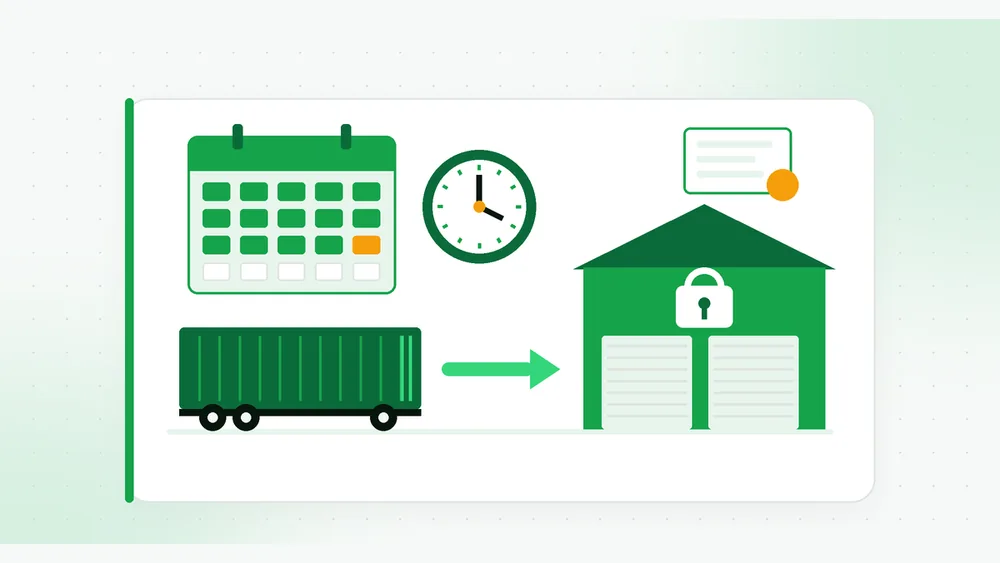
“General order” (GO) is CBP’s custody status for imported cargo that nobody has entered in time. Under 19 CFR 4.37, landed cargo without a release may stay at the place of unlading until the fifteenth calendar day after landing. After that, a bonded GO warehouse moves and stores it at the consignee’s risk and expense. If it sits unclaimed for 6 months, CBP can sell it.
A general order warehouse is where imported cargo ends up when the importer’s side of the entry has gone quiet: no entry filed in time, duties unpaid, or documents missing. Landed cargo without a release permit may stay at the place of unlading “until the fifteenth calendar day after landing”; the carrier then reports it to Customs and hands it to a bonded warehouse approved for general order merchandise.[1] This guide covers the timeline, who pays, how to get cargo out through your customs broker, and what happens to freight left unclaimed.
In this guide
- What is general order in customs?
- The 15-day rule under 19 CFR 4.37
- What is a general order warehouse?
- Why cargo ends up in general order
- Who pays for general order storage?
- How to get cargo out of general order
- Unclaimed merchandise: what happens after 6 months?
- Example scenario
- After release: where a New Jersey warehouse fits
- Frequently asked questions
Key takeaways
- Unentered cargo may stay at the place of unlading until the fifteenth calendar day after landing (19 CFR 4.37).
- The carrier must notify Customs, and a GO-certified bonded warehouse, no later than 20 calendar days after landing.
- GO transport and storage are at the risk and expense of the consignee.
- Cargo left in Customs custody 6 months from the date of importation, charges unpaid, is unclaimed and can be auctioned.
- Only your customs broker and CBP can get cargo out of GO.
What Is General Order in Customs?
Under 19 CFR 127.1, merchandise is “general order merchandise” when it is taken into the custody of the port director and deposited in the public stores or a general order warehouse “at the risk and expense of the consignee.”[2]
Until that transfer happens, the statute puts unentered cargo on the carrier. Under 19 U.S.C. 1448, unentered merchandise “shall be the responsibility of the master or person in charge of the importing vessel or vehicle, or agent thereof, until it is removed from the carrier’s control in accordance with section 1490.”[3] Section 1490 is the general order statute: it tells the carrier to notify a bonded warehouse of the unentered cargo, and the warehouse then arranges its transportation and storage at the consignee’s risk and expense.[4]
CBP describes the program as one established “to maintain control of unclaimed and or abandoned merchandise.”[5] It is a custody arrangement, not a penalty, but it adds a warehouse, extra moves and a deadline.
The 15-Day Rule Under 19 CFR 4.37
19 CFR 4.37(a) says merchandise “regularly landed but not covered by a permit for its release shall be allowed to remain at the place of unlading until the fifteenth calendar day after landing.”[1] CBP’s own summary says the same thing from the importer’s side: the merchandise stays at the importing carrier’s facility until the importer files an entry, and “the importer has 15 calendar days to do this.”[5]
| When | What the rule says | Who acts |
|---|---|---|
| Landing | Cargo without a release permit may stay at the place of unlading “until the fifteenth calendar day after landing.”[1] | Importer and broker file the entry |
| No later than 20 calendar days after landing | The master, owner or agent must notify Customs of unentered cargo, and the carrier must notify a GO-certified bonded warehouse within the same 20-day period.[1] | Carrier |
| After notification | The bonded warehouse proprietor arranges transport and storage “at the risk and expense of the consignee.”[1] | GO warehouse |
| 6 months from the date of importation | Merchandise still in Customs custody without estimated duties and storage or other charges paid is considered unclaimed and abandoned.[6] | CBP |
| After that | Unclaimed merchandise is appraised and sold by CBP at public auction.[7] | CBP |
The 20-day notice is the carrier’s duty: failing to notify Customs can bring a penalty of up to $1,000 per bill of lading.[1] Parallel rules apply to unentered cargo moved under a permit to transfer or an in-bond entry.[1] For the importer, the clock starts at landing, not when someone notices the box.
What Is a General Order Warehouse?
A general order warehouse is a Class 11 bonded warehouse. 19 CFR 19.1 defines Class 11 as bonded warehouses “known as ‘general order warehouses,’ established for the storage and disposition exclusively of general order merchandise.”[8] That separates it from a Class 3 public bonded warehouse, used “exclusively for the storage of imported merchandise,” and from ordinary commercial warehouses, which have no bonded status at all.[8]
The carrier cannot pick just any bonded facility. 19 CFR 4.37(c) requires notice to “a bonded warehouse certified by the port director as qualified to receive general order merchandise.” The carrier also prepares a CF 6043 Delivery Ticket, or an approved electronic equivalent, to cover the warehouse’s receipt and transport of the cargo.[1]
General order in the Port of New York and New Jersey
CBP has held general order auctions locally; a 2011 CBP release announced one in Carteret–Rahway, New Jersey.[5] Which GO warehouse holds a given shipment depends on the carrier’s notification, so ask your broker where your cargo went.
Why Cargo Ends Up in General Order
19 U.S.C. 1490 and 19 CFR 127.1 list the triggers. Cargo goes to general order when:[4][2]
- Entry is not made within the time provided by law or regulation
- Entry is incomplete because estimated duties were not paid
- In the port director’s opinion, entry cannot be made for want of proper documents or other causes
- The port director believes the merchandise is not correctly or legally invoiced
- The consignee, or the vessel’s owner or master, asks the port director to take possession after 1 day from the vessel’s entry
On the ground, those legal triggers usually come from ordinary failures:
- No broker engaged. Each side assumes the other is clearing the cargo.
- Documents stuck upstream. The invoice or bill of lading arrives late, or the invoice doesn’t match the goods.
- Unpaid duties. The importer can’t fund the duty deposit, often after tariff rates changed between booking and arrival.
- Disputes. Nobody wants to own the entry while buyer and seller argue.
- Another hold. If your box was selected for inspection instead, see our guide to CBP exam holds.
Who Pays for General Order Storage?
The consignee pays. 19 CFR 4.37(c) says the bonded warehouse proprietor arranges transportation and storage “at the risk and expense of the consignee,”[1] and 19 U.S.C. 1490 uses the same words.[4] “Risk” matters too: check your cargo insurance for the extra handling.
Expect several layers of cost, each set by whoever bills it, not by regulation:
- GO warehouse charges. Cartage, handling and storage for as long as the cargo stays.
- Carrier and terminal charges. Anything that accrued before the transfer. Our demurrage vs. detention guide explains how those clocks work.
- Duties, taxes and fees. Still owed on entry.
- Outbound drayage. Your trucker picks up from the GO warehouse, not from the terminal.
Don’t rely on figures you find online
Blogs quote per-day GO rates and flat transfer fees, but no regulation sets them. Get the actual charges in writing from the GO warehouse, through your broker.
How to Get Cargo Out of General Order
You get cargo out of GO by completing a proper entry and paying what is owed. 19 U.S.C. 1491 lets merchandise facing sale be entered or withdrawn for consumption “at any time prior to such sale upon payment of all duties, taxes, fees, interest, storage, and other charges, and expenses that may have accrued thereon.”[7] In practice, work through your customs broker:
- Confirm the status. Have your broker confirm the cargo is in GO and which warehouse holds it.
- Fix the cause. Supply the missing invoice or documents, correct invoice problems, or fund the duty deposit.
- File the entry. Your broker files the entry, and entry summary where required, and handles CBP questions.
- Pay the GO warehouse. Settle cartage and storage charges before pickup.
- Get CBP release. Nothing leaves the bonded warehouse until CBP releases it.
- Book pickup and the next stop. Line up the trucker and the destination before release.
If the goods should leave the country instead of entering it, ask your broker early whether exportation is an option.
Unclaimed Merchandise: What Happens After 6 Months?
Under 19 CFR 127.11, merchandise that “remains in Customs custody for 6 months from the date of importation” without all estimated duties and storage or other charges paid is considered “unclaimed and abandoned.”[6] The statute, 19 U.S.C. 1491, adds that such merchandise “shall be appraised and sold by the Customs Service at public auction.”[7]
- The 6 months can be shorter. Section 127.11 allows “a lesser period for special merchandise,”[6] and 1491 lets explosives, and goods whose value may fall below the charges owed through damage, leakage or other causes, be sold “forthwith.”[7]
- Abandonment can be voluntary. 19 CFR 127.12 treats some merchandise as voluntarily abandoned, including cargo the port director takes into possession at the consignee’s request, and cargo abandoned within set periods after entry or examination.[9] Decide it with your broker.
- Walking away is not a plan. GO storage was at the consignee’s expense from the start. Get legal advice before letting cargo go unclaimed.
Example Scenario
This is a hypothetical to illustrate the sequence, not a real shipment. Say a small importer expected the seller’s agent to clear a container of flat-pack furniture. It lands at Port Newark, no entry is filed, and the carrier notifies Customs and a GO warehouse within the 20-day window. The importer hires a customs broker, who gets a corrected invoice, files the entry and pays the duty deposit. The importer settles the GO charges and CBP releases the cargo, but several pallets are leaning after repeated handling. The importer has the freight trucked to a nearby warehouse to be rebuilt, relabeled and held until the new delivery appointment.
After Release: Where a New Jersey Warehouse Fits
RapidShips is not a customs broker and not a bonded or general order warehouse. We can’t file entries, talk to CBP for you, receive GO cargo, or get anything released; that is for your customs broker, CBP and the GO warehouse. Our part starts only after CBP has released the freight and your trucker brings it to our dock in East Brunswick. From there we can help with the physical side:
- Rebuilding, re-wrapping and relabeling pallets that were handled several times on the way through GO, with our freight rework service.
- Holding released freight when the delivery window has moved, using short-term freight storage near the port.
- Receiving loads that a consignee refused after a long delay, through our rejected-load recovery service, then devanning or transloading them to domestic trailers.
If your broker expects a release soon and you want the post-release move lined up, call 800-376-2808 or send us the shipment details.
Frequently Asked Questions
What is general order in customs?
What is a general order warehouse?
How long can cargo stay in a general order warehouse?
Who pays general order warehouse fees?
What happens to unclaimed cargo containers?
Can a regular warehouse get my cargo out of general order?
Sources
- Legal Information Institute, Cornell Law School, "19 CFR § 4.37 – General order," accessed September 2026.
- Legal Information Institute, Cornell Law School, "19 CFR § 127.1 – Merchandise considered general order merchandise," accessed September 2026.
- Legal Information Institute, Cornell Law School, "19 U.S. Code § 1448 – Unlading," accessed September 2026.
- Legal Information Institute, Cornell Law School, "19 U.S. Code § 1490 – General orders," accessed September 2026.
- U.S. Customs and Border Protection, "General Order Auction Announced," accessed September 2026.
- Legal Information Institute, Cornell Law School, "19 CFR § 127.11 – Unclaimed merchandise," accessed September 2026.
- Legal Information Institute, Cornell Law School, "19 U.S. Code § 1491 – Unclaimed merchandise; disposition of forfeited distilled spirits, wines and malt liquor," accessed September 2026.
- Legal Information Institute, Cornell Law School, "19 CFR § 19.1 – Classes of customs warehouses," accessed September 2026.
- Legal Information Institute, Cornell Law School, "19 CFR § 127.12 – Abandoned merchandise," accessed September 2026.
This guide is general operational information, not legal or regulatory advice. Rules change; confirm current requirements with the relevant agency or your carrier before acting.