
In this guide
- Why Discovering a Shift Is a Decision Point, Not a Minor Delay
- The Immediate Stop-or-Proceed Decision Tree
- Shift Severity vs. Response Action — Quick-Reference Matrix
- Why Pushing Through Creates Its Own Liability
- The Restack/Re-Secure Decision Matrix: Which Fix Matches Which Shift
- What a Compliant Repair Actually Requires Under 49 CFR Part 393
- Documentation: The Paper Trail That Protects Every Party
- How RapidShips Handles Same-Day Shifted Load Repair in NJ
- Frequently Asked Questions About Shifted Load Repair
Direct answer: When a load shifts in transit, the driver must pull over immediately and assess whether the shift has affected vehicle stability or maneuverability, and whether aggregate tie-down working load limit still equals at least 50% of cargo weight per 49 CFR Part 393 Subpart I — FMCSA cargo securement regulations. If either condition is violated, the vehicle cannot legally move until the load is re-secured. Proceeding with a non-compliant load risks FMCSA civil penalties up to $19,246 per violation, an out-of-service order, and near-strict Carmack Amendment liability for any cargo damage at delivery. The correct response is to photograph the load, notify dispatch, and either re-secure roadside if the shift is minor or route to a cross-dock facility for a professional restack before continuing.
Why Discovering a Shift Is a Decision Point, Not a Minor Delay
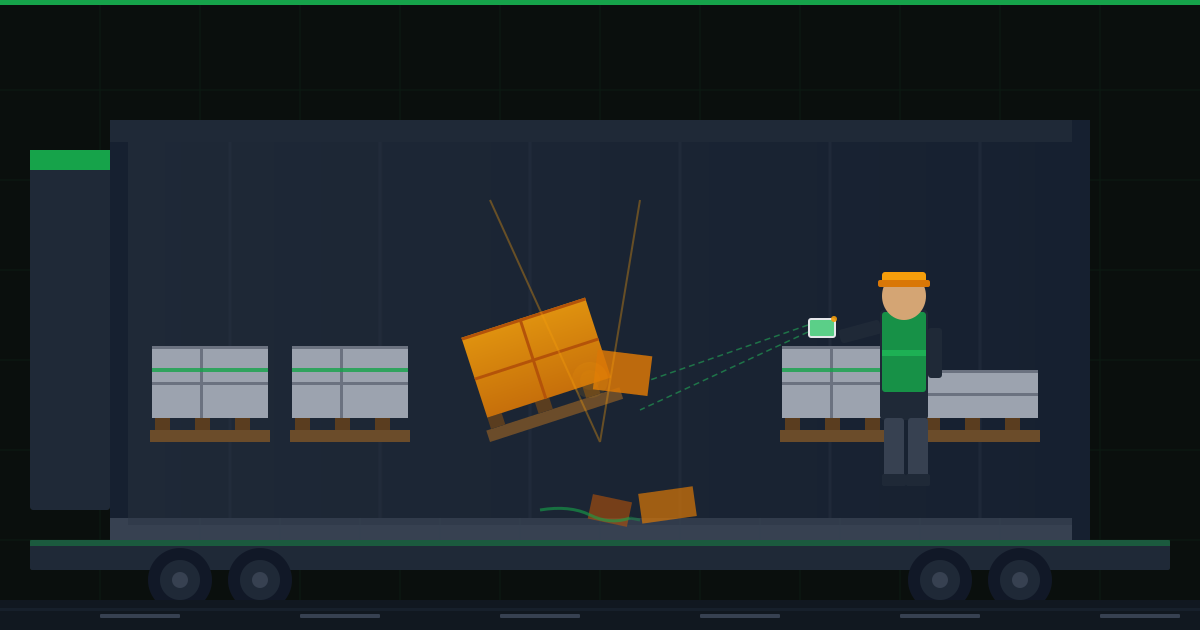
Most drivers treat a shifted load as a scheduling problem. It isn't. The moment you crack the trailer doors and see leaning pallets or a collapsed floor stack, a federal compliance clock starts running — not a delivery clock.
If you haven't dealt with this category of complete guide to shifted loads in transit freight emergency before, the short version: you are now operating under 49 CFR Part 393 Subpart I, and every decision you make from this point forward carries a regulatory, financial, and liability consequence.
The moment of discovery: three places it happens
Shifts get discovered in three situations: during a mid-route stop inspection (fuel stop, weigh station, rest area), after a hard brake or sudden swerve when the driver hears movement, or at delivery when the receiver opens the doors. Each scenario is different operationally, but the required response is identical.
If discovery happens at the receiver's dock door, options narrow fast. The receiver can reject on sight. At that point you're looking at a return trip, a demurrage clock, and a damaged-freight claim — all avoidable earlier in the run.
What "shifted" actually means under federal law (49 CFR 393.100(c))
Definition — Cargo Shift Under 49 CFR 393.100(c): Cargo must be contained, immobilized, or secured on or within a vehicle to prevent shifting upon or within the vehicle to such an extent that the vehicle's stability or maneuverability is adversely affected. A shift that does not reach this threshold is not, by itself, a violation — but any movement that impairs handling or compromises tie-down working load limit compliance crosses into federal violation territory.
That word "adversely" does a lot of work in enforcement. Inspectors don't need to observe the truck swerving. A load leaning hard to one side, shifting axle weight, or riding with broken tie-downs is enough. During the 2026 CVSA International Roadcheck — 54,575 inspections across three days in May — cargo securement produced 1,724 out-of-service violations, ranking fourth among all vehicle OOS categories. Cargo securement is a consistent enforcement priority year-round, not just during Roadcheck cycles.
The Immediate Stop-or-Proceed Decision Tree
Step 1: Pull over safely and conduct a visual and physical assessment
Get off the road. Completely. A highway shoulder is a last resort — find a truck stop, a parking lot, or a nearby exit. Once stopped, open the trailer fully before assessing anything. A cracked door gives you nothing useful.
Check: Are pallets leaning against the walls? Are tie-downs still attached and taut? Is anything on the floor that shouldn't be? Is the load pressing against the doors? Is there visible product damage?
Step 2: Photograph everything before touching the load
Do not move a single pallet before you have photos. Take shots from inside the trailer showing load position and any failed tie-downs, from outside the trailer, and close-up of any broken strapping, damaged wrap, or compromised pallets. Timestamp is automatic on a phone — confirm the clock is accurate.
These photos are your documentation under the Carmack Amendment. Without them, you have no recorded pre-delivery condition to fall back on when a claim is filed.
Step 3: Apply the four-question decision test
- Does the shift affect vehicle stability or maneuverability? If yes — stop. Do not proceed.
- Does aggregate tie-down WLL still equal at least 50% of cargo weight per 49 CFR 393.106? If no — stop. Do not proceed.
- Can the shift be corrected roadside without a dock and equipment? If no — route to a cross-dock.
- Is the destination receiver likely to reject on arrival? If yes — your repair window is now, not at the dock door.
If any answer puts you in the risk column, the load does not move until it's re-secured. Under FMCSA official cargo securement rules and 49 CFR 392.9 specifically, a driver must not operate a vehicle with cargo that is not properly secured. That is a federal prohibition, not guidance.
Step 4: Notify dispatch and broker within minutes, not hours
Call dispatch as soon as the assessment is done — not after attempting a fix, not after driving another 20 miles. Dispatch notifies the broker; the broker notifies the shipper and receiver. The notification chain timestamp matters for every claim that follows.
Shift Severity vs. Response Action — Quick-Reference Matrix
| Shift Type | Driver Can Fix Roadside? | Dock / Equipment Needed? | Est. Repair Time | OOS Risk if You Proceed | Recommended Action |
|---|---|---|---|---|---|
| Minor lean / loose wrap | Usually yes | No | 15–30 min | Low–moderate | Re-wrap, retighten, document, continue |
| Partial collapse, pallets reachable | Rarely | Yes — dock and pallet jack | 30–90 min | High | Route to cross-dock for restack |
| Full pallet collapse, dock required | No | Yes — forklift, re-wrap equipment | 2–4 hours | Very high — likely OOS | Full freight rework at a dock facility |
| Product spill or damage requiring sorting | No | Yes — full warehouse capability | Half-day to full day | Certain OOS if moved | Full rework with product sort and re-palletize |
Why Pushing Through Creates Its Own Liability
FMCSA fines and CSA score damage
FMCSA civil penalties for cargo securement violations reach $19,246 per violation for general infractions and up to $23,048 per violation when the infraction triggers an out-of-service order. Each violation cited during a single inspection is assessed separately — one truck, one stop, five violations can add up to six figures before a freight claim is even filed.
Every cargo securement citation also hits the carrier's CSA Cargo-Related BASIC score. Those points stay on record for 24 months and affect insurance rates, shipper contracts, and broker relationships. During the 2026 CVSA International Roadcheck, across 54,575 inspections, cargo securement produced 1,724 out-of-service violations — 12.4% of all vehicle OOS violations, ranking fourth overall.
The Carmack Amendment trap: delivering damaged freight locks in liability
The Carmack Amendment (49 U.S.C. § 14706) has been federal law since 1906. If cargo was accepted in good condition at origin and arrives damaged, the carrier faces near-strict liability. The shipper does not need to prove negligence — they prove three things: cargo accepted in good condition, delivered damaged, and the dollar amount of loss. Then the burden shifts to the carrier to prove a defense.
One of the few available defenses is that damage resulted from the shipper's improper loading. The moment a driver discovers a shift, continues anyway, and documents nothing, that defense is gone. The carrier knew. The carrier drove. That is not an "act of shipper." Freight claims cost U.S. shippers more than $50 billion annually, and incomplete or missing documentation accounts for 35–40% of all claim denials. The paperwork skipped at the scene is the paperwork that kills the claim later.
Receiver rejection and the downstream dwell/detention cost cascade
A rejected load at the dock is not just a wasted run. At Port Newark terminals, demurrage fees start at $150–$250 per container per day in tier 1 and escalate past $350 per day after the first week — and Maersk increased all Newark terminal dry and non-operating-reefer tiers by $20 per day effective January 1, 2026. See the Port Newark freight corridor dwell and congestion guide for the full tier breakdown.
Add driver detention time, return trip fuel and miles, redelivery scheduling, and compounding effects on on-time delivery metrics — and pushing through a known shift stops being a time-saver and becomes one of the most expensive decisions in a dispatch week.
The Restack/Re-Secure Decision Matrix: Which Fix Matches Which Shift
Minor lean or loose wrap: roadside re-wrap and retighten
A single pallet leaning against the wall with intact stretch wrap and functioning tie-downs is often a roadside fix. Carry extra strapping and a hand ratchet. Re-wrap with stretch film if the existing wrap is compromised, retighten tie-downs, verify WLL math, re-inspect at 50 miles, and document everything. This is the only scenario where continuing without dock access is straightforwardly viable.
Partial collapse requiring dock access: cross-dock restack
When two or more pallets have shifted, wrap has failed on multiple units, or tie-down attachment points are compromised, a dock is required. A cross-dock restack is the middle-ground solution: the load transfers to a staging bay, pallets are repositioned and re-wrapped, tie-downs are replaced to compliance, and the trailer is reloaded without entering long-term warehouse storage. Turnaround runs 30 to 90 minutes for a straightforward restack.
Full floor-load collapse or pallet failure: full freight rework
Full pallet collapse — where a pallet has broken down, product is on the floor, or the structural integrity of the stack is gone — requires a forklift, replacement pallets, and re-wrapping equipment. This is freight rework and restack services territory. Expect 2 to 4 hours minimum. The carrier needs to authorize the scope before work starts, and freight claim documentation begins at this point, not after delivery.
When product damage means contents must be sorted before re-palletizing
If product is damaged, mixed, or spilled, restacking alone is not enough — sorting is required. Damaged units get segregated and documented. Undamaged product gets re-palletized and re-wrapped. This is the most time-intensive scenario, often running half a day or more, and it requires labor and warehouse space that a dock-only facility may not have. Confirm the facility's capabilities before the trailer backs in.
What a Compliant Repair Actually Requires Under 49 CFR Part 393
WLL math: recalculating tie-down count after a restack
After any restack, the tie-down math must be redone from scratch. Aggregate WLL of all tie-downs must equal at least 50% of the cargo weight being secured. The number of tie-downs required depends on article length and weight per the 49 CFR 393.106 table. A restack that changes cargo arrangement or adds weight to a trailer section changes the WLL calculation for that section.
Any rolling articles must be chocked per 393.100(c). If axle weight distribution changes during the restack — which happens frequently when floor loads are repositioned — that is a separate compliance issue. See the RapidShips page on axle-weight compliance after a restack for how New Jersey weight enforcement interacts with post-restack load configuration.
Blocking, bracing, and dunnage bag requirements under 49 CFR 393.106(b)
Blocking and bracing must prevent cargo from moving forward, rearward, and laterally. Dunnage bags are an accepted void-filler under the regulations but must be rated for the application — an undersized dunnage bag used as primary lateral restraint is a citation waiting to happen. If dunnage bags were part of the original securement and failed during transit, replace them with correctly rated bags or supplement with blocking.
The post-repair 50-mile re-inspection obligation under 49 CFR 392.9
After any repair and reload, the driver is back under the standard 49 CFR 392.9 inspection obligation: re-inspect within the first 50 miles after beginning the trip and at each change of duty status. Skipping the 50-mile check is a separately citable violation even if the load rides perfectly. Build it into the dispatch plan — it is not optional.
One additional compliance note: the CVSA 2026 Out-of-Service Criteria — official announcement took effect April 1, 2026, with 17 approved changes, including a wire rope damage chart added to the Cargo Securement Tiedown Defect Table. If tie-down equipment includes wire rope, inspectors now have standardized visual criteria for evaluating condition. Make sure replacement tie-downs are not borderline before leaving the dock.
Documentation: The Paper Trail That Protects Every Party
Before-and-after photos: what angles the inspector and claims adjuster need
Inside the trailer — showing load position, lean angle, and any failed tie-downs. Outside the trailer — both sides if load distribution is visible. Close-up of every damaged packaging unit, every broken strap, every compromised pallet. Then after the repair — the same angles, showing the corrected load, new tie-downs in place, and any replaced packaging.
Claims adjusters work from documentation. Inspectors work from documentation. Build the record at the scene, before anything is moved.
Notation on the BOL and how it affects Carmack liability
Writing "damaged" on a BOL is not sufficient. Write specific pallets by position, describe the condition — "pallets 3 and 4 from the nose, left side, shifted approximately 18 inches toward trailer wall, stretch wrap compromised, product visible through wrap" — and note which tie-downs failed or were slack. Generic notations do not establish the specifics a Carmack claim requires.
Under Carmack, failing to note pre-existing damage at origin and then delivering in damaged condition creates a presumptive liability case against the carrier. Shippers have nine months from the delivery date to file a written freight damage claim and two years from the date of claim denial to file suit. The BOL notation is one of the few tools the carrier has to contest origin-condition assumptions.
Driver exception report and carrier notification chain
Every shifted-load event should generate a written driver exception report — what was found, when, where, what action was taken, and by whom. That report feeds the carrier's notification chain: dispatch, safety manager, broker, shipper. If documentation escalates to a port-level hold or rejection, that paper trail is what supports the port-rejected container triage process and keeps each party's liability exposure defined.
Incomplete or missing documentation is the leading driver of claim denials — 35 to 40% of all rejections trace back to it. Document everything at the scene, before anything is moved.
How RapidShips Handles Same-Day Shifted Load Repair in NJ
Location advantage: East Brunswick, minutes from Port Newark and GCT
RapidShips is located at 25A Cotters Lane, East Brunswick NJ — a straight shot to Port Newark-Elizabeth Marine Terminal and Global Container Terminal. When a drayage load shifts in the port corridor, drivers are 20 to 30 minutes from a dock set up specifically for this work.
That proximity matters when running against a demurrage clock or a tight delivery window. Getting a shifted load into a dock quickly is the difference between a same-day repair and a next-day delivery scramble.
What happens when the trailer backs in: the triage-to-restack sequence
When a trailer arrives with a shifted load, the first step is a documented photo intake — same angles required for a freight claim, timestamped and logged. Then a full scope assessment before touching anything: how many pallets, what failed, what's damaged, what can be restacked versus what requires sorting.
From there: pallet-by-pallet restack or full rework depending on severity, re-wrap and re-strap to 49 CFR 393 compliance, and a post-work photo package delivered to the carrier for claims documentation. RapidShips operates 24/7. The 2 a.m. restack gets the same process as the 2 p.m. one. Cross-docking as an emergency repair staging solution is a standing service here, not something spun up on request.
Getting back on the road: typical turnaround and what you need to call in
For a straightforward pallet restack — a few pallets shifted, wrap intact, no product damage — turnaround runs 30 to 90 minutes. For a partial collapse with pallet replacement, plan for 2 to 3 hours. Full rework with product sorting is a half-day minimum.
When calling in, provide: number of pallets affected, whether there's product damage or only positional shift, and whether post-repair documentation is needed for a freight claim. That information gets the right crew and equipment staged before the trailer arrives. Call ahead to 800-376-2808.
Frequently Asked Questions About Shifted Load Repair
Is it legal to continue driving after discovering a shifted load?
A driver may continue only if the load still meets 49 CFR 393.100(c) — meaning the shift has not adversely affected vehicle stability or maneuverability, and aggregate tie-down working load limit still equals at least 50% of cargo weight per 49 CFR 393.106. If either condition is violated, the vehicle must not move until the load is re-secured. Driving with a known non-compliant load is a federal violation under 49 CFR 392.9, regardless of how close the destination is.
What are the FMCSA fines for delivering with an unsecured or shifted load?
FMCSA civil penalties reach $19,246 per violation for general cargo securement infractions and up to $23,048 per violation when the infraction triggers an out-of-service order. Each violation cited during a single inspection is assessed separately — a single roadside stop on one truck can generate multiple five-figure penalties. Violations also hit the carrier's CSA Cargo-Related BASIC score and remain on record for 24 months, affecting insurance rates and shipper contract eligibility.
Does delivering a shifted load hurt a freight damage claim?
Yes — significantly. Under the Carmack Amendment (49 U.S.C. § 14706), a carrier who accepts cargo in good condition at origin and delivers it damaged faces near-strict liability. The shipper needs to prove only three things: good condition at origin, damaged at delivery, and the dollar amount of loss. Driving a known shifted load to delivery removes the carrier's most available defense — that damage resulted from the shipper's loading — because the carrier had knowledge of the condition and chose to proceed.
How long does a professional restack take at a cross-dock facility?
Scope determines time. A simple restack of a few leaning pallets with intact wrap and no product damage typically runs 30 to 90 minutes at a staffed dock. A partial collapse requiring pallet replacement and full re-strapping takes 2 to 3 hours. A full-trailer rework involving collapsed floor loads, product sorting, and re-palletizing can run 4 hours to a full day. Facilities operating 24/7 — such as RapidShips in East Brunswick NJ — can begin work immediately regardless of arrival time, making same-day turnaround achievable in most scenarios.
Who pays for the restack — carrier, shipper, or broker?
Cost responsibility follows the claim. If the shift resulted from improper shipper loading — incorrect stacking, inadequate initial securement, or overloaded pallets — the shipper may bear the cost. If the shift occurred under carrier control during transit, the carrier is typically liable. In practice, the carrier must fund the repair immediately to keep the load moving, then recover costs through the freight claim process. Brokers may facilitate that recovery but are generally not the primary liable party for physical rework costs.
What documentation should a driver collect at the scene of a load shift?
Collect timestamped photos from inside the trailer showing load position, lean angle, and any failed or slack tie-downs; photos from outside the trailer; and close-up shots of damaged packaging and broken strapping. Before moving anything, note specific pallet positions and conditions on the BOL — "damaged" alone is legally insufficient under Carmack. Notify dispatch immediately so the carrier's notification chain is documented with accurate timestamps. Incomplete or missing documentation is responsible for 35 to 40% of all freight claim denials.
A shifted load discovered on the road is a decision point with a narrow window. The right call — stop, photograph, assess, re-secure properly — takes more time upfront but costs a fraction of the alternative: an out-of-service order, five-figure fines, Carmack Amendment liability, and a receiver rejection at the dock door.
If the shift is beyond a roadside fix and the truck is running in the NJ port corridor, call RapidShips at 800-376-2808. The dock is at 25A Cotters Lane, East Brunswick NJ, running 24/7, with a crew that can be staged before the trailer arrives.