
In this guide
- The Problem With How This Question Is Usually Answered
- Trigger 1 — Your Ocean Container Is Burning Demurrage Days
- Trigger 2 — You Have Multi-Stop LTL Freight That Needs Sorting and Consolidation
- Trigger 3 — You Need Time: Overflow, Seasonality, or a Customs Hold
- The Decision Framework: Match Your Trigger to Your Service
- Why Proximity to Port Newark-Elizabeth Changes the Math
- Special Situations: When the Freight Itself Forces the Choice
- How to Choose a Facility — and What to Ask Before You Book
- Frequently Asked Questions
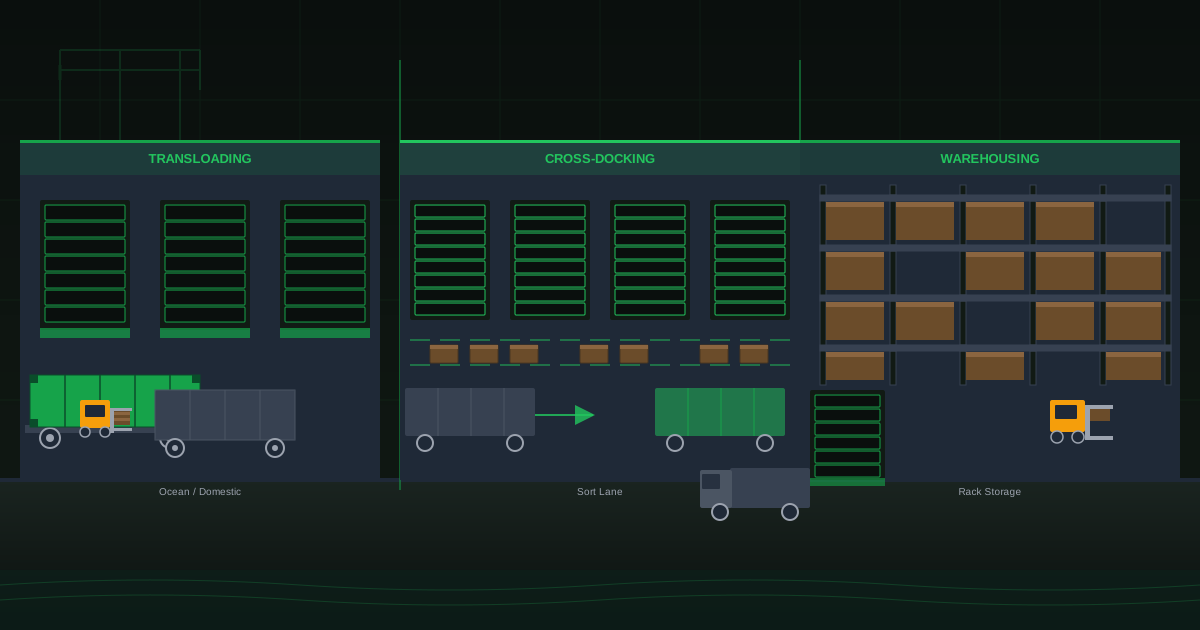
Quick answer: Cross-docking moves already-palletized freight from an inbound truck directly to an outbound truck with minimal dwell time and no mode change. Transloading physically transfers cargo out of an ocean container into domestic equipment — typically a 53-foot trailer — stopping demurrage from accruing the moment the container leaves the terminal. Warehousing holds freight for a defined period when the outbound move is not yet ready. The right service is determined by the specific operational problem at hand: demurrage exposure points to transloading, multi-stop LTL sorting points to cross-docking, and a customs hold or seasonal overflow points to warehousing.
The Problem With How This Question Is Usually Answered
Why "it depends" is a useless answer
Search "cross-docking vs transloading" and you get a table of definitions — dwell times, equipment types, cost comparisons by row. Clean, organized, and nearly useless if you have a container sitting at Port Newark Container Terminal right now burning through demurrage at $480 a day.
The question is never abstract. Something went wrong — or is about to. A vessel discharged early. CBP put a hold on your container. Your DC can't take a delivery until next Tuesday and today is Thursday. Three LTL stops need to ship tonight and the freight is scattered across two inbound trucks. The operational trigger came first. The service choice follows from it.
The three trigger situations that actually determine the right service
After pulling containers out of Port Newark-Elizabeth Marine Terminal, Global Container Terminal (GCT), and Port Newark Container Terminal (PNCT), the scenarios that come through our dock at 25A Cotters Lane reduce to three core triggers:
- Time pressure from the port. Demurrage is running. You need the container off the terminal today.
- Freight routing complexity. You have multiple outbound destinations and freight that needs to be sorted, consolidated, or deconsolidated before it moves.
- The outbound move isn't ready. Customs hold, appointment mismatch, seasonal surge, receiver not ready. The freight needs a place to hold — productively.
Each trigger maps to a different primary service. What follows works through each one with actual numbers.
Trigger 1 — Your Ocean Container Is Burning Demurrage Days
Service: Transloading
Primary goal: Stop the demurrage clock. Move cargo off the terminal into domestic equipment immediately.
What the clock actually costs at Newark terminals in 2025–2026
Free time at Port Newark-Elizabeth has shrunk. Five years ago, carriers routinely allowed 7–10 days. As of 2026, that window is down to 4–5 days on most import shipments. Miss it, and the charges stack fast.
On Maersk's current tariff for a standard 20-ft or 40-ft dry container at Newark: days 1–4 after free time expires run approximately $370/day. Days 5–9 jump to $480/day. Days 10–29 exceed $620/day. After day 30, the rate reaches $725/day. Maersk's January 2026 tariff update added $20/day to all tiers for dry containers, non-operating reefers, SOC, and tanks at Newark terminals, and $40/day for operating reefers.
Run the math on a container that sits 12 days past free time: you're past $6,000 in demurrage alone, before any detention on the chassis.
Under the FMC Final Rule 46 CFR Part 541 — Demurrage and Detention Billing Requirements (effective May 28, 2024), published February 26, 2024 (89 FR 14330) under authority of the Ocean Shipping Reform Act of 2022, carriers must provide a compliant invoice showing the container number, bill of lading, free-time start and end dates, and the applicable tariff clause. The billed party has 30 days from the invoice date to contest the charges, and the billing party must then attempt to resolve the dispute within 30 days. That rule gives you leverage — but only if you know what you're looking at and move fast enough to use it.
Why transloading is the correct answer here, not warehousing
Warehousing does not stop demurrage. The container is still on the terminal while you arrange storage. Transloading stops the clock — the moment the container is pulled from the port and brought to our East Brunswick dock, demurrage stops accruing. Every hour the container stays on the terminal is a dollar figure you cannot recover.
Transloading a floor-loaded ocean container into a 53-foot domestic trailer runs $300–$600 at most US port-market facilities in 2026. Palletized freight transfers at $150–$300. Compare either figure to a single extra day of post-day-9 demurrage at $620 and the economics are straightforward.
See more detail on transloading services at our East Brunswick facility and how we sequence the port pull with the transfer to minimize total exposure. Our notes on Port Newark freight corridor congestion and dwell times cover how terminal availability affects same-day pulls.
The 3-into-2 math: how container-to-53ft-trailer consolidation works
A 53-foot domestic dry van trailer has roughly 3,800 cubic feet of usable space. A standard 40-foot high-cube ocean container holds approximately 2,700 cubic feet — making the domestic trailer about 40% larger by cube. For floor-loaded freight, three 40-foot containers typically consolidate into two 53-foot trailers. One outbound truck move eliminated entirely.
For shipments moving 700 miles or more to a single distribution center, multi-container transloading programs typically save 10–25% on inland freight costs. Below 250–500 miles, the math usually doesn't support the transload stop unless demurrage exposure is already forcing your hand. When demurrage is the trigger, the transload cost is almost never the relevant number — the demurrage you're stopping is.
Trigger 2 — You Have Multi-Stop LTL Freight That Needs Sorting and Consolidation
Service: Cross-Docking
Primary goal: Route freight to multiple outbound destinations without putting it into storage.
What cross-docking actually does (and does not do)
Definition — Cross-Docking: The direct transfer of freight from an inbound truck or container to an outbound truck with minimal or no storage dwell time. Goods move from receiving dock to shipping dock within hours. Cross-docking does not involve long-term inventory holding. It requires that freight arrive already sorted, labeled, and palletized, with accurate documentation attached.
Three practical cross-dock types show up in port-area operations:
- Pre-distribution cross-docking: The shipper has already sorted and labeled freight by destination before it arrives. The dock is purely a transfer point.
- Consolidation cross-docking: Multiple smaller inbound shipments combine into a single outbound load — classic LTL-to-FTL consolidation.
- Opportunistic cross-docking: Freight is redirected in real time based on current demand signals — common in retail replenishment and perishables.
According to CSCMP research, companies that implement cross-docking achieve an average 18% reduction in warehousing costs and a 22% reduction in inventory levels. Storage-heavy logistics models carry inventory holding costs equal to 20–30% of inventory value per year. Cross-docking eliminates most of that exposure by keeping dwell time to hours instead of weeks.
Read more about how cross-docking works and when it fits your freight profile.
Freight profiles that cross-docking handles well
- Palletized inbound freight with destination labels already applied
- High-velocity retail replenishment moving to multiple store locations
- LTL consolidation: several small inbound loads combining into one FTL outbound move
- Temperature-stable consumer goods, packaged food, and electronics where handling touchpoints need to stay low
- Time-sensitive freight where any storage dwell creates a downstream problem
When the freight is NOT ready for cross-docking
Cross-docking fails when freight arrives without accurate documentation, without destination labeling, or in a condition that requires physical rework before it can move. If a pallet arrives damaged, mixed, or mis-labeled, it cannot flow through a cross-dock operation without first being corrected. Pushing it through anyway creates downstream errors that cost more than the dwell time you were trying to avoid.
If the freight needs to be sorted, re-palletized, relabeled, or physically restructured, that work happens before the cross-dock step — not instead of it.
Trigger 3 — You Need Time: Overflow, Seasonality, or a Customs Hold
Service: Warehousing
Primary goal: Hold freight productively until the outbound move is ready to execute.
What warehousing provides that the other two cannot
Cross-docking and transloading both assume the outbound leg is ready or imminent. Warehousing is the right answer when it isn't. A CBP examination at Port Newark can push a container days past its last free day. A seasonal surge can fill a DC faster than it can absorb freight. A receiver cancels an appointment 12 hours before delivery. The freight has to go somewhere — and that somewhere needs to be functional, not just a parking lot.
Short-term buffer warehousing (days to a few weeks) is structurally different from long-term storage. Long-term holding at 20–30% of inventory value per year is expensive by definition. Short-term buffer is a cost-avoidance move: you pay a fraction of that rate to keep freight moving through the supply chain on a corrected schedule instead of sitting at a terminal burning demurrage or sitting on a truck waiting for a dock appointment.
We maintain 24/7 staffing and asset-backed operations at our East Brunswick dock, which means a container that comes off the port at 11pm doesn't sit in a truck cab waiting for an 8am opening.
Details on short-term and overflow warehousing in NJ and our 24-hour port-rejected container triage process are on those service pages.
Short-term vs. long-term storage: knowing which you actually need
One question determines it: do you know when this freight ships out? If you have a date — even a rough one — you need short-term buffer. If the answer is "not sure yet," that points toward longer-term storage with inventory management, which carries different cost structures and service requirements.
Most freight problems that originate at the port are short-term buffer situations. A customs hold resolves in days, not months. An appointment reschedule is a week, not a quarter.
Value-added services that turn a delay into a productive step
Freight sitting in a warehouse for a customs resolution can be relabeled, kitted, sorted by SKU, or prepped for the delivery appointment while it waits. That work happens now so the outbound move is clean when the hold releases. The alternative — releasing the hold and then discovering the freight needs prep — adds another delay on the back end.
The Decision Framework: Match Your Trigger to Your Service
Decision tree logic
- Is demurrage running or about to start? → Transloading. Pull the container from the terminal. Stop the clock.
- Is freight palletized, documented, and heading to multiple outbound destinations? → Cross-docking. Sort and route without putting it into storage.
- Is the outbound move not ready — customs hold, appointment mismatch, seasonal overflow, receiver not ready? → Warehousing. Hold productively until the outbound leg is confirmed.
- Is the freight overweight, shifted, damaged, or port-rejected? → Freight rework first. Then route to whichever service applies.
The "total friction" test: why the cheapest line item is the wrong metric
The handling rate at a warehouse is not the cost of the warehousing decision. The real cost includes demurrage exposure you're carrying while the load sits, missed delivery appointments and the chargebacks that follow, truck wait time on the outbound side, and any secondary handling if the freight has to move to a second facility because the first one couldn't complete the job.
Evaluate those together. A facility that charges a higher handling rate but eliminates a $1,200 demurrage bill and two missed appointments is cheaper by a wide margin.
What happens when you need all three in sequence
This is more common than the textbook version of these services suggests. A vessel discharges at GCT. The container has 72 hours of free time left. We pull it same-day, transload the cargo into a 53-foot trailer to stop demurrage exposure. The freight is going to four destinations — two lanes have confirmed appointments this week, two do not. We cross-dock the confirmed lanes immediately. The remaining pallets go into short-term buffer storage until the appointments confirm, then cross-dock out. One container. One facility. Three sequential services without a single additional transfer.
That sequential model only works under one roof. Every time freight moves between facilities, you add handling touches, transit time, damage risk, and cost.
Comparison: Cross-Docking vs. Transloading vs. Warehousing
| Factor | Cross-Docking | Transloading | Warehousing |
|---|---|---|---|
| Primary trigger | Multi-stop LTL consolidation or sorting needed | Ocean container burning demurrage; mode conversion required | Outbound move not ready; customs hold; seasonal overflow |
| Typical dwell time | Hours (under 24) | Hours (2–8 depending on freight type) | Days to weeks |
| Key cost avoided | Inventory carrying cost; warehouse handling fees | Demurrage and detention; excess linehaul moves | Port demurrage; missed appointment chargebacks |
| Equipment requirement | Inbound and outbound domestic trailers | Ocean container + 53-ft domestic trailer(s) | Racking, floor space, inventory management system |
| Best freight profile | Palletized, labeled, documented, multiple destinations | Floor-loaded or palletized ocean containers; 700+ mile inland moves | Any freight awaiting outbound readiness |
| Demurrage clock impact | No direct impact (container already off terminal) | Stops immediately on port pull | No impact — container must be off terminal first |
| Ideal distance from port | Any distance | Strongest ROI at 500+ miles inland | Any distance |
| RapidShips capability | Yes — 12 dock doors, 24/7, East Brunswick NJ | Yes — 12 dock doors, 24/7, East Brunswick NJ | Yes — 12 dock doors, 24/7, East Brunswick NJ |
Why Proximity to Port Newark-Elizabeth Changes the Math
Port Newark volume and free-time pressure in 2025
The Port of New York and New Jersey handled 8.89 million TEUs in 2025, finishing the year as the second-busiest U.S. gateway for loaded containers. See the Port Authority of New York and New Jersey 2025 cargo volume data for full figures. That volume means competition for terminal appointments, chassis, and drayage capacity is real and daily.
Combine that volume with a free-time window that has shrunk to 4–5 days and you get a port environment where the margin for error on container retrieval is measured in hours. The window between "discharged" and "demurrage accruing" is shorter than it has ever been.
How drayage distance affects transloading ROI
A facility minutes from the port changes the transloading ROI calculation in two ways. First, the drayage leg from terminal to transload facility is short — typically under an hour from Port Newark to our East Brunswick dock, minimizing chassis time and driver hours on the shortest segment of the move. Second, because we can pull same-day on a 24/7 basis, there is no overnight chassis sit waiting for a morning appointment.
The 10–25% inland linehaul savings from consolidating three containers into two trailers apply most strongly on moves over 500 miles. The demurrage avoidance value applies regardless of inland distance — a container 200 miles from its destination still burns $480/day if it's past its free-time window.
For context on terminal capacity changes, see our article on PNCT expansion and what it means for drayage shippers.
East Brunswick as a pivot point for the NY/NJ freight corridor
East Brunswick sits on the Route 18 corridor, connecting Port Newark-Elizabeth, PNCT, and GCT to I-95, I-287, the New Jersey Turnpike, and points south and west. A transloaded 53-foot trailer leaving our dock has direct access to the full inland distribution network without navigating port-area surface congestion on a loaded ocean container chassis.
Special Situations: When the Freight Itself Forces the Choice
Overweight or axle-non-compliant loads
An overweight ocean container cannot legally move on New Jersey roads without an NJDOT overweight permit. In many cases the container is over gross vehicle weight on the chassis — and a permit alone doesn't solve a load distribution problem. The freight has to be physically redistributed across axles, or partially offloaded and moved on a separate vehicle, before the container can dispatch legally. That is freight rework. It is a prerequisite step. It happens before cross-docking or transloading logic applies.
The load comes in, we assess axle weights, restack or redistribute as needed, and then route the freight through the appropriate next service. Details on overweight load correction and NJ axle compliance are on that service page.
Shifted or damaged loads arriving at the dock
A load that shifted in transit — whether in an ocean container or a domestic trailer — cannot move safely until it's been restacked and secured. The load comes in, the doors open, and whatever is in there needs to be corrected before anything else proceeds. Attempting to transload or cross-dock a shifted load without correcting it first creates safety risk and produces damaged freight on the outbound side.
See the emergency guide for loads shifted in transit and our freight rework for non-compliant shipments page for what that process looks like in practice.
Rejected containers requiring emergency triage
A port-rejected container — CBP exam failure, seal discrepancy, documentation hold — needs a decision within hours. Where does the freight go? What condition is it in? Does it need rework before it can move? Does it need short-term warehousing while the documentation issue resolves? The answer to those questions determines whether it routes to transloading, cross-docking, warehousing, or some combination.
A facility that can only do one of those things cannot handle this scenario. You need all three capabilities plus 24/7 staffing, because port rejections do not happen on a business-hours schedule.
How to Choose a Facility — and What to Ask Before You Book
The 6 operational questions every shipper should ask
- Do you operate 24/7? Port activity doesn't stop at 5pm. Your facility shouldn't either.
- How many dock doors do you have? Door count determines how many simultaneous loads you can handle without creating a bottleneck that adds dwell time.
- Can you handle cross-docking, transloading, and warehousing in-house? If the answer is "we'd need to send that to our partner facility," you've already added a transfer, a truck move, and hours of exposure.
- Are you licensed for in-bond transloading? If your freight is moving under a customs bond, the facility must be authorized to handle it. This is not optional.
- What is your average turnaround per container? Get a number, not a range. Floor-loaded containers take longer than palletized ones. Ask specifically for your freight type.
- Do you have asset-backed drayage? A facility that pulls your container from the terminal with its own truck and chassis eliminates the coordination gap between the drayage carrier and the transload facility. Same-day pulls require this.
Red flags that signal a single-service provider can't handle your situation
- They offer transloading but no warehousing — freight that needs to hold has nowhere to go.
- They offer warehousing but no drayage — someone else has to pull the container, adding coordination time you don't have when demurrage is running.
- They are not open nights or weekends — port discharges don't align with Monday–Friday schedules.
- They have 4 dock doors for a high-volume operation — throughput backs up and creates exactly the dwell time you're trying to avoid.
RapidShips: all three services, 12 dock doors, 24/7, East Brunswick NJ
We run cross-docking, transloading, and warehousing out of a single facility at 25A Cotters Lane, East Brunswick NJ — 12 dock doors, staffed and operational 24 hours a day, seven days a week. Asset-backed drayage lets us pull containers from Port Newark-Elizabeth, PNCT, and GCT same-day. When freight needs rework before it can route — overweight, shifted, damaged, rejected — we do that in-house before the container goes anywhere else.
If your container is sitting at a Newark terminal right now, or you have freight that needs to move tonight, call RapidShips 24/7 at 800-376-2808.
Frequently Asked Questions
What is the main difference between cross-docking and transloading?
Cross-docking moves already-palletized freight from one inbound truck directly to an outbound truck with minimal dwell time and no change in transportation mode. Transloading physically transfers cargo out of one mode — typically an ocean container — into different domestic equipment, such as a 53-foot dry van trailer. Transloading often involves unpacking, sorting, or re-palletizing floor-loaded freight. Cross-docking assumes the freight is already sorted and ready to route; transloading converts it from port equipment into domestic distribution equipment.
How do I know if my container is accruing demurrage at Port Newark?
Demurrage begins after your carrier's free-time window expires — as short as 4–5 days at Port Newark on most import shipments as of 2026. On Maersk's current tariff, charges start at approximately $370/day after free time expires, reach $480/day on days 5–9, and exceed $620/day after day 9. Under FMC Final Rule 46 CFR Part 541, effective May 28, 2024, your carrier must provide a compliant invoice showing the container number, bill of lading, free-time start and end dates, and the applicable tariff clause. The billed party has 30 days from the invoice date to contest the charges. If you don't have a discharge notice and free-time confirmation, contact your carrier or NVO immediately.
Can the cargo from three ocean containers really fit into two domestic trailers?
Yes, for most floor-loaded freight. A 53-foot domestic dry van trailer has roughly 3,800 cubic feet of usable space, while a standard 40-foot ocean container holds approximately 2,390 cubic feet and a 40-foot high-cube holds approximately 2,700 cubic feet — making the domestic trailer materially larger by cube. Three 40-foot containers of floor-loaded freight typically consolidate into two 53-foot trailers, eliminating one outbound truck move. For shipments moving 700 miles or more to a single distribution center, multi-container transloading programs typically save 10–25% on inland freight costs.
When does warehousing make more sense than cross-docking or transloading?
Warehousing is the right answer when the freight needs time before the outbound move can execute. Common triggers include a CBP customs hold that delays release, a receiver who cannot accept delivery on the original schedule, a seasonal inventory surge that fills the DC faster than it can absorb freight, or an appointment mismatch that leaves freight without an outbound slot. Cross-docking and transloading both assume the outbound move is ready or imminent. When it is not, warehousing holds the freight productively — and can include value-added services like relabeling and sorting — until it is.
Can one facility handle all three services without transferring my freight to another location?
Yes — and that single-facility capability is what matters operationally. Every transfer between facilities adds handling touches, transit time, damage risk, and cost. A container that gets transloaded at one facility, then trucked to a cross-dock at a second facility, then moved to a warehouse at a third has accumulated three additional freight moves and three sets of handling fees. RapidShips operates cross-docking, transloading, and warehousing under one roof at 12 dock doors in East Brunswick NJ, minutes from Port Newark-Elizabeth, PNCT, and GCT, with 24/7 staffing and asset-backed drayage.
What if my freight arrives overweight, shifted, or port-rejected — does that change which service I need?
Yes. These situations require freight rework before any service routing applies. Overweight containers cannot move legally on New Jersey roads without axle-weight compliance — the load must be redistributed or partially offloaded before dispatch. Shifted or damaged freight must be physically corrected and restacked before it can be transloaded or cross-docked safely. Port-rejected containers need emergency triage within 24 hours to determine condition, documentation status, and next steps. A facility offering only one of the three core services cannot handle these scenarios. All three capabilities plus rework services and 24/7 availability are required.
If you have a container at Port Newark-Elizabeth right now with demurrage running, or freight that needs to move tonight, call us directly. We are at 25A Cotters Lane, East Brunswick NJ, and our dock operates around the clock. Call RapidShips 24/7 at 800-376-2808 and tell us what you're dealing with. We'll tell you exactly what service applies and whether we can pull the container same-day.